A 13 km machine learning weather model matches ICON on near-surface forecasts
AICON, a graph neural network trained on high-resolution ICON data without multi-step rollout, is now operational at DWD and competes with ICON near the surface, but it smooths fine scales and underestimates cyclone intensity.
Why it matters
Weather services are looking at how to add machine learning models to daily forecasting. AICON is among the first such systems in full operational use, and it feeds into DWD’s weather warnings. The paper shows both the gains, such as steadier forecasts from run to run, and the costs, such as smoother fields and weak extremes.
What they did
The authors trained a graph neural network on the 13 km, 3-hourly ICON-DREAM reanalysis. They used a mesh built from the ICON grid. They trained first at 52 km, then 26 km, then 13 km, reusing the earlier model each time. They chose not to train on multi-step rollouts, to keep small-scale detail. They tested the model against surface and radiosonde observations, precipitation data, a spectral analysis, a typhoon case, and forecaster feedback.
Key findings
- Against observations, AICON does better than ICON for most surface variables in the first forecast days. The gain is stronger and lasts longer in summer than in winter.
- Surface pressure and geopotential height are weak points, mainly after about day 2 for surface pressure, and especially in winter for geopotential.
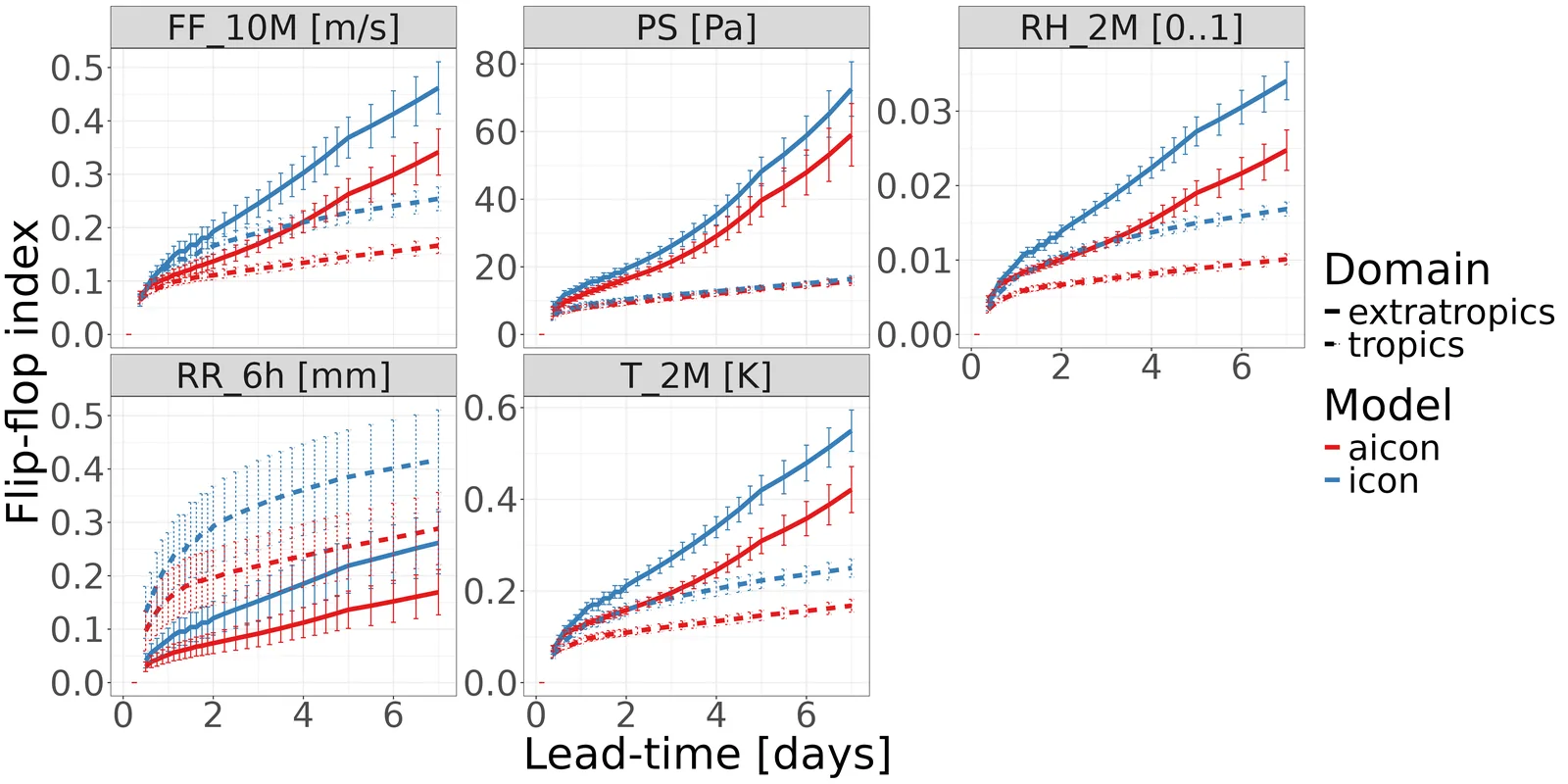
- Successive AICON forecasts change less from run to run than ICON forecasts, giving a lower flip-flop index for all variables, domains and lead times.
- AICON has less small-scale activity than ICON. Even so, the authors say it is less blurry than other deterministic AI models trained on ERA5. Fine-tuning a 52 km version with 24-hour rollout reduced small-scale activity.
- AICON underestimates tropical cyclone intensity (Typhoon Sinlaku) and strong winds. At long lead times it forms unrealistic precipitation at coastal grid points.
Limitations
- Observation-based verification is disadvantaged by AICON’s 13 vertical levels, which add interpolation error. The fairer check against own analysis covered only May and June 2026.
- Long-range precipitation shows spurious coastal rain. The authors are still investigating and cannot exclude that it affects precipitation only.
- The forecaster evaluation was subjective, with no quantitative measures. This is a preprint and has not been peer reviewed.
Glossary
- Rollout training: Training a model by feeding its own forecasts back in for several steps and scoring the whole chain.
- Flip-flop index: A measure of how much successive forecasts for the same time jump around instead of converging steadily.
- ICON-DREAM: DWD’s global reanalysis at 13 km and 3-hourly output, used here as training data.
- RMSE: Root mean squared error, a common score of forecast error where lower is better.
Original paper
AICON: An operational global machine learning weather forecasting model
arXiv · 25 August 2026
This paper is a preprint. It has not been peer reviewed, and its results may change.
AI-generated summary of the original article; changes were made. Check the original before relying on it.