Analog method gives skillful temperature and rainfall-index forecasts from seasons to years
Picking climate-model years whose ocean temperatures match today's observed pattern gives seasonal to multi-year forecasts that are close to operational systems at far lower computing cost.
Why it matters
Operational seasonal and decadal systems are costly, run by few centres, and issue forecasts only once or a few times a year. The analog method can issue forecasts every month with one consistent setup across timescales. It can complement existing systems where they leave gaps.
What they did
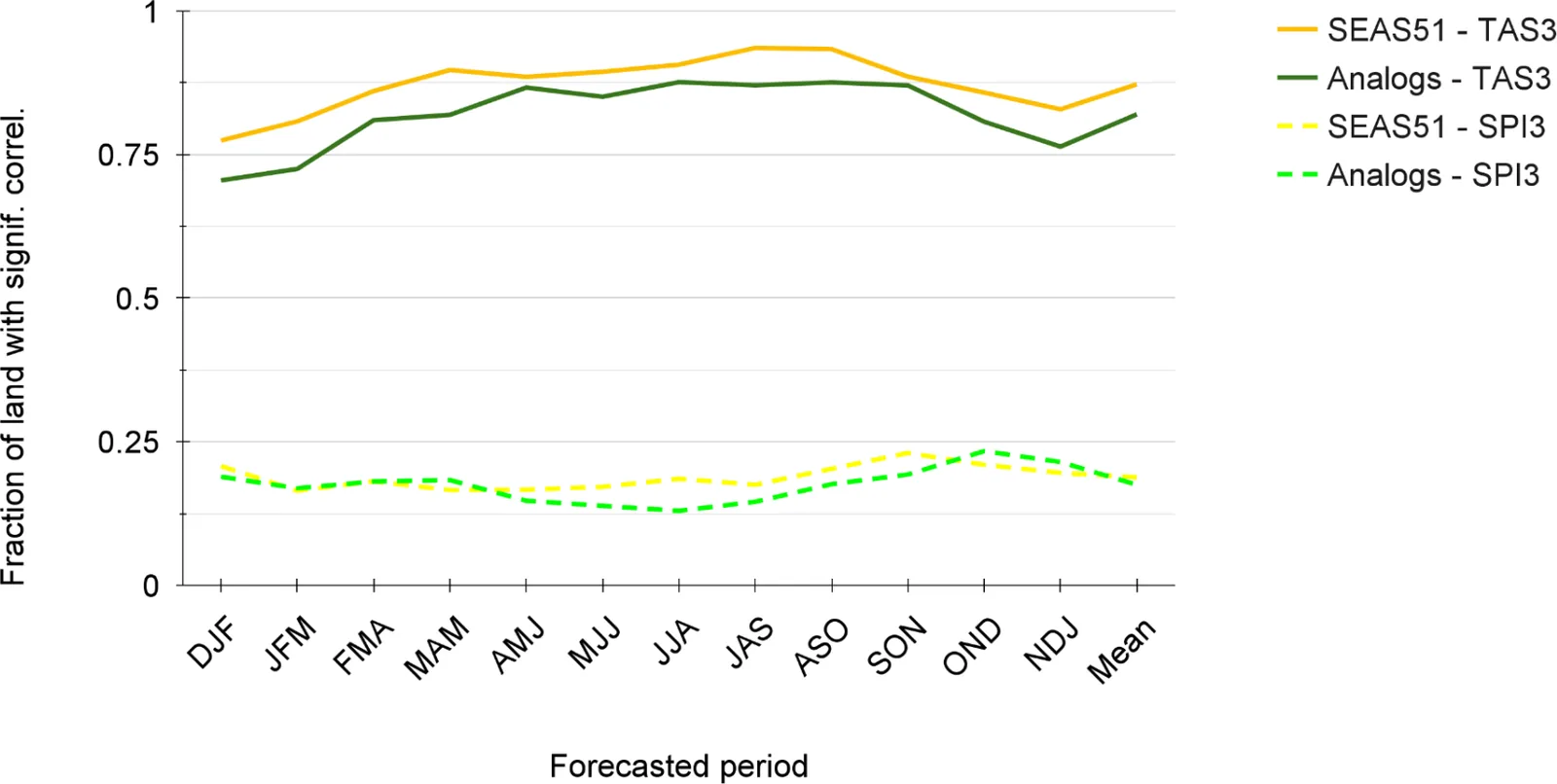
The authors used 149 CMIP6 simulations from 19 models covering 1960–2030. For each observed month, they found the model months with the most similar global sea surface temperature pattern. They averaged the conditions that followed those analogs to forecast surface air temperature and the Standardized Precipitation Index over 3 months to 4 years. They scored the forecasts against observations and against the SEAS51 and EC-Earth3 prediction systems.
Key findings
- Analog temperature forecasts show skill from seasons to several years and add value over the unconstrained CMIP6 ensemble, especially at seasonal to annual ranges.
- Precipitation-index forecasts are less skillful than temperature forecasts but still better than unconstrained CMIP6.
- Skill patterns closely resemble those of SEAS51 and EC-Earth3, though SEAS51 is generally more skilful at 3 months.
- For July–June forecasts, analogs initialized in June had a residual correlation of 0.74, against 0.26 for EC-Earth3 initialized the previous November.
- Monthly initialization made annual and 2-year analog forecasts broadly better than the benchmark, and 4-year ones comparable.
Limitations
- Analogs only approximate the observed starting state, since the model catalog is finite. Skill rises with ensemble size, so part of the skill comes from using 149 members versus 25 in the benchmarks.
- Bias in the analog forecasts often leaves little or no gain over CMIP6 on the error-based score, especially at 2 and 4 years, where the forced signal drives most skill.
- Only EC-Earth3 was used as the decadal benchmark, so other systems may do better in some regions or timescales.
Glossary
- Analog method: Forecasting by selecting past or simulated climate states that resemble the current observed state and using what followed them.
- Standardized Precipitation Index (SPI): A measure of how wet or dry a period is relative to normal, computed over a chosen number of months.
- Residual correlation: Correlation after removing the externally forced signal, showing skill from natural variability alone.
- MAESS: Mean absolute error skill score, showing how much a forecast’s error is smaller than a reference forecast’s.
Original paper
Seamless seasonal to multi-annual predictions of temperature and Standardized Precipitation Index by constraining transient climate model simulations
Earth System Dynamics · 15 October 2025
AI-generated summary of the original article; changes were made. Check the original before relying on it.