Arctic mixed-phase clouds lasted by constantly forming new droplets, with plentiful ice nuclei
Year-round lidar and radar data from near the North Pole suggest long-lived Arctic mixed-phase clouds persist because new droplets keep forming and ice-nucleating particles never run short.
Why it matters
Mixed-phase clouds are hard to model, and the authors say their lifetime depends on how freezing is represented. The low ice production and large supply of ice-nucleating particles lead them to recommend time-dependent immersion freezing schemes in cloud models. The first full-year statistics of liquid-phase properties also give a reference for the central Arctic.
What they did
The research icebreaker Polarstern drifted with the pack ice from 4 October 2019 to 16 May 2020, and measurements continued to September 2020. A dual field-of-view polarization lidar gave droplet properties, and lidar combined with a cloud radar gave ice properties below the liquid layer. The authors studied two long-lasting events, in December 2019 and September 2020. They also built liquid-phase statistics from 3070 cloud profiles (7 min averages) covering about 360 h of stratiform clouds.
Key findings
- In both case studies, droplet number rose or recovered while droplet size fell, which the authors read as continuous activation of cloud condensation nuclei that kept the cloud alive.
- Ice crystals were rare relative to droplets. In December, the ice fraction by number was on the order of 10−5 to 10−6, and ice crystal concentrations were mostly 0.5–1 per liter.
- Estimated reservoirs of cloud condensation nuclei and ice-nucleating particles in the free troposphere were always well filled, with no sign of depletion.
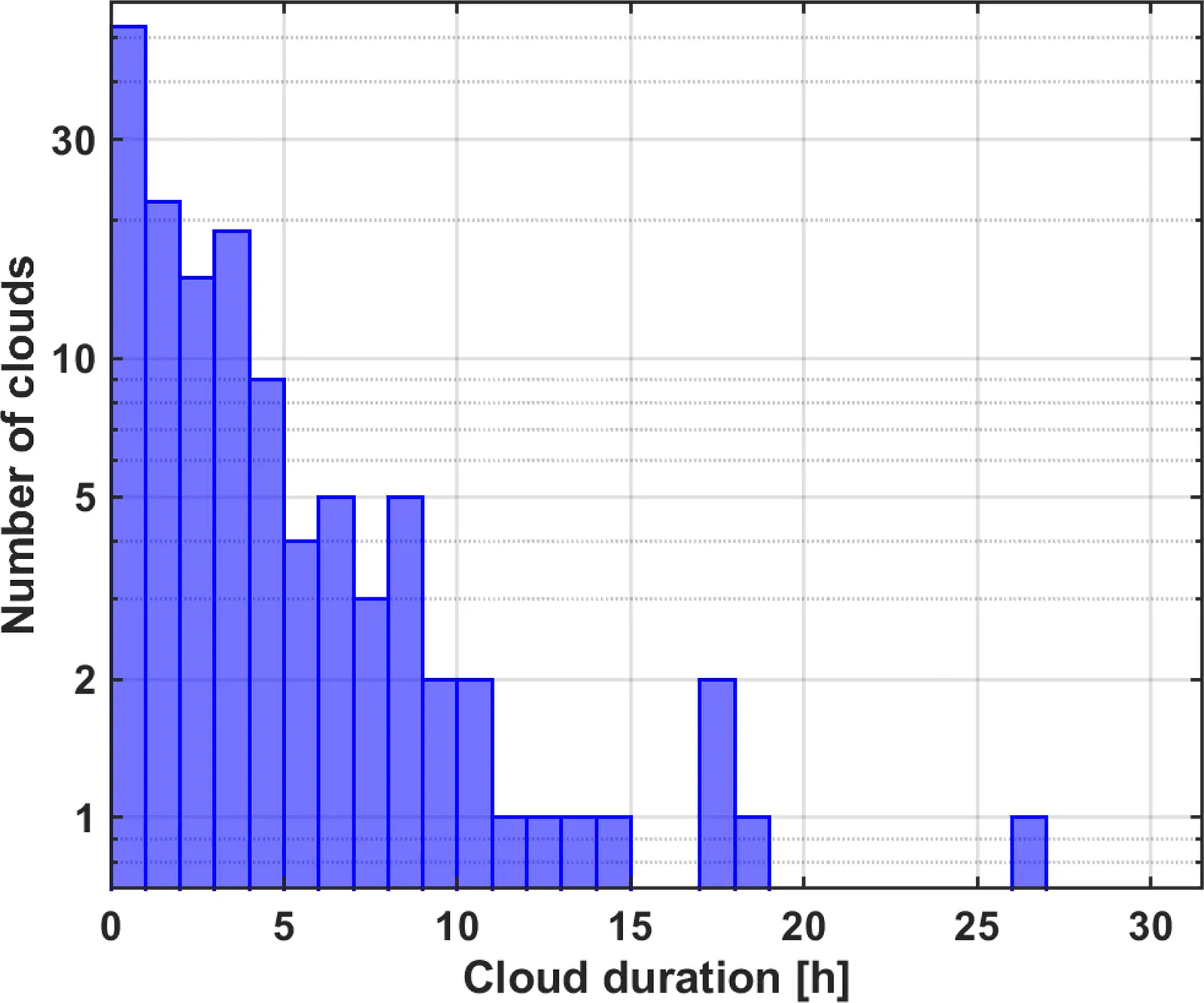
- Of 147 cloud events, about 50 % crossed the ship in under 2 h, 30 % took 2–5 h, 13 % took 5–10 h, and 7 % lasted more than 10 h.
- Mixed-phase clouds had top temperatures mostly between -16 and -32 °C and narrower droplet property ranges than pure liquid clouds. Cloud dissipation in the free troposphere appeared linked to falling water vapor.
Limitations
- Statistics cover only the liquid phase. The ice-phase retrieval could not be automated and was applied only to a few case studies.
- The lidar did not cover the lowest 500 m, where local aerosols may affect clouds, and the reservoir estimates rely on assumed conversion factors and dust fractions.
- Measurements were taken at a fixed location, so cloud life cycles are inferred from point observations, and the cause of the September perturbation is unknown.
Glossary
- Mixed-phase cloud (MPC): A cloud containing both supercooled liquid droplets and ice crystals.
- Immersion freezing: Ice formation on a particle that sits inside a supercooled water droplet.
- Dual field-of-view lidar: A lidar that measures depolarization at two viewing angles to derive droplet size and extinction.
- Ice-nucleating particle (INP): An aerosol particle that can start ice formation, such as mineral dust.
Original paper
MOSAiC studies of long-lasting mixed-phase cloud events and analysis of the liquid-phase properties of Arctic clouds
Atmospheric Chemistry and Physics · 20 October 2025
AI-generated summary of the original article; changes were made. Check the original before relying on it.