Hydrogen aircraft contrail cirrus forcing is modelled as 66 % lower than for jet fuel
In a model, hydrogen-powered aircraft make contrail cirrus with much less warming than jet fuel aircraft in most cases, but lubrication oil droplets could erase the benefit.
Why it matters
Contrail cirrus make up a little over half of aviation’s climate forcing. Hydrogen aircraft may cut this as well as CO2. The results suggest engine designs should keep lubrication oil out of the exhaust, or make its droplets large.
What they did
The authors changed the CoCiP contrail model so that ice forms on lubrication oil droplets and ambient aerosols instead of soot. They built fast emulators from a microphysical model of ice formation in the plume. They ran 2019 weather data (ERA5) on a global grid for a Boeing 737-type aircraft, assuming hydrogen energy use equal to jet fuel in the base case. They then varied oil droplet size, oil emission index, oil hygroscopicity, ambient aerosol concentration and energy use.
Key findings
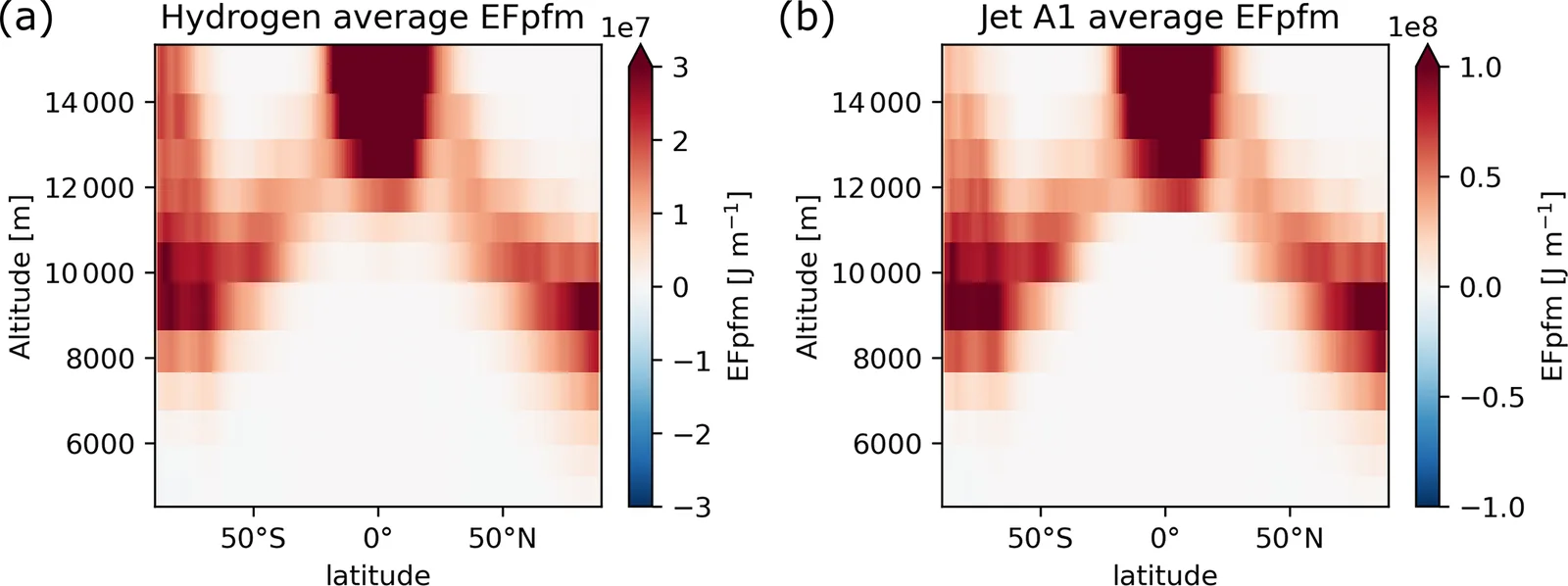
- Hydrogen allows contrails at lower altitudes and higher temperatures, yet global average energy forcing per flight meter is 66 % lower in the base case.
- Hydrogen contrails live 39 % shorter on average, and ice particle numbers fall by about 85 % in the base case.
- Results depend strongly on oil droplet size. Large droplets, as when oil is vented, gave a 99 % cut in ice particle number.
- In the worst cases (high oil emission or high hygroscopicity, small droplets), forcing exceeded jet fuel by up to 43 %, and ice particle number rose by about 10 %.
- Raising the energy use of the hydrogen aircraft by 60 % raised forcing by less than 60 %. Even a tenfold rise in ambient aerosols left the best oil case 90 % below jet fuel.
Limitations
- No hydrogen aircraft is modelled explicitly, and no measurements of hydrogen contrails or hydrogen-engine oil emissions exist to check the results.
- CoCiP is simplified and may miss late contrail stages, and the ice formation model may under- or overestimate ice numbers, especially for very small oil droplets.
- Ambient aerosols are a single representative type, and homogeneous nucleation and NOx effects are left out.
Glossary
- CoCiP: The Contrail Cirrus Prediction model, which simulates contrail life cycles and their energy forcing.
- Schmidt-Appleman criterion: A temperature and humidity condition that says whether a contrail can form behind an aircraft.
- Energy forcing: The net energy a contrail adds to or removes from the Earth system over its lifetime.
- Kelvin effect: The rule that very small droplets need more supersaturation to grow, so tiny particles activate less.
Original paper
Climate impact of contrail cirrus from hydrogen combustion aircraft
Atmospheric Chemistry and Physics · 25 September 2026
AI-generated summary of the original article; changes were made. Check the original before relying on it.