Extreme droughts in central Chile projected to double in frequency by 2070
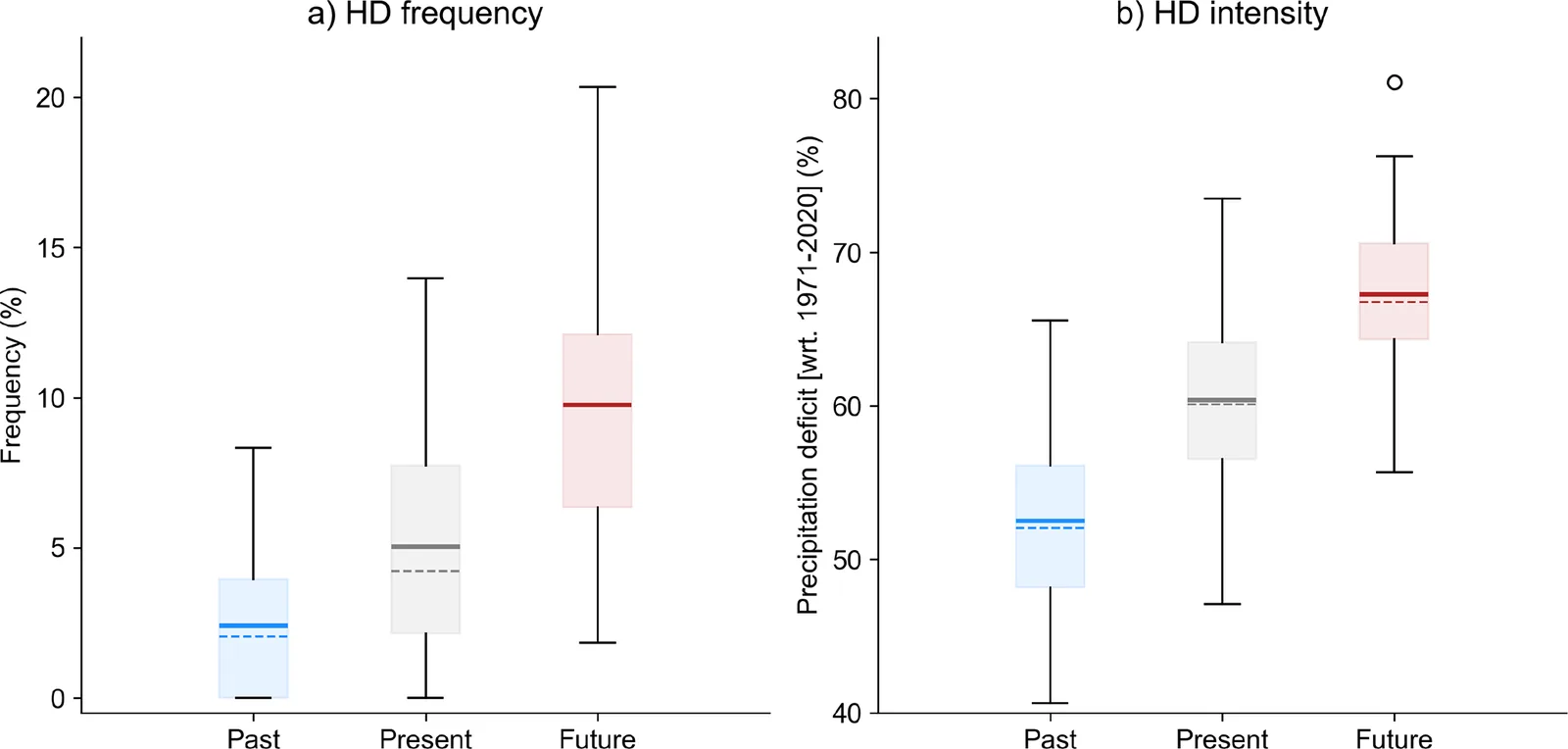
Climate models show that extreme droughts in central Chile will occur twice as often by 2070 compared to today, with greater intensity.
Why it matters
Central Chile supplies water to millions of people and is a global source of wine and fruit. Extreme droughts have already caused power blackouts, economic losses, and social unrest; accelerating frequency under climate change threatens the region’s water and food security.
What they did
Researchers analyzed precipitation data from 48 weather stations covering 1920–2023, supplemented with tree-ring records extending back to 1400. They used a 100-member climate model ensemble forced with moderate warming projections through 2070. They examined atmospheric circulation, river discharge, groundwater, vegetation damage, sediment transport, agricultural impacts, and social responses during five extreme droughts in the past century.
Key findings
- Five extreme droughts with precipitation deficits around 75% occurred in 1924, 1968, 1998, 2019, and 2021; tree rings show similar events occurred roughly every 22 years since 1400
- Climate models project extreme droughts will double in frequency by 2021–2070 under moderate warming, with typical intensity increasing to 70% precipitation deficits
- Environmental impacts depend heavily on antecedent conditions: the 1998 drought caused less river flow decline because it followed an exceptionally wet year, while 2019 was catastrophic during a decade-long dry spell
- Vegetation showed non-linear collapse far below expected relationships during extreme droughts, especially in forests which took years to partially recover from 2019 browning
- Social impacts varied by economic era: extreme droughts in 1924 and 1968 preceded military coups; 1998 effects included power blackouts; 2019 occurred alongside broader social protests
Limitations
- Satellite vegetation data available only from 1982 onward, limiting detailed assessment of older droughts
- Climate model snow data has unquantified uncertainties for the subtropical Andes region where ground-truth verification is scarce
- Groundwater observations affected by nearby water extraction, creating measurement noise in individual wells
Glossary
- Hyperdrought: An extremely dry year defined as the lowest 5% of annual precipitation in the region, typically with deficits near 75%
- NDVI: Normalized Difference Vegetation Index; a satellite measurement of plant greenness used to track vegetation health and drought stress
- Palmer Drought Severity Index: A drought measure reconstructed from tree rings to extend climate records back centuries
Original paper
Hyperdroughts in central Chile: drivers, impacts, and projections
Hydrology and Earth System Sciences · 20 October 2025
AI-generated summary of the original article; changes were made. Check the original before relying on it.