Glider and SWOT satellite watch a smaller eddy merge into the Lofoten Vortex
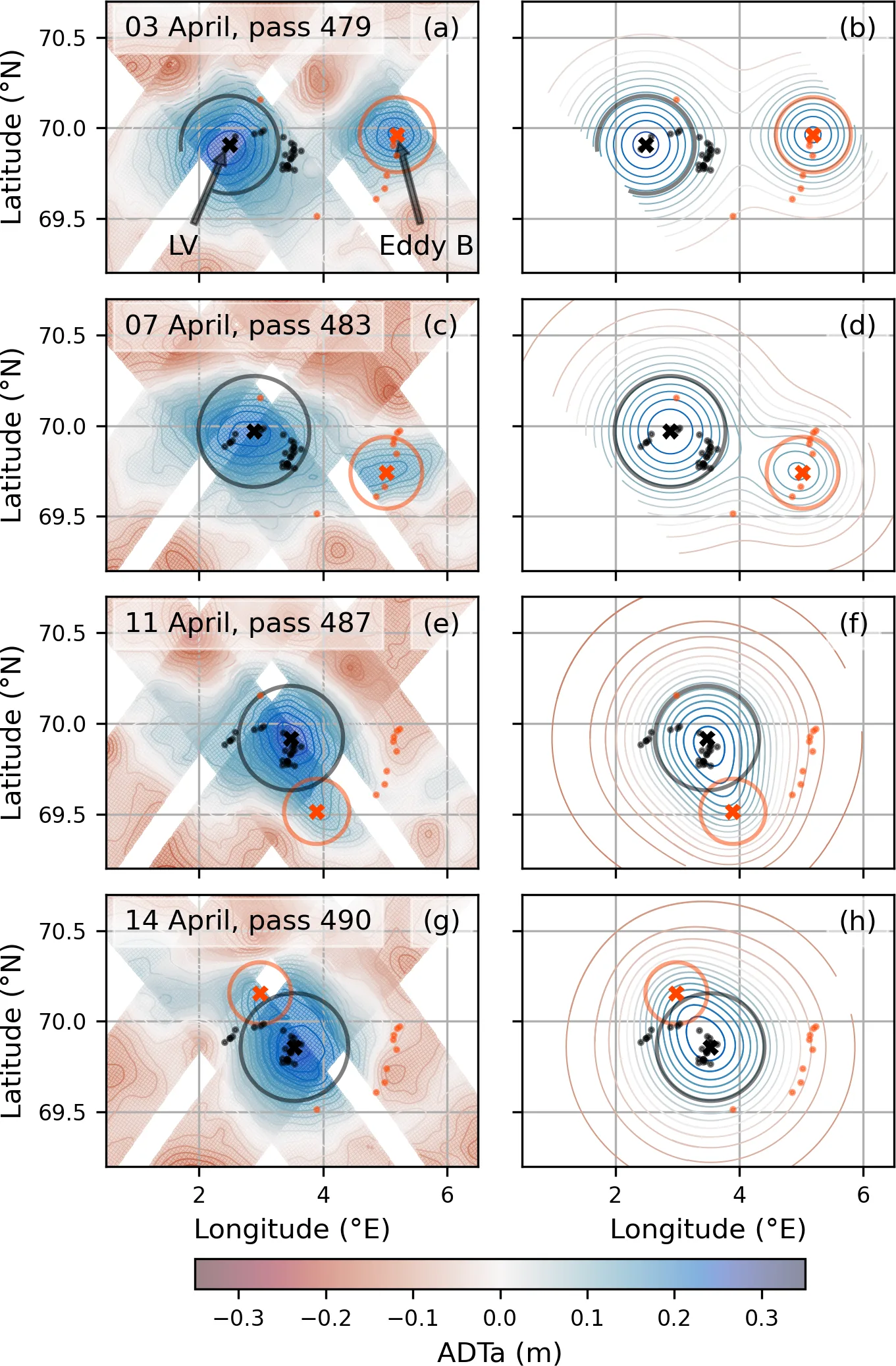
Combining a glider with SWOT altimetry, researchers saw a smaller, stronger eddy approach, co-rotate with and merge into the Lofoten Vortex in April 2023, spinning it up.
Why it matters
Eddy mergers are thought to keep the Lofoten Vortex alive against energy losses, but they are hard to catch. This is the first direct in situ view of one, linked to the surface signal. It gives models something real to be tested against, and it suggests mergers may be more common than models found.
What they did
A Seaglider made about 200 dives near the vortex between 3 March and 7 May 2023. It spiralled into and out of the vortex to build radial sections of temperature, salinity, velocity and potential vorticity. The authors added SWOT sea surface height maps from its fast-sampling phase in April 2023, and converted them to velocities and vorticity. They fitted Gaussian eddy shapes to track the vortex and the incoming eddy B, and compared the changes with surface heat and freshwater fluxes from ERA5.
Key findings
- Eddy B approached the vortex, stretched out, attached to its side and co-rotated with it, much as models had predicted.
- Before the merger, the two had similar amplitudes, but eddy B was smaller and had a stronger vorticity signature (Romax of about -1 versus -0.5 for the vortex, with cyclogeostrophic balance).
- No double-core structure formed, because eddy B had a density range similar to the vortex.
- After the merger the vortex core vorticity reached -0.79(±0.19)f, more anticyclonic than the -0.57(±0.12)f seen in March.
- Surface heat flux of 23 Wm-2 was an order of magnitude too small to explain the core warming, so the merger dominated. A probable earlier merger in March (eddy A) is inferred from changes in the core water.
Limitations
- The March merger with eddy A is inferred, not observed, because there were no in situ or high-resolution SWOT data then.
- The glider moved faster than the merger, so it sampled the core just before eddy B fully merged. Gaussian fits are less reliable as the eddies elongate.
- The record covers only about two months, and the results may not hold for other winter mixing depths or for a vortex with stacked cores.
Glossary
- Anticyclonic: Rotating in the sense opposite to a cyclone, which in the Northern Hemisphere means clockwise.
- Potential vorticity (PV): A quantity combining spin and stratification; low values in the vortex core act as a barrier to lateral mixing.
- Rossby number: Relative vorticity divided by the Coriolis parameter, a measure of how strongly an eddy spins.
- SWOT: A satellite altimeter that maps sea surface height in wide swaths at about 2 km resolution.
Original paper
Merging of a mesoscale eddy into the Lofoten Vortex in the Norwegian Sea captured by an ocean glider and SWOT observations
Ocean Science · 4 November 2025
AI-generated summary of the original article; changes were made. Check the original before relying on it.