Integrated agricultural models forecast drought impacts sooner than rainfall
An integrated system forecasting farm profits and crop yields provides reliable drought warnings months ahead of rainfall-based indicators.
Why it matters
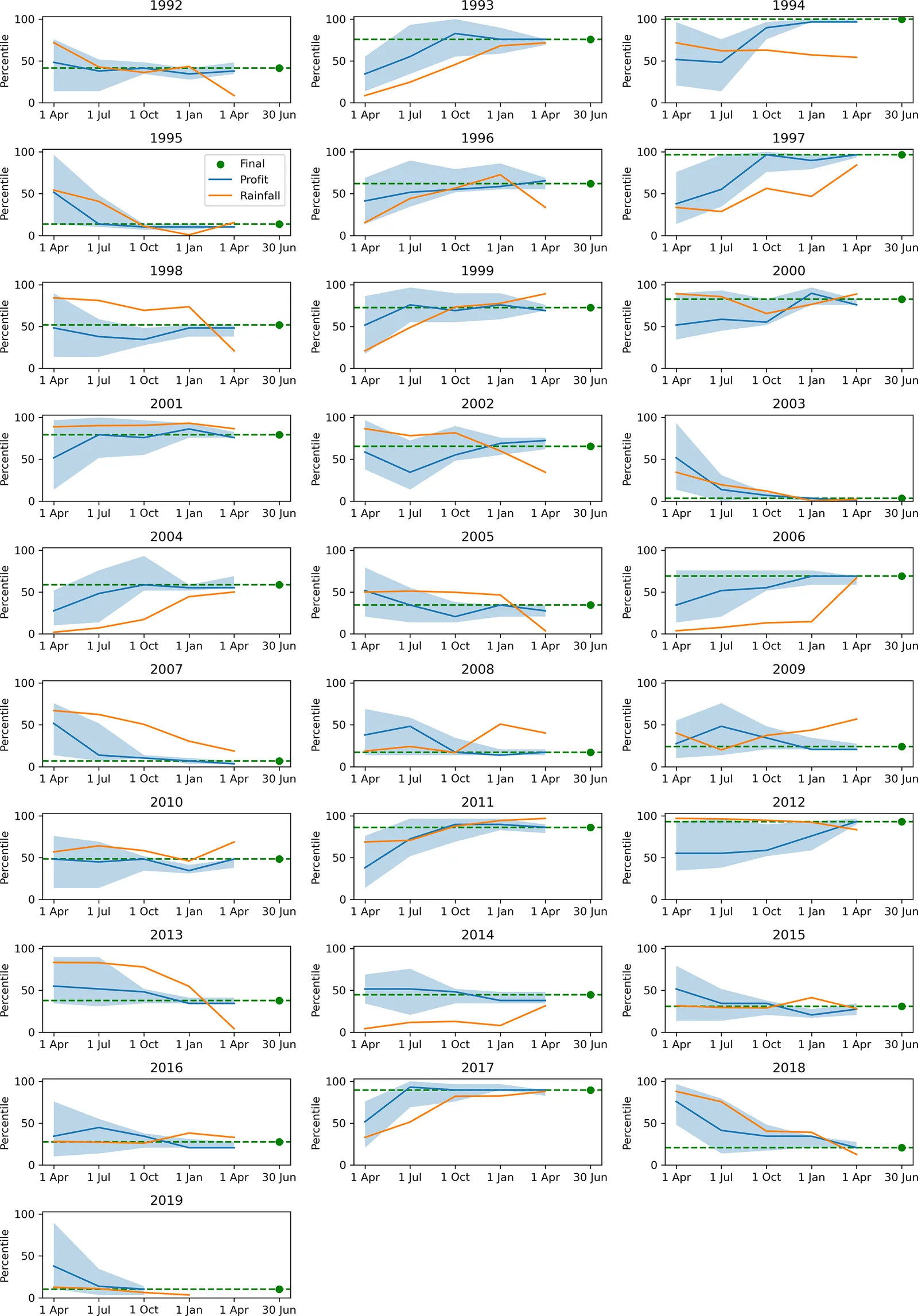
Drought response in Australia currently relies on rainfall measurements, which poorly reflect real impacts on farms. This forecasting system predicts farm profitability and crop yields directly, providing warning of drought-affected regions up to six months earlier than rainfall indicators. Early, accurate forecasts enable better-targeted government support and industry risk management.
What they did
The researchers connected Australia’s seasonal climate model (ACCESS-S2) to three agricultural simulators: crop yield models, pasture growth forecasts, and farm profit predictions. They tested these integrated forecasts for 1990-2018 at 5 km resolution across Australian farming regions. Climate forecasts were statistically calibrated and downscaled before driving the agricultural models, then verified using ensemble methods.
Key findings
- Farm profit forecasts show skill scores of 43% at 12 months lead time, 67% at 6 months, and 73% at 3 months
- Forecasts show high reliability and low bias (below 2%), making them suitable for risk management decisions
- Wheat yield forecasts show moderate skill early in season (around 31%) but improve to 80-90% by harvest
- Sorghum yield forecasts show lower skill, with biases reaching up to 20% in some areas
- The system identifies drought-affected areas up to 6 months before rainfall-based methods
Limitations
- Forecasts are verified against model-simulated farm outcomes rather than actual on-the-ground observations
- Some regions show moderate biases; sorghum predictions can have errors up to 20%
- Models trained on historical climate data may not maintain their skill as future climate conditions change
Glossary
- Skill score: Measure of forecast accuracy relative to a baseline using historical patterns; 0% indicates no improvement, 100% is perfect
- Lead time: Number of months in advance that a forecast is issued
Original paper
Forecasting agricultural drought: the Australian Agricultural Drought Indicators
Natural Hazards and Earth System Sciences · 21 October 2025
AI-generated summary of the original article; changes were made. Check the original before relying on it.