Iodine-129 and uranium-236 track Atlantic and Pacific water shifts in the central Arctic
Two radionuclide tracers show that in 2021 Pacific-influenced surface water met Atlantic-origin water at the Lomonosov Ridge, that this front moved from the Makarov Basin toward the ridge between 2011/2012 and 2015, and that Atlantic layer ages rose from 2015 to 2021 in several regions.
Why it matters
Where Atlantic and Pacific waters meet, and how fast Atlantic Water moves, matter for freshwater, nutrients and ecosystems in the Arctic. The paper notes that circulation changes also affect how anthropogenic carbon is stored and moved. The tracer data add an independent line of evidence that agrees with earlier gas-tracer studies, but the cause of the older ages is still unclear.
What they did
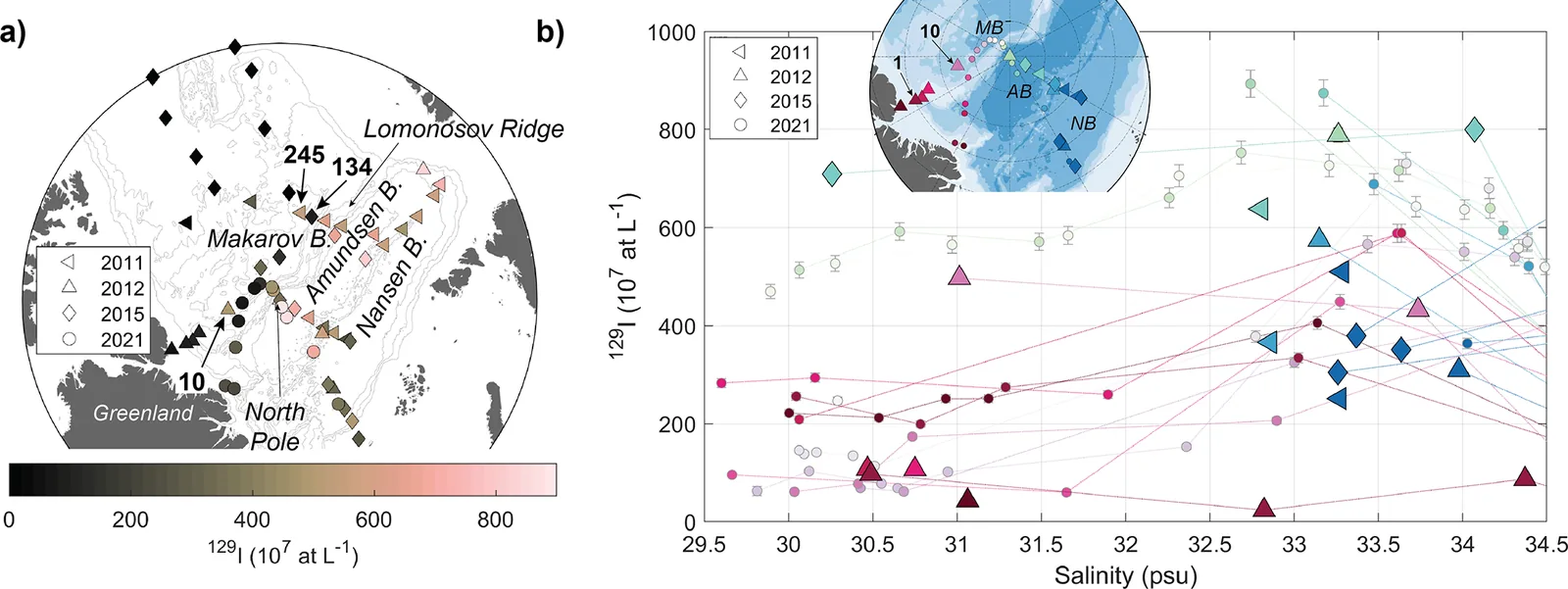
The authors measured 129I and 236U in seawater collected on the SAS-Oden 2021 expedition, including the first such data from north of Greenland. They combined these with published data from six earlier expeditions between 2011 and 2020. A simple two-end-member mixing model gave tracer ages and dilution in the surface layer. A transit time distribution model gave circulation times and mixing in the mid-depth Atlantic layer.
Key findings
- In 2021, surface 129I and 236U dropped sharply between the Amundsen and Makarov Basins, pointing to substantial Pacific Water on the Makarov side of the Lomonosov Ridge.
- Halocline waters had similar tracer levels on both sides of the ridge, suggesting a common formation region with a clear Atlantic signal.
- North of Greenland, surface and mid-depth waters looked like a mixture of Canada Basin and Amundsen Basin waters.
- Mid-depth mode ages were clearly higher in the Makarov Basin than in the Amundsen Basin, suggesting a longer transport route.
- The Atlantic-Pacific front lay farther into the Makarov Basin in 2011/2012 than in 2015 and 2021, when it sat at the Lomonosov Ridge. Mean and mode ages in the Amundsen Basin rose from 2015 to 2021, which suggests a slowdown or changed pathways.
Limitations
- Sampling was sparse in space and depth, especially for 129I in 2011 and 2012 and for 236U, so the front position is only constrained along the sampled transect.
- Results depend on well-constrained tracer input functions, and Pacific Water fractions from the N:P method carry large uncertainties.
- The cause of the older Atlantic layer ages from 2015 to 2021 is unclear, and the mid-depth record is too short to link it to atmospheric conditions.
Glossary
- 129I and 236U: Long-lived radioactive isotopes released mainly by European nuclear reprocessing plants, used here as tags for Atlantic-origin water.
- Transit Time Distribution (TTD): A model that describes the spread of travel times of water from a source region to a sampling site.
- Mode age: The most likely travel time within the transit time distribution.
- Polar Surface Water: The cold, fresh upper layer of the Arctic Ocean, including the mixed layer and the halocline.
Original paper
Changes in water mass composition and circulation in the central Arctic Ocean between 2011 and 2021 inferred from tracer observations
Ocean Science · 5 December 2025
AI-generated summary of the original article; changes were made. Check the original before relying on it.