New EAWS Matrix standardizes avalanche danger assessment across Europe
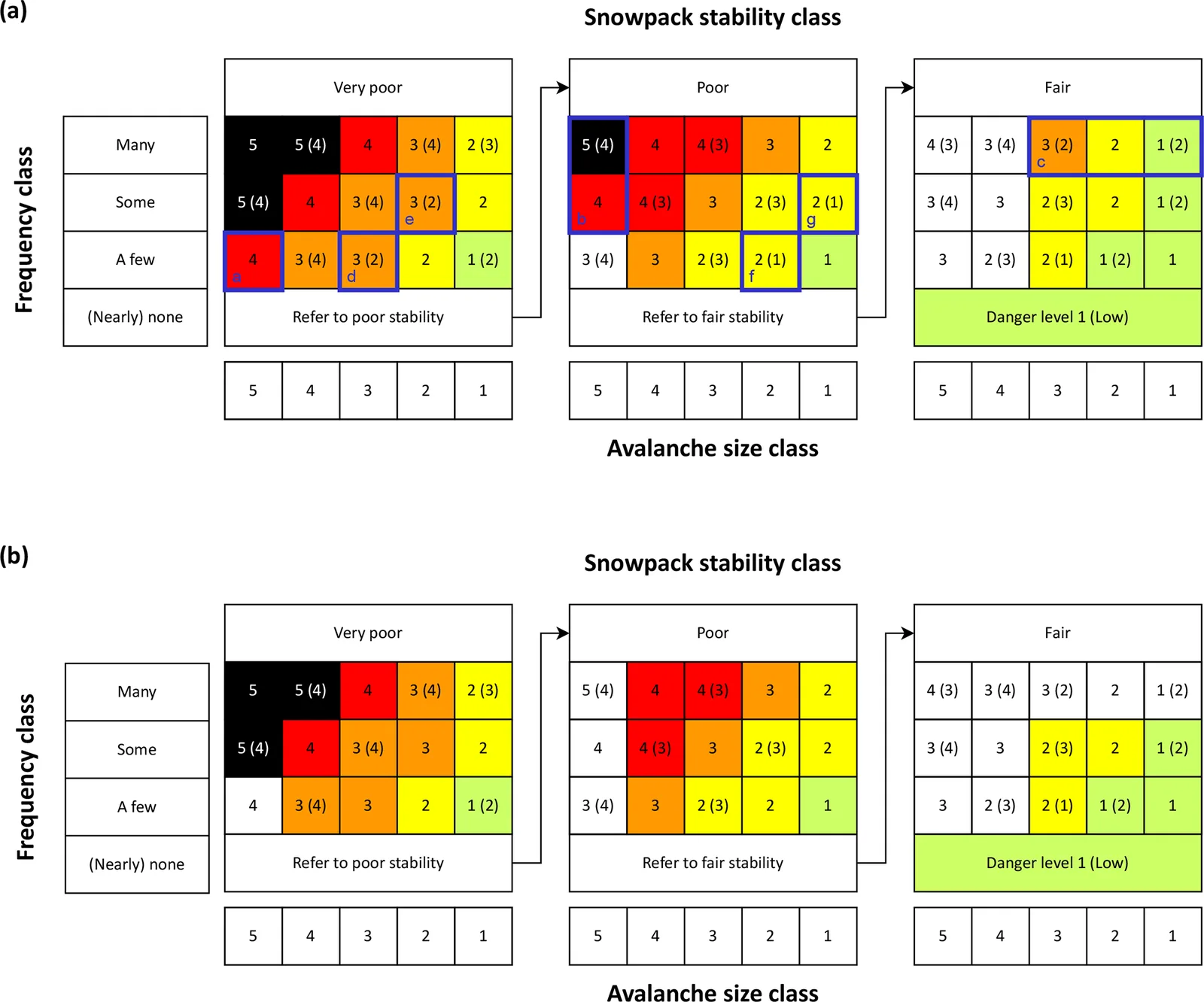
The EAWS Matrix is a decision-support tool developed by European avalanche forecasters that assigns danger levels by linking snowpack stability, how frequently it occurs, and expected avalanche size.
Why it matters
Avalanche forecasts directly influence public decisions about recreation and risk management in mountainous regions. The previous European standard, unchanged since 1993, had vague definitions that caused inconsistency between forecasters. The new Matrix provides clearer, standardized guidance designed to improve forecast consistency and safety.
What they did
A working group revised the European Avalanche Warning Services Matrix through three steps. First, they established clear definitions for three key factors: snowpack stability, frequency distribution of stability, and avalanche size. Second, they surveyed 76 avalanche forecasters from 12 European countries, asking each to assign danger levels to all combinations of these factors. Third, they tested the resulting matrix in real operational forecasting over three winters and refined it based on how forecasters actually used it.
Key findings
- A new EAWS Matrix standardizes how European forecasters assign avalanche danger by linking three factors (snowpack stability, its frequency, and avalanche size) to five danger levels, formally adopted in 2025.
- Survey of 76 forecasters across Europe showed strong agreement on extreme cases but disagreement on intermediate combinations; only 18 of 45 possible combinations had clear majority support, with 27 combinations showing secondary danger levels.
- The most problematic transitions were poor-some-size 2 and very poor-some-size 3, where forecasters frequently disagreed on whether to assign danger level 2 or 3, and 3 or 4 respectively.
- Operational testing revealed that some rarely-used combinations could not be validated, while other cells showed consensus that warranted removing secondary options.
- The matrix functions as a decision-support tool to structure thinking and increase transparency; forecasters can select multiple cells to express uncertainty and retain final judgment authority.
Limitations
- The frequency class some is broad with indistinct boundaries to a few and many, making it difficult to estimate reliably in operational forecasting.
- About half the matrix cells lack full consensus and include bracketed secondary danger levels, especially at problematic transitions like poor-some-size 2 and very poor-some-size 3, reflecting persistent ambiguity.
- Unreliability in factor estimation is the primary limiting factor for consistency; disagreements stem from data availability, forecasters’ varying skills interpreting evidence, and difficulty categorizing continuous information into discrete classes.
Glossary
- Snowpack stability: The tendency of snow at a location to avalanche, measured at individual point locations.
- Frequency distribution: The proportion of terrain locations where each snowpack stability class occurs within avalanche terrain.
- Danger level: A classification from 1 (low) to 5 (very high) indicating the expected avalanche hazard in a region.
Original paper
The EAWS matrix, a decision support tool to determine the regional avalanche danger level (Part A): conceptual development
Natural Hazards and Earth System Sciences · 13 November 2025
AI-generated summary of the original article; changes were made. Check the original before relying on it.