North Sea marine heatwaves rose mainly because average sea surface temperature climbed
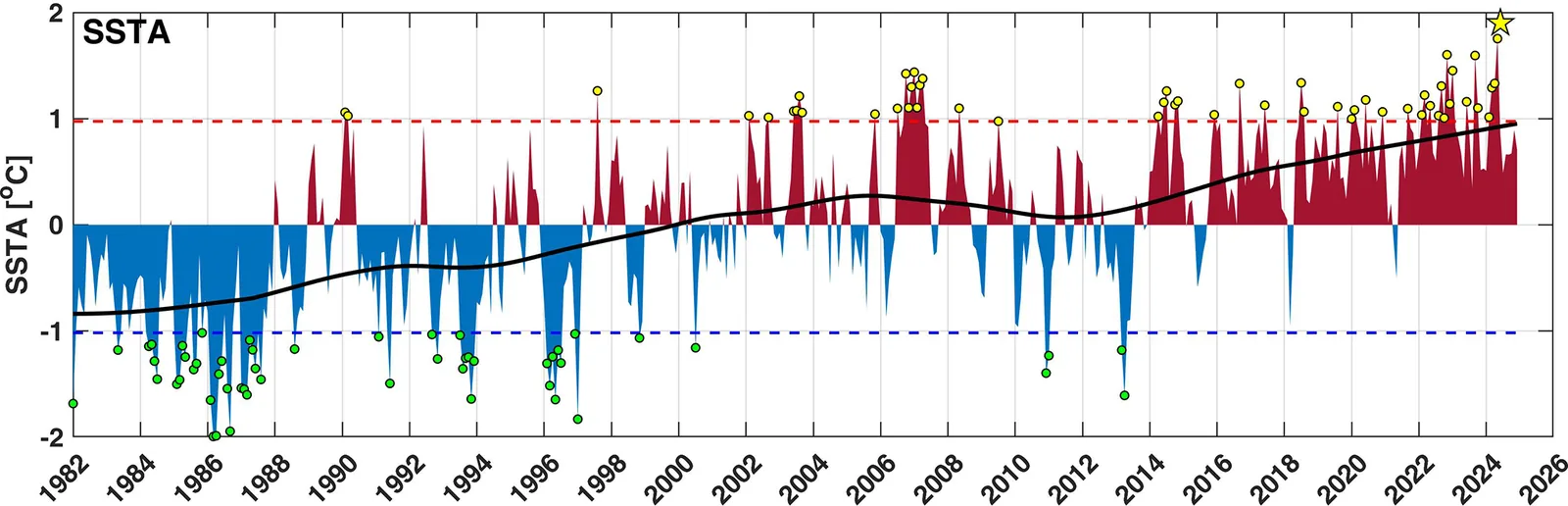
Over 1982–2024, rising mean sea surface temperature, not changes in variability, drove most of the increase in North Sea marine heatwaves, with a clear step up after 2013.
Why it matters
The North Sea supports major fisheries, and many species there live near their thermal limits. The results suggest marine heatwaves will keep increasing as mean warming continues. The chlorophyll results show that heatwave effects on plankton differ between deep, cold northern waters and shallow, warm southern waters.
What they did
The authors used daily satellite-based sea surface temperature for 1982–2024 and ERA5 atmospheric data. They detected marine heatwaves with a standard definition, once on the original data and once after removing the linear warming trend. They tested for abrupt shifts, compared the periods before and after 2013, and linked the changes to the Atlantic Multidecadal Oscillation and East Atlantic Pattern climate indices. They also studied the May 2024 event in detail and correlated satellite chlorophyll a with heatwave days for 1998–2024.
Key findings
- A second abrupt warming shift occurred in 2013. The SST trend rose from 0.4 °C per decade before 2013 to 0.8 °C per decade after.
- Over 1982–2024, SST rose 0.38 °C per decade, heatwave frequency 1.04 events per decade, and heatwave days 17.27 d per decade.
- With the warming trend removed, all heatwave trends became insignificant. About 80 % of the trend in heatwave frequency is attributed to long-term warming.
- The longest (27 d) and most intense (2.2 °C) heatwave ran from 10 May to 5 June 2024. It coincided with high pressure over the Baltic Sea and southern Norway, less cloud and more solar radiation.
- Chlorophyll a fell with heatwaves in deep, cold northern waters and rose in shallow, warm southern waters.
Limitations
- Only a linear trend was removed, although the authors note that North Sea warming is nonlinear because of the two regime shifts.
- The chlorophyll link rests on correlations. Light, nutrient inputs from rivers and other factors also matter, and the authors call for further research.
- Future heatwaves under different climate scenarios were not modelled.
Glossary
- Marine heatwave (MHW): A period of at least 5 consecutive days when sea surface temperature is above the local seasonal 90th percentile.
- Trend attribution ratio (TAR): A measure from -1 to 1 of whether long-term warming (near 1) or internal variability (near -1) drives a heatwave trend.
- Fraction of attributable risk (FAR): The share of heatwave risk linked to a change, calculated as 1 minus 1 divided by the probability ratio.
- Chlorophyll a: A pigment used as a measure of phytoplankton amount in the water.
Original paper
Amplified warming and marine heatwaves in the North Sea under a warming climate and their impacts
Ocean Science · 20 October 2025
AI-generated summary of the original article; changes were made. Check the original before relying on it.