Subpolar North Atlantic plankton stay smaller even after CO2 returns to its starting level
In a climate model, removing CO2 back to its starting level does not bring back large diatoms in the Subpolar North Atlantic, because weaker ocean circulation keeps surface nutrients low, and this cuts carbon export.
Why it matters
Even if CO2 is pulled back to today’s level, the ocean’s food web and its ability to move carbon to depth in this key region may not return to their earlier state. A shrunken biological carbon pump could add to warming. The results also suggest that delaying mitigation makes the shift worse.
What they did
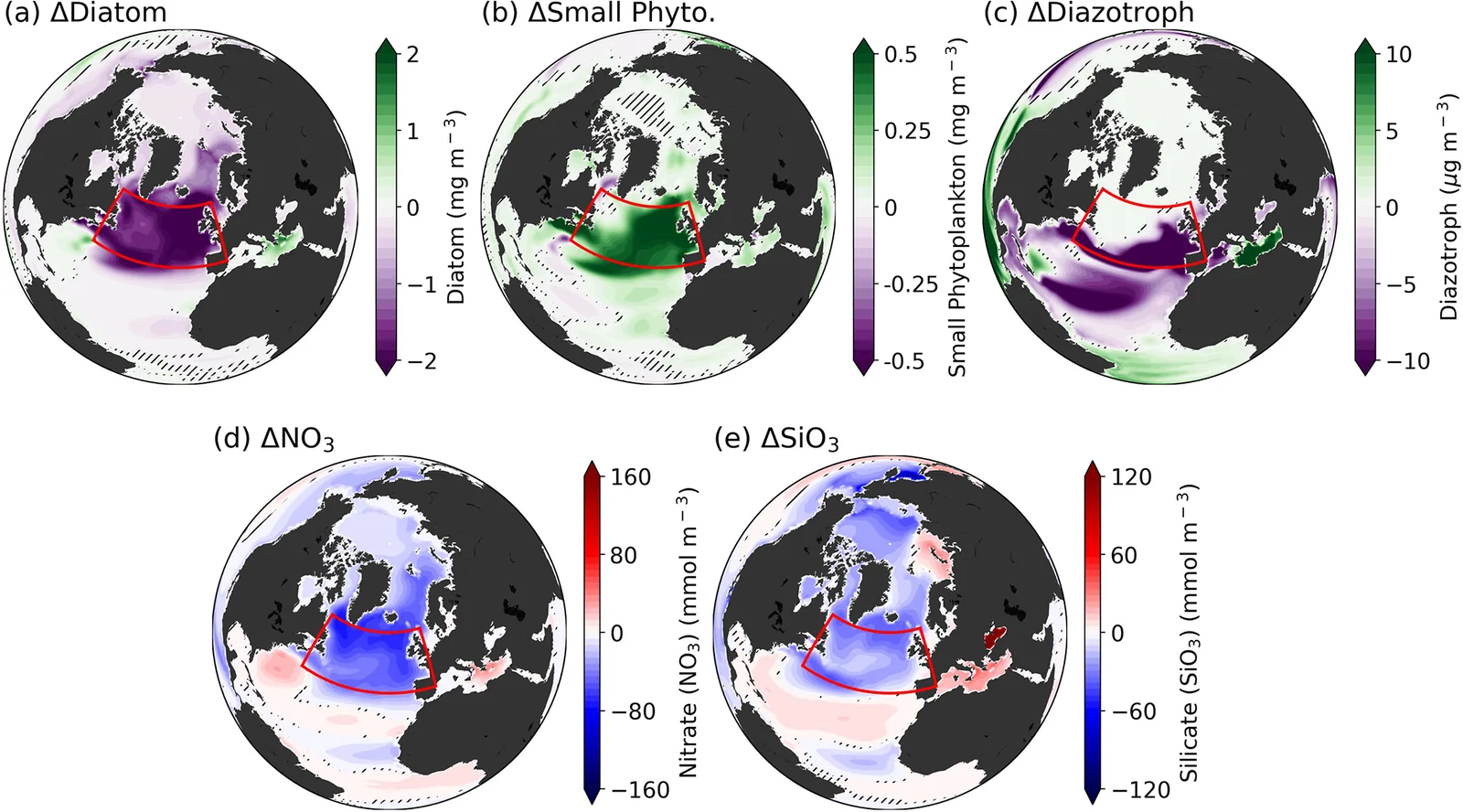
The authors ran idealized CO2 simulations with the Community Earth System Model 2, using ten ensemble members. CO2 rose from 383 ppm to a peak of 725 ppm, fell back to 383 ppm, then stayed at net-zero emissions until year 2400. They compared an early 11-year period with an 11-year period at the same CO2 level on the way down. They tracked three plankton types, nutrients, the Atlantic Meridional Overturning Circulation (AMOC), and carbon export. They measured community change with the Bray-Curtis dissimilarity.
Key findings
- The Subpolar North Atlantic showed the largest change in plankton community of any region, even at the same CO2 level as the start.
- Diatoms fell to 24 % of their initial value, while small phytoplankton rose by about 283 %.
- AMOC weakened until about year 2142, and nutrients stayed low and recovered late. Diatom limitation moved from silicon to nitrogen around year 2076.
- The carbon (POC) flux at 100 m was less than half of its initial value when CO2 returned to 383 ppm.
- Diazotrophs declined mainly with temperature, and they overshot during the restoring period.
Limitations
- The main results come from one model, CESM2, which is reported to weaken AMOC more sensitively than other models and so may overstate the ecosystem changes.
- The model has only three phytoplankton types, which simplifies a complex real community.
- The simulations are idealized CO2 pathways, not forecasts.
Glossary
- AMOC: Atlantic Meridional Overturning Circulation, the large ocean current system that carries water and nutrients between low and high latitudes.
- Phytoplankton functional type (PFT): A group of phytoplankton with shared traits; here diatoms, small phytoplankton and diazotrophs.
- Bray-Curtis dissimilarity: A score from 0 to 1 showing how different the make-up of two communities is.
- Biological pump: The process by which sinking organic carbon moves carbon from the surface ocean to depth.
Original paper
Irreversible phytoplankton community shifts over Subpolar North Atlantic in response to CO 2 forcing
Earth System Dynamics · 20 November 2025
AI-generated summary of the original article; changes were made. Check the original before relying on it.