Survey of 481 water managers shows reactive drought responses across Europe in 2022
The 2022 drought showed that European water managers see rising drought risk but mostly respond with short-term, supply-side fixes, so the authors call for a binding European Drought Directive.
Why it matters
Europe has no unified drought policy. It relies on water directives and non-binding communications. The survey shows large gaps between regions in how organizations manage drought. The authors argue that growing awareness after 2022 is a window to bring in common, binding rules.
What they did
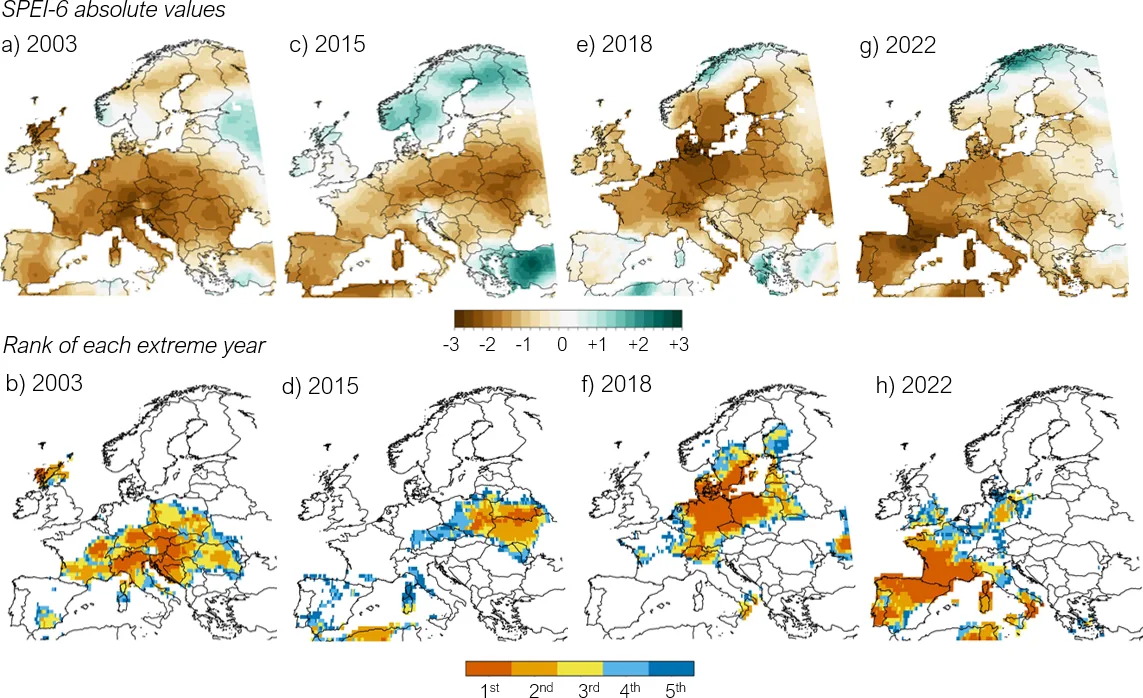
The authors ran a survey of water managers on the 2022 drought. It drew 481 valid responses from 30 European countries and asked about sector impacts and management measures. They paired the answers with SPEI drought data computed from CRU TS climate records. They also looked at two regional cases, Catalonia in Spain and Italy.
Key findings
- Most respondents (87 %) believe drought risk is increasing, and only 1 % think it is decreasing.
- Southern Europe saw earlier, longer and more severe impacts, while northern Europe saw fewer and milder ones.
- Respondents reported more supply-side measures than demand-reduction or efficiency measures. This runs against the EC Blueprint, which puts demand reduction first.
- Compared with 2018, many organizations reported more awareness, but not all reported more preparedness or effectiveness. Among those with more awareness, 49 % reported more preparedness.
- Some heavily hit sectors got low water priority, such as forestry in Germany and energy and fisheries in Italy.
Limitations
- Respondents were recruited by snowball sampling, which may not represent each country or sector. The number of responses also varied a lot between countries.
- Effectiveness and awareness are the respondents’ own perceptions, and many answers were blank, unknown or not relevant.
- The SPEI uses a 1971–2000 reference period, and the authors note a more recent period could give somewhat different results.
Glossary
- SPEI: Standardised Precipitation Evapotranspiration Index, a drought measure based on the balance between rainfall and potential evaporation; values below -1 mean drought.
- Maladaptation: A response that seems to help in the short term but raises vulnerability to drought later.
- Snowball sampling: A survey method where early participants recruit further participants through their own contacts.
- EC Blueprint: The 2012 European Commission guidance on safeguarding water resources, which ranks demand reduction above efficiency and supply increase.
Original paper
The 2022 drought needs to be a turning point for European drought risk management
Natural Hazards and Earth System Sciences · 12 November 2025
AI-generated summary of the original article; changes were made. Check the original before relying on it.