Ten-member ICON ensemble with two-moment ice scheme detects more ice-supersaturated air
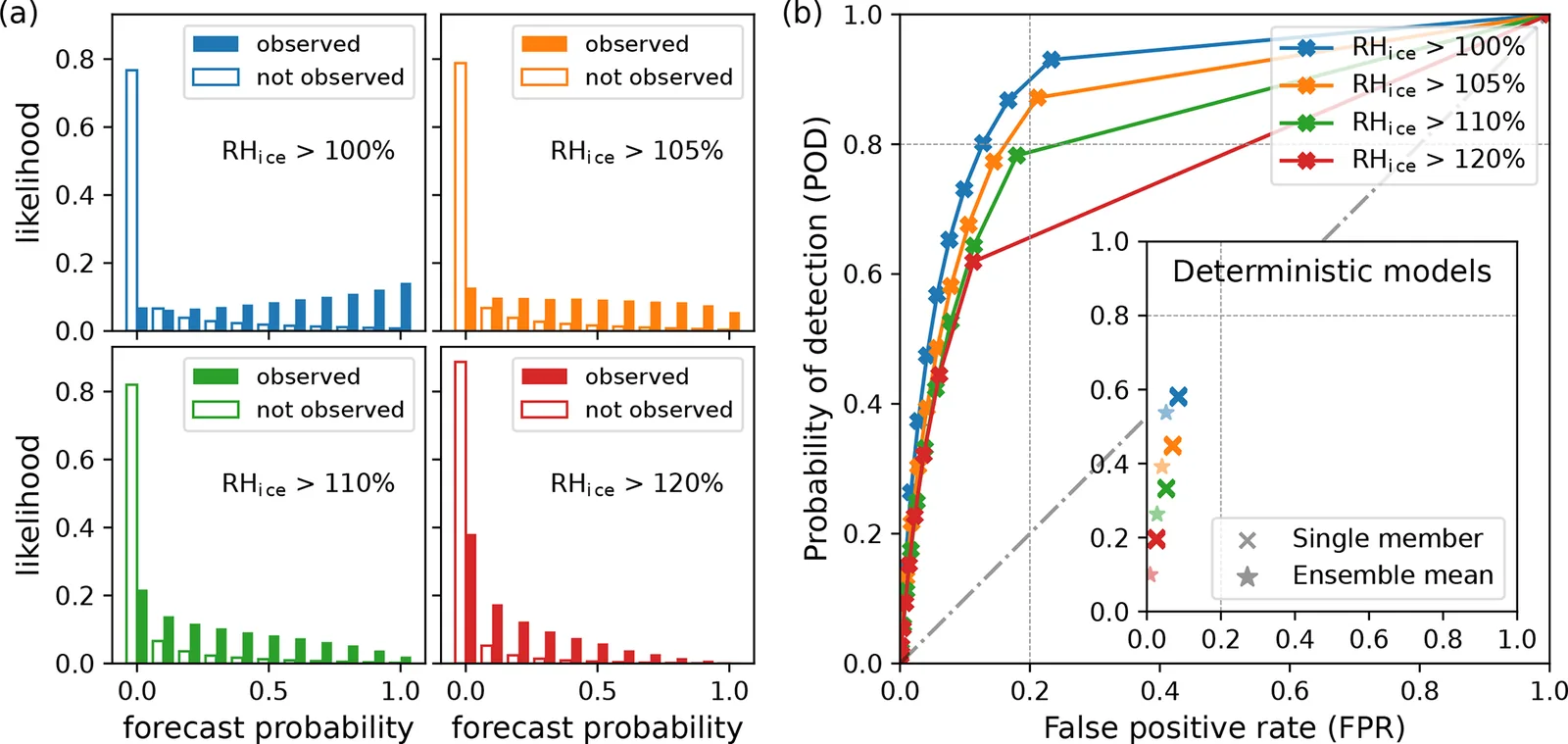
Adding a two-moment ice scheme and a ten-member ensemble to the ICON model raises the share of ice-supersaturated regions detected from 0.4 to 0.6 for one run, and to 0.8 for a three-member vote.
Why it matters
Persistent contrails form in ice-supersaturated air, so better forecasts of it can support rerouting flights to avoid them. The ensemble lets planners trade off false alarms (needless detours) against missed contrail regions. Since June 2024, more than 100 flights have been rerouted in a trial using these forecasts.
What they did
The authors added a two-moment cloud ice scheme, which tracks ice particle number as well as mass, to the global ICON weather model. They ran it as a ten-member ensemble and compared humidity over ice with Vaisala RS41 radiosondes (about 820 000 matched samples over 14 months) and with aircraft data from 625 IAGOS flights. They treated ice supersaturation as a yes/no event and scored forecasts with detection and false-alarm rates. They also tested decision rules based on how many members agree, ensemble spread, and a CatBoost classifier.
Key findings
- For ice supersaturation, the probability of detection rose from about 0.4 (operational one-moment ICON) to about 0.6 (two-moment ICON), with a false positive rate near 0.1.
- Requiring at least three of ten members to predict supersaturation gave a detection rate of 0.8 at a false positive rate of 0.13.
- When ensemble spread was low, skill was high, with detection of 0.9–1 at a false positive rate of 0.1 or less. When spread was high, skill fell toward random.
- Skill held up to 36 h of lead time, with detection above 0.8 and false positives below 0.2. Aircraft data gave ROC curves similar to the radiosonde results.
- A gradient boosting classifier trained on the ten members slightly outperformed the simple member-count rules.
Limitations
- The ensemble is underdispersed (it does not capture the full observed variability) and slightly underestimates humidity in supersaturated conditions.
- Skill drops for strongly supersaturated air (above 120 %). Grid spacing of about 26 km misses small-scale gravity waves, and aerosol fields are prescribed.
- Verification covers only the Northern Hemisphere, and the machine-learning results are early and based on limited data.
Glossary
- Ice-supersaturated region (ISSR): Air where relative humidity over ice is above 100 %, where persistent contrails can form.
- Two-moment ice microphysics: A cloud scheme that predicts both ice mass and ice particle number, instead of estimating number from temperature.
- ROC curve: A plot of detection rate against false positive rate across all decision thresholds.
- Matthews correlation coefficient (MCC): A single score from −1 to +1 for yes/no forecasts that stays fair when events are rare.
Original paper
Predicting ice supersaturation for contrail avoidance: ensemble forecasting using ICON with two-moment ice microphysics
Atmospheric Chemistry and Physics · 1 December 2025
AI-generated summary of the original article; changes were made. Check the original before relying on it.