Weaker Shamal winds, La Niña and negative NAO drive the Gulf's hottest summers
Extreme summer sea temperatures in the Arabian Gulf come from weaker local winds and trapped moist air, and ENSO and the NAO together explain over 50 % of the year-to-year variation.
Why it matters
The Gulf is the hottest sea in the world in summer, and marine heatwaves there bleach corals. Because ENSO and the NAO shape Gulf summers and tend to come before the temperature signal, the authors see promise for seasonal early warning. Reef managers could use such forecasts to act before bleaching.
What they did
The authors analysed a 1/10° regional ocean hindcast of the Indian Ocean and Gulf for 1980–2018, forced by ERA-Interim. They combined it with ERA5 reanalysis, and checked key results against JRA-55 and MERRA-2. They looked at summer (July–September) anomalies, removing the seasonal cycle and the long-term trend. They used heat budgets, correlations, composites, regression and a self-organizing map to link Gulf temperatures to local weather and to ENSO, NAO, IOD and the Indian monsoon.
Key findings
- Atmospheric heat fluxes dominate Gulf SST variability: they account for 92 % of the variance in the northern Gulf and about 83 % in the southern Gulf.
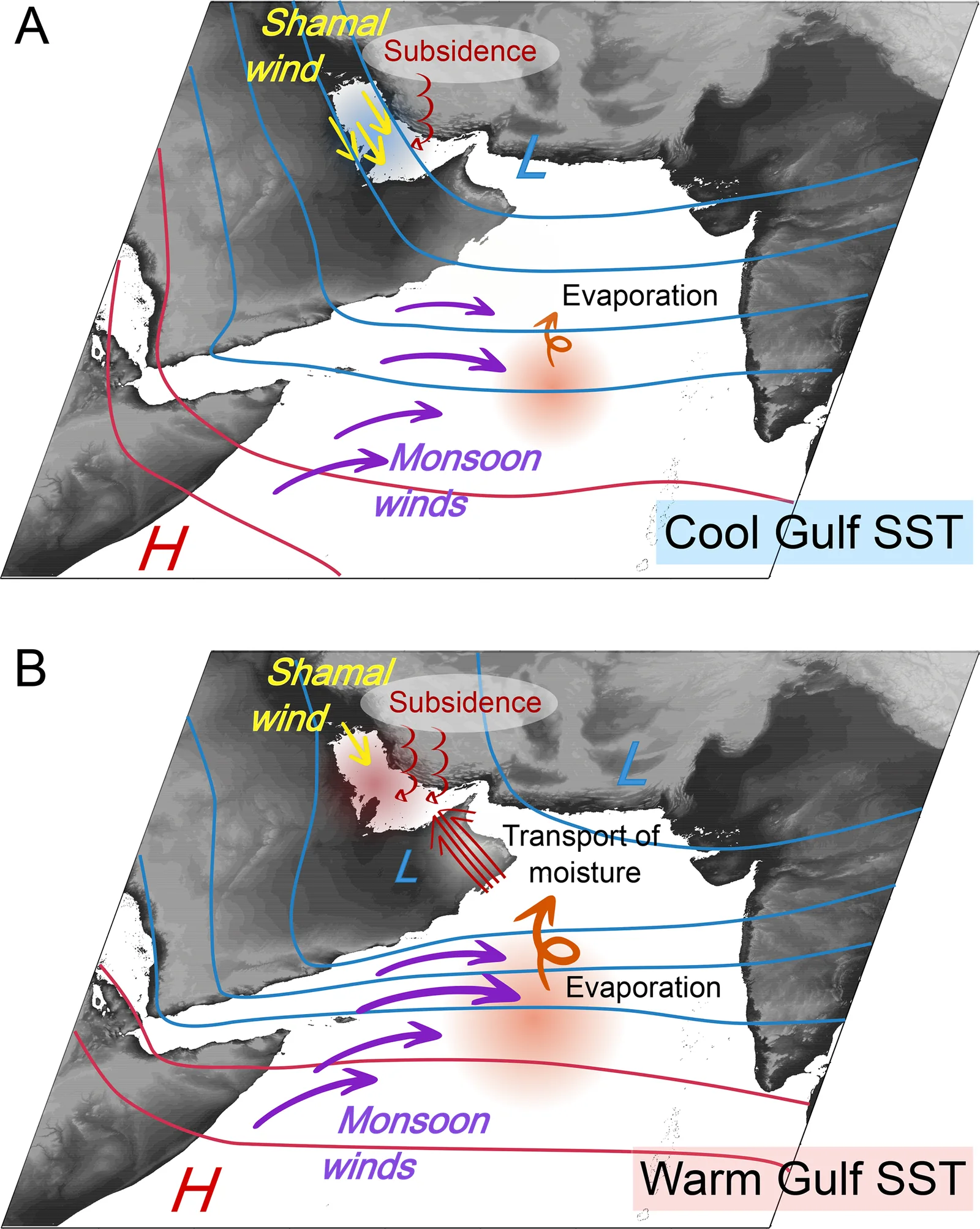
- Warm summers coincide with lower pressure over the Arabian Peninsula and higher pressure over Iran and Pakistan. This weakens the Shamal winds and strengthens monsoon winds over the western and southern Arabian Sea.
- Three mechanisms trap heat near the surface: moisture buildup, reduced evaporative cooling and stronger upper-air subsidence. Warm summers have more downward longwave radiation but less shortwave radiation.
- ENSO and NAO together explain more than 50 % of summer SST variability. IOD and the monsoon add only marginally.
- Their effects add up: the warmest summers (e.g. 1998) occur when La Niña and negative NAO coincide. La Niña and El Niño often have the opposite effect in the Gulf than in the Arabian Sea.
Limitations
- All three reanalyses are coarse and long local observations are scarce, so small-scale effects such as orography and local validation are limited.
- The study does not explain how ENSO and NAO physically alter pressure over the Arabian Peninsula and Iran; this needs further work with models.
- The analysis targets the whole Gulf, so ocean heat input from the Sea of Oman may matter more near the Strait of Hormuz.
Glossary
- Shamal: Northwesterly winds that bring dry air over Iraq, the Arabian Peninsula and the Gulf.
- Marine heatwave (MHW): A spell of unusually high sea temperature that can cause coral bleaching.
- ENSO: El Niño–Southern Oscillation, a tropical Pacific climate cycle with warm El Niño and cool La Niña phases.
- NAO: North Atlantic Oscillation, a pressure seesaw between the Azores and Iceland.
Original paper
Local and remote climatic drivers of extreme summer sea surface temperatures in the Arabian Gulf
Ocean Science · 2 December 2025
AI-generated summary of the original article; changes were made. Check the original before relying on it.