2024 saw record CO2 growth and a large budget gap as fossil emissions rose 1.1 %
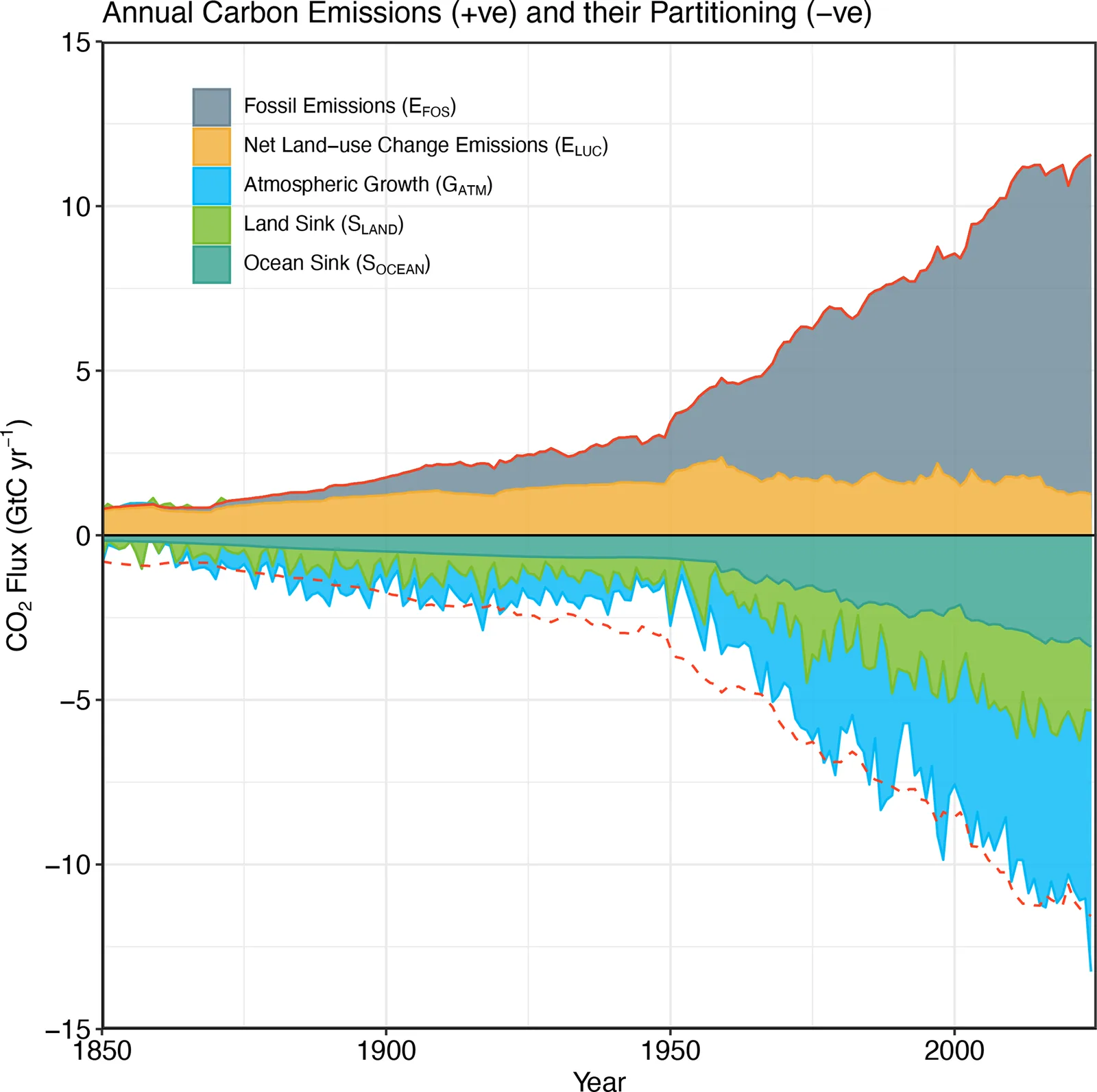
Fossil emissions hit a new high in 2024 and are projected to rise again in 2025, while 2024's record atmospheric CO2 growth left the carbon budget about 1.7 GtC out of balance.
Why it matters
The budget tracks how much human CO2 stays in the air and how much the ocean and land absorb. It shows that emissions are still growing, far from the cuts needed for the Paris goals. The remaining budget for 1.5 °C is nearly used up, and the biggest uncertainties (land-use emissions, northern land sink, ocean sink trend) limit how well the carbon cycle can be tracked.
What they did
The Global Carbon Project pooled many datasets and models for the fifth annual budget terms: fossil emissions, land-use emissions, atmospheric growth, and ocean and land sinks. It also compared them with atmospheric inversions, oxygen data and Earth system models. This year it added corrections to land-use emissions and to the ocean and land sinks, and a satellite-based growth rate. It projected 2025 values using regional energy data, regression and a neural network.
Key findings
- Fossil CO2 emissions were 10.3 ± 0.5 GtC in 2024, up 1.1 %, and are projected to rise 1.0 % in 2025 to 10.4 GtC.
- Atmospheric CO2 growth in 2024 was a record 7.9 GtC (3.73 ppm), mostly tied to El Niño. Projected 2025 growth is 4.4 GtC, and the 2025 concentration is 425.6 ppm, 53 % above pre-industrial.
- Over 2015–2024 the ocean took up 29 % of emissions and the land 21 %. The budget imbalance was near zero for the decade but -1.7 GtC in 2024.
- Land-use emissions averaged 1.4 ± 0.7 GtC yr−1 over 2015–2024 and have fallen about 0.2 GtC per decade since the late 1990s.
- The remaining budget for a 50 % chance of 1.5 °C is about 50 GtC from 2026, roughly 4 years of 2025 emissions.
Limitations
- Land-use emissions remain very uncertain, and the 2024 estimate relies on extrapolated land-use data.
- Methods disagree on the northern land sink and on the mean ocean sink. Ocean flux products may overstate trends because data are sparse, and ocean observation coverage has declined.
- The near-zero decadal imbalance could hide cancelling errors, and the cause of the 2024 imbalance is not identified.
Glossary
- Budget imbalance (BIM): The gap between estimated emissions and the sum of atmosphere, ocean and land changes.
- fCO2-products: Estimates of ocean CO2 uptake built from surface ocean CO2 measurements.
- DGVM: Dynamic global vegetation model, used to simulate the land carbon sink.
- Atmospheric inversion: A method that infers where CO2 enters and leaves the surface from atmospheric measurements.
Original paper
Global Carbon Budget 2025
Earth System Science Data · 13 May 2026
AI-generated summary of the original article; changes were made. Check the original before relying on it.