A compact climate-human model suggests most SSP baselines are too optimistic on growth
FRIDA v2.1 is a fast, highly aggregated model that couples climate and human systems with feedbacks, and its 100 000-run ensemble points to SSP3 and SSP4 baselines as the more plausible no-policy futures.
Why it matters
Standard scenario sets leave out how climate damages feed back on human activity. FRIDA shows that a small, quick model can include those feedbacks and still report uncertainty. Its results suggest high-growth baselines with large warming may not be plausible, which matters for people who use these baselines in policy work.
What they did
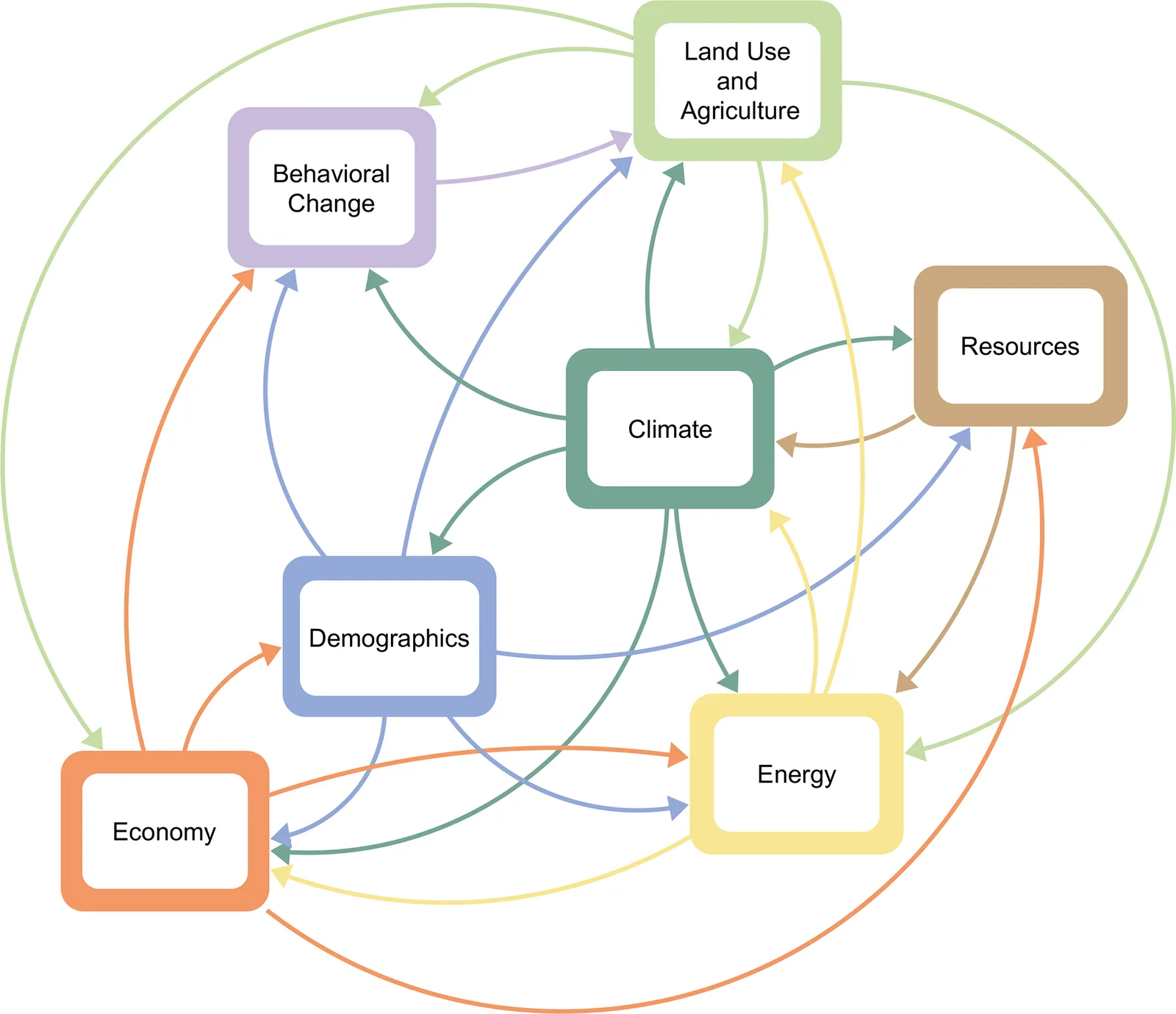
The authors built FRIDA v2.1 with the System Dynamics method. It has seven linked modules: climate, demographics, economy, land use and agriculture, energy, resources (concrete) and behaviour change. The climate part is a modified FaIR v2.1 with process-based land and ocean carbon cycles. They calibrated it to 158 observed time series for 1980 to 2023. Then they ran a 100 000-member ensemble varying 801 parameters, with no future climate policy, and compared it with six standard IAMs on the five SSP baselines.
Key findings
- One FRIDA run from 1980 to 2150 takes only a few seconds on a consumer laptop, so very large uncertainty ensembles are practical.
- Climate affects humans through four routes in the economy: lower labour productivity, sea level rise damage, financial instability and strained government budgets.
- The ensemble’s 95 % bounds include the warming of SSP1, SSP2 and, for most of the century, SSP5 baselines. The high GDP per capita in those scenarios does not fit FRIDA’s coupled structure.
- SSP3 and SSP4 baselines fit best. Their warming lies within the ensemble’s 67 % bounds, and their GDP per capita mostly lies within the 95 % bounds.
- The authors read this as evidence that leaving out two-way coupling in the standard IAMs overstates economic growth under strong warming.
Limitations
- FRIDA is global and highly aggregated, with no regional or sector detail, so it cannot give the specific outputs of ESMs and detailed IAMs.
- The ensemble ignores future policy changes, unmodelled processes such as global trade, and major technology breakthroughs. Parameter ranges were set assuming independence and the runs were not weighted by likelihood.
- The SSP comparison depends on FRIDA’s structure being roughly right. The authors say further analysis is still needed to confirm it.
Glossary
- CHANS: Coupled human and natural systems: models where climate and human activity affect each other in both directions.
- System Dynamics: A modelling method that uses stocks, flows and feedback loops written as differential equations.
- SSP: Shared Socioeconomic Pathway: a set of story-based scenarios of future society used in climate assessments.
- IAM: Integrated assessment model: a model of human systems and their emissions, used to study climate policy.
Original paper
An overview of FRIDA v2.1: a feedback-based, fully coupled, global integrated assessment model of climate and humans
Geoscientific Model Development · 30 October 2025
AI-generated summary of the original article; changes were made. Check the original before relying on it.