A digital twin delivers 5–10 km climate projections and impact indicators to users
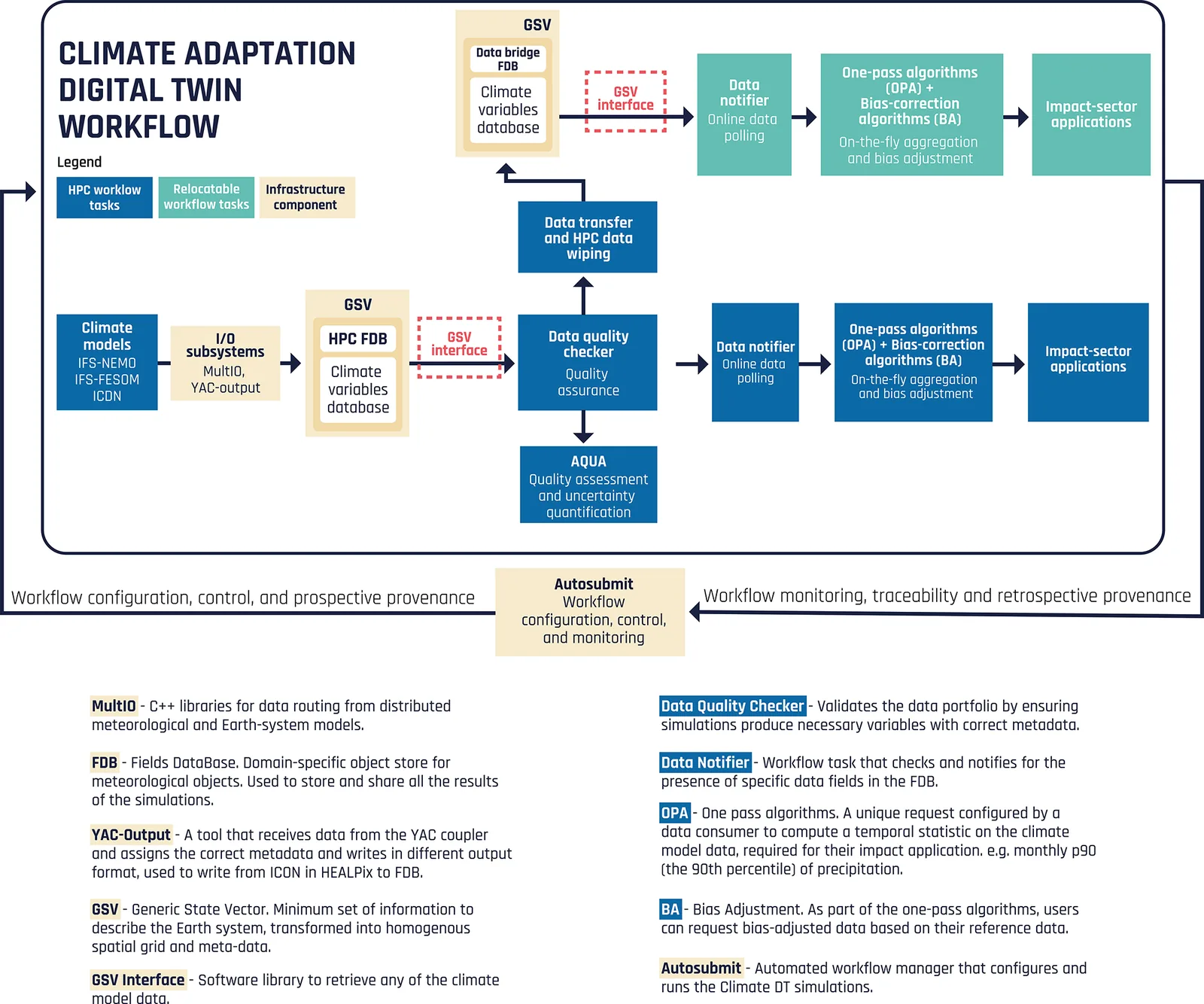
The Destination Earth Climate DT is an operational system that runs three km-scale climate models in one workflow and streams their output to sector applications and quality checks.
Why it matters
Adaptation planners need climate information at local scale, updated often, and shaped by their needs. This system aims to supply it globally and on a yearly cycle, as a complement to CMIP and CORDEX. It also shows how to handle the huge data volumes of km-scale models.
What they did
The authors describe the design of the Climate DT. It runs three global models (ICON, IFS-NEMO, IFS-FESOM) at 5–10 km on EuroHPC supercomputers, with one workflow manager and one common data format on a HEALPix grid. Output is streamed to applications while the simulations run, and it is then moved to cloud data bridges. Control, historical and projection runs followed a streamlined HighResMIP protocol. Storyline runs replay real extreme events under past, present and future climates.
Key findings
- All three models write the same variables and grid, so tools can read any of them as the run progresses.
- One-pass algorithms compute statistics such as percentiles on the fly, which gets around the limit that streaming shows only instantaneous data.
- Storylines of hurricane Helene gave accumulated rainfall of 247 mm (PAST), 264 mm (PRESENT) and 271 mm (FUTURE).
- Embedded applications cover wind energy, freshwater and floods, extreme rain over Europe, and fire weather and wildfire spread.
- Two monitoring tools, AQUA and OBSALL, check the simulations against reanalysis and observations while they run.
Limitations
- Computing cost is high. Current throughput is about 0.5 simulated years per day at 5 km, and the compute allows only a small multi-model ensemble per cycle.
- Uncertainty quantification still goes no further than multi-model estimates, and the AI tools (emulators, chatbots) are still in development.
- Stakeholder engagement so far rests mainly on discussions with selected key users, and external users cannot run the system themselves.
Glossary
- Digital twin: A replica of a system that lets users explore what-if questions and stays linked to reality.
- Storyline simulation: A run that replays a real extreme event, with winds nudged to reanalysis, under different climate conditions.
- HEALPix: An equal-area global grid used here as the common output grid for all models.
- One-pass algorithm (OPA): A routine that updates a statistic, such as a mean or percentile, as new model data arrives.
Original paper
The Destination Earth digital twin for climate change adaptation
Geoscientific Model Development · 14 April 2026
AI-generated summary of the original article; changes were made. Check the original before relying on it.