Adding salt at the surface delays modeled AMOC tipping versus spreading it through the ocean
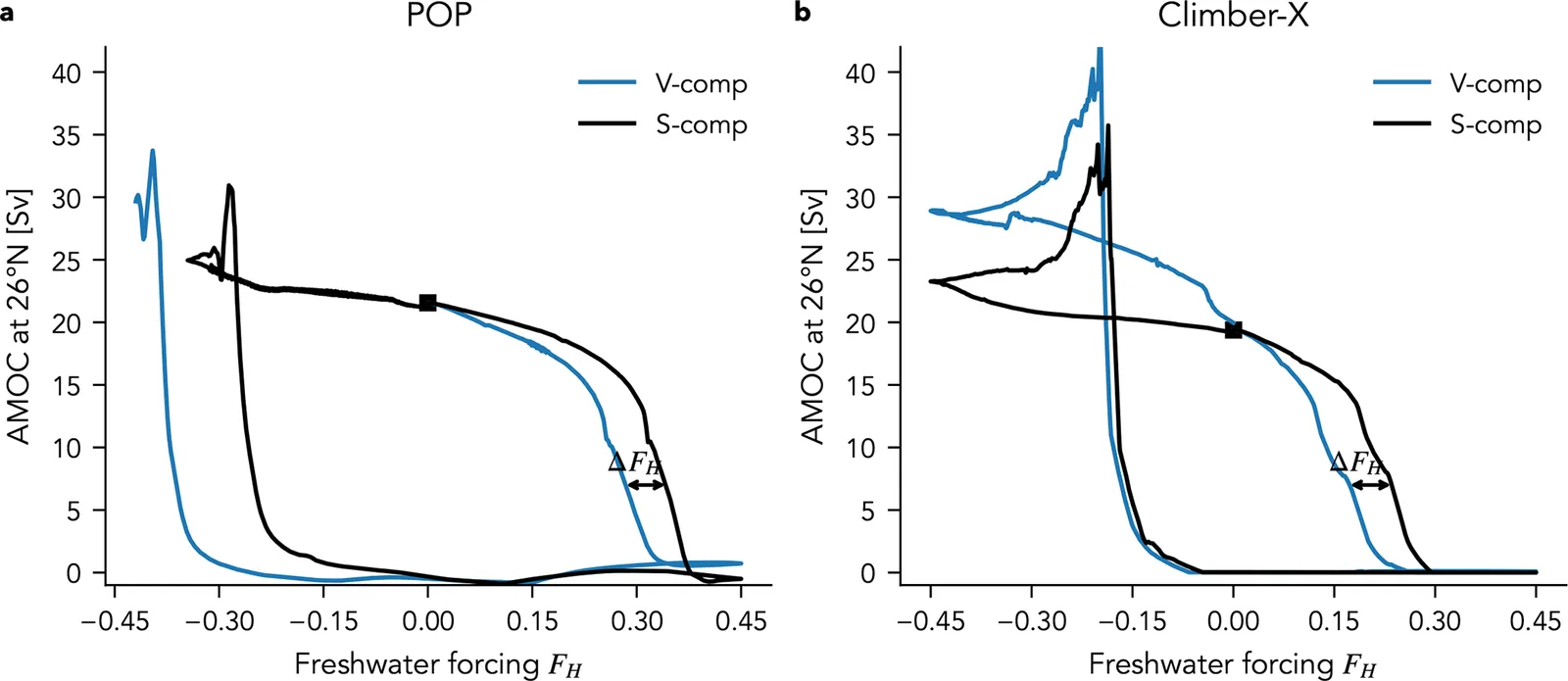
In two models, compensating freshwater hosing with surface salt pushes the AMOC tipping point to higher forcing than volume compensation, so past thresholds may be too high.
Why it matters
Modelers add salt to keep global salinity fixed when they push freshwater into the North Atlantic. The way they add it changes the estimated tipping point. Earlier studies using surface compensation may have overestimated how far today’s climate is from AMOC tipping. Volume compensation behaves most like a real freshwater input.
What they did
The authors used a 1° ocean model (POP) and an intermediate-complexity coupled model (Climber-X). They slowly ramped freshwater forcing over 20–50° N up to 0.45 Sv at 0.3 Sv kyr−1, then back down, tracing the hysteresis loop. They compared surface and volume salt compensation. They also used a passive salt tracer, a thermal wind reconstruction of the AMOC, and Climber-X tests that removed compensation regions one at a time.
Key findings
- In both models, surface compensation delays AMOC tipping. The difference in critical forcing is around 0.06 Sv.
- At a slower forcing rate in Climber-X, the difference shrinks to 0.04 Sv but remains.
- The compensation salt piles up in the subpolar North Atlantic and offsets the freshening there. Removing the tracer in POP reproduces the volume-compensation weakening until around year 600.
- Compensation over the North Atlantic and Arctic has an 8-times stronger influence per area than the global average. A run with no compensation tips almost like volume compensation.
- No Pacific overturning cell forms in any run, so the compensation method does not change AMOC recovery qualitatively, unlike an earlier study.
Limitations
- POP has no interactive atmosphere or sea ice, and Climber-X has a coarse ocean with simplified dynamics.
- Both models parametrize ocean eddies, and it is unclear whether results hold in higher-resolution or more complex coupled models.
- Regional effects do not add up linearly, so the regional numbers are only qualitative.
Glossary
- AMOC: Atlantic Meridional Overturning Circulation, the ocean current system that carries warm water north and deep water south in the Atlantic.
- Hysteresis: A loop in which the system collapses and recovers at different forcing values.
- Salinity compensation: Adding salt to offset added freshwater so global salinity stays constant, either at the surface or through the ocean volume.
- Sv (Sverdrup): A unit of flow equal to one million cubic metres of water per second.
Original paper
Critical freshwater forcing for AMOC tipping in climate models – compensation matters
Earth System Dynamics · 12 May 2026
AI-generated summary of the original article; changes were made. Check the original before relying on it.