AI-based satellite reconstruction suggests ocean fronts drive much of the energy cascade
Combining satellite data with a generative model learned from simulations, the authors find that small ocean fronts carry a disproportionate share of energy moving both to larger and smaller scales in the Agulhas region.
Why it matters
Climate models cannot resolve features a few kilometers across, and current eddy parameterizations do not represent upscale energy transfer or its concentration in fronts. The authors’ results point to fronts as targets for new parameterizations. The method may also allow routine kilometer-scale monitoring of surface currents from space.
What they did
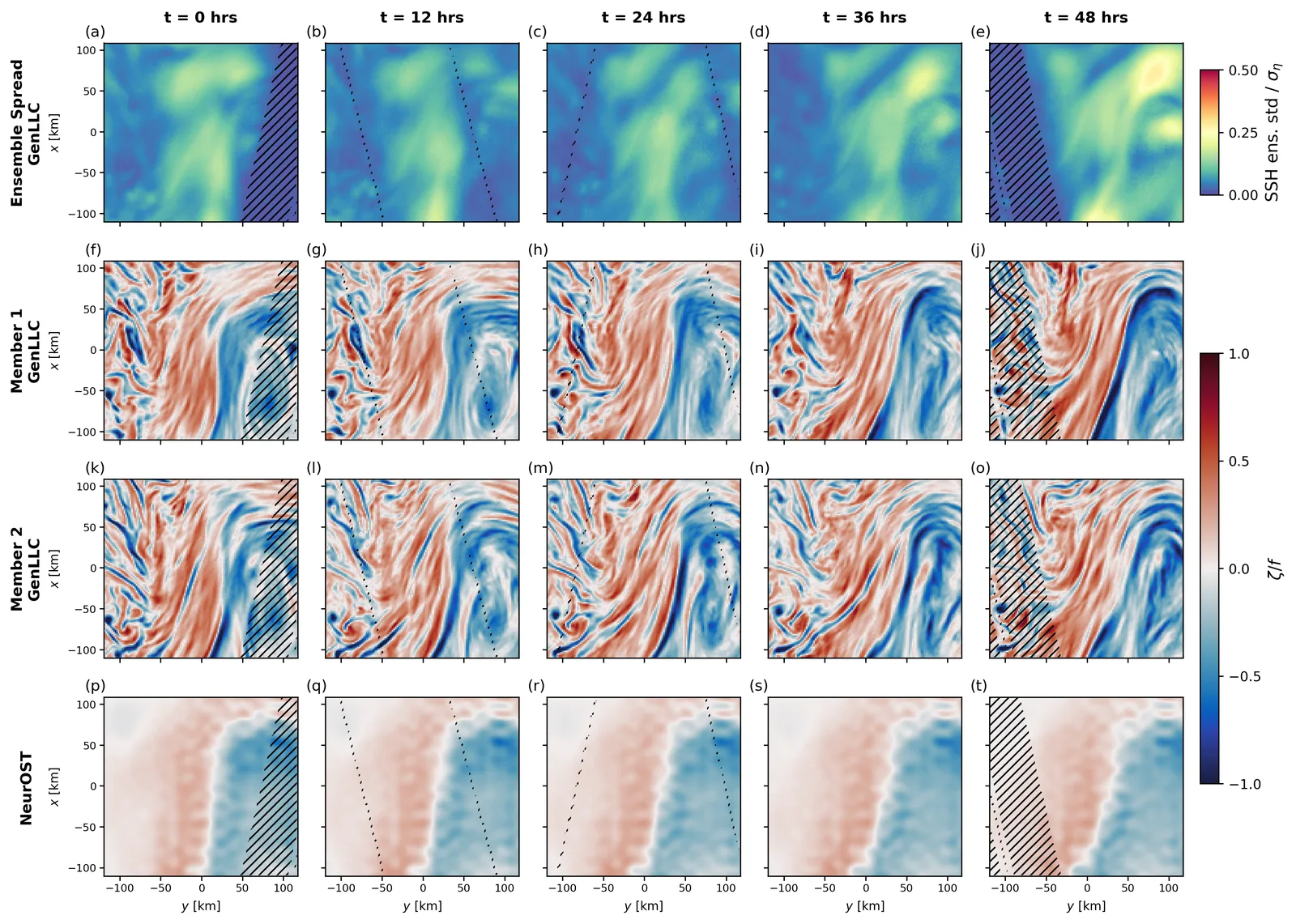
They trained a video diffusion model on a high-resolution global ocean simulation (LLC4320) to learn plausible surface states. They then guided it with 2024 satellite observations of sea surface height (including SWOT) and sea surface temperature, plus coarse gridded products. This gave gap-free, kilometer-scale currents in two Agulhas sub-regions. They computed cross-scale kinetic energy flux from these currents and checked the method with withheld observations, drifters and a simulated-observation test with known truth.
Key findings
- In the Ring Path, energy moves upscale from scales above 10 km to the mesoscale. The upscale flux peaks at −3.5 μWm-3 in winter and spring, 40% stronger than in summer and autumn.
- Below 10 km, convergence at fronts drives a downscale cascade toward dissipation.
- Convergence zones (δ<−0.2 f) cover 1.7% of the area but carry 28% of the gross downscale flux at 5 km, which is 16-fold more efficient than the domain average.
- High-strain regions (σ>0.4 f) cover 7.5% of the area and carry 25% of the gross upscale flux at 20 km, a three-fold gain in efficiency.
- The cascade the authors diagnose from satellites is up to 70% stronger than in LLC4320 in the Ring Path. In the more energetic Return Current, transfers are an order of magnitude larger.
Limitations
- The learned prior comes from one simulation, LLC4320, so its biases (for example in symmetric instability or summertime mixed-layer instability) may carry into the estimates where observations are sparse.
- SWOT height data contain internal-wave signals that the prior was not trained on. The authors tested this only in simulation, where it caused modest degradation. They have not tested it in the real world.
- The study covers one seasonal cycle and surface fields only, so interannual variability and energy passing into the interior are not captured. Real-world surface currents also lack direct high-resolution validation.
Glossary
- Generative data assimilation: Using a generative model, trained on simulations, to produce ensembles of plausible ocean states that also match sparse observations.
- Submesoscale: Ocean motions roughly 1–50 km across, such as sharp fronts and small eddies.
- Cross-scale kinetic energy flux: The rate at which energy moves between large and small scales of motion. Negative values mean upscale and positive values mean downscale.
- OSSE: Observing system simulation experiment: synthetic observations are sampled from a simulation so results can be compared with a known truth.
Original paper
Generative data assimilation highlights fronts as key regulators of ocean energy cascade
arXiv · 15 August 2026
This paper is a preprint. It has not been peer reviewed, and its results may change.
AI-generated summary of the original article; changes were made. Check the original before relying on it.