CMIP7 impacts request asks climate modelers for 539 variables in 60 groups
The CMIP7 impacts and adaptation team gathered community input into 13 opportunities and 60 variable groups, and urges modeling groups to pick variable groups that fit their resources.
Why it matters
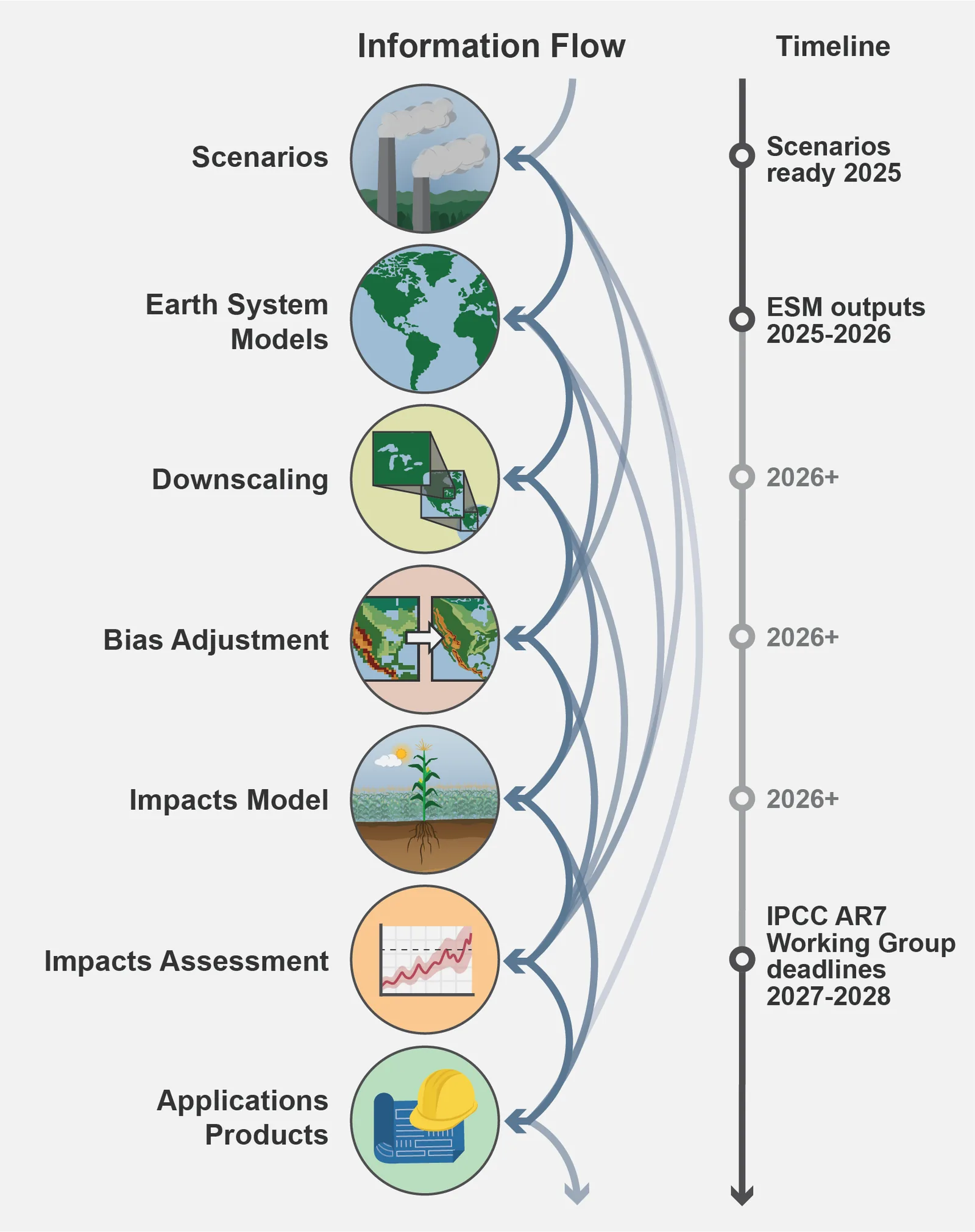
Climate model output is the first step in a long chain that leads to adaptation decisions. If the right variables are missing, whole fields of downstream work are cut off. The paper shows modeling groups what users need and how to compromise when resources are tight.
What they did
The Impacts and Adaptation team ran an open call through a shared online whiteboard with boards for 11 sectors and one for other topics. They reached out through many networks. They then merged the inputs into variable groups and opportunities, using CMIP7 standard templates. Independent data request authors reviewed the result, which led to further consolidation. The team also consulted modeling leaders on priorities.
Key findings
- The process produced 13 impacts and adaptation opportunities, 60 variable groups and 539 unique variables, of which 93 are new for CMIP7.
- Users want sub-daily output, since extreme rain, heat and humidity, and energy-system modeling need finer time steps than daily or monthly data. Most of these requests are 2-dimensional surface variables.
- Historical runs and 21st century ScenarioMIP runs are the most wanted experiments. Many groups also want an outlook to 2125.
- For time subsets, the team recommends the recent past first, then periods centered on the 2050s and the 2080s, of 20, 30 or more years.
- Core variable groups are marked as highest priority. Modelers are told that supplying even one group or a subset is valuable.
Limitations
- Outreach drew mostly professional and scientific communities, and some groups with needs probably did not take part.
- Some requested variables were left for a later version of the data request. They were not yet in CF standards or needed model changes.
- Dates for IPCC deadlines were not final at the time of writing, and the request depends on limited modeling resources.
Glossary
- Variable group: A set of model output variables that together allow one specific impacts or adaptation application.
- Dynamical downscaling: Running a regional climate model, driven by global model output, to get finer detail.
- Bias adjustment: Correcting model output so its statistics better match observations.
- Emulator: A fast statistical or machine learning model trained to mimic a full climate model.
Original paper
CMIP7 data request: impacts and adaptation priorities and opportunities
Geoscientific Model Development · 4 December 2025
AI-generated summary of the original article; changes were made. Check the original before relying on it.