CMIP7 proposes seven emission scenarios, run mostly in emission-driven mode
ScenarioMIP for CMIP7 sets out seven emission scenarios, from High to Very Low, to be run mostly with CO2 emissions driving the models, with some extended to 2500.
Why it matters
These scenarios will feed climate model runs that support research, impact studies and IPCC assessments. Running models from emissions lets carbon cycle uncertainty show up in the results. The long extensions allow study of tipping points and how reversible warming is.
What they did
A steering committee designed the scenario set after a 2023 meeting and several rounds of review by researchers and users. Integrated assessment models are producing the emissions and land use pathways, with one “marker” version for each scenario. The authors used a simple climate model, FaIR, to illustrate likely temperature outcomes. They also defined stylized extensions to 2500 and set out how carbon dioxide removal is passed to Earth system models.
Key findings
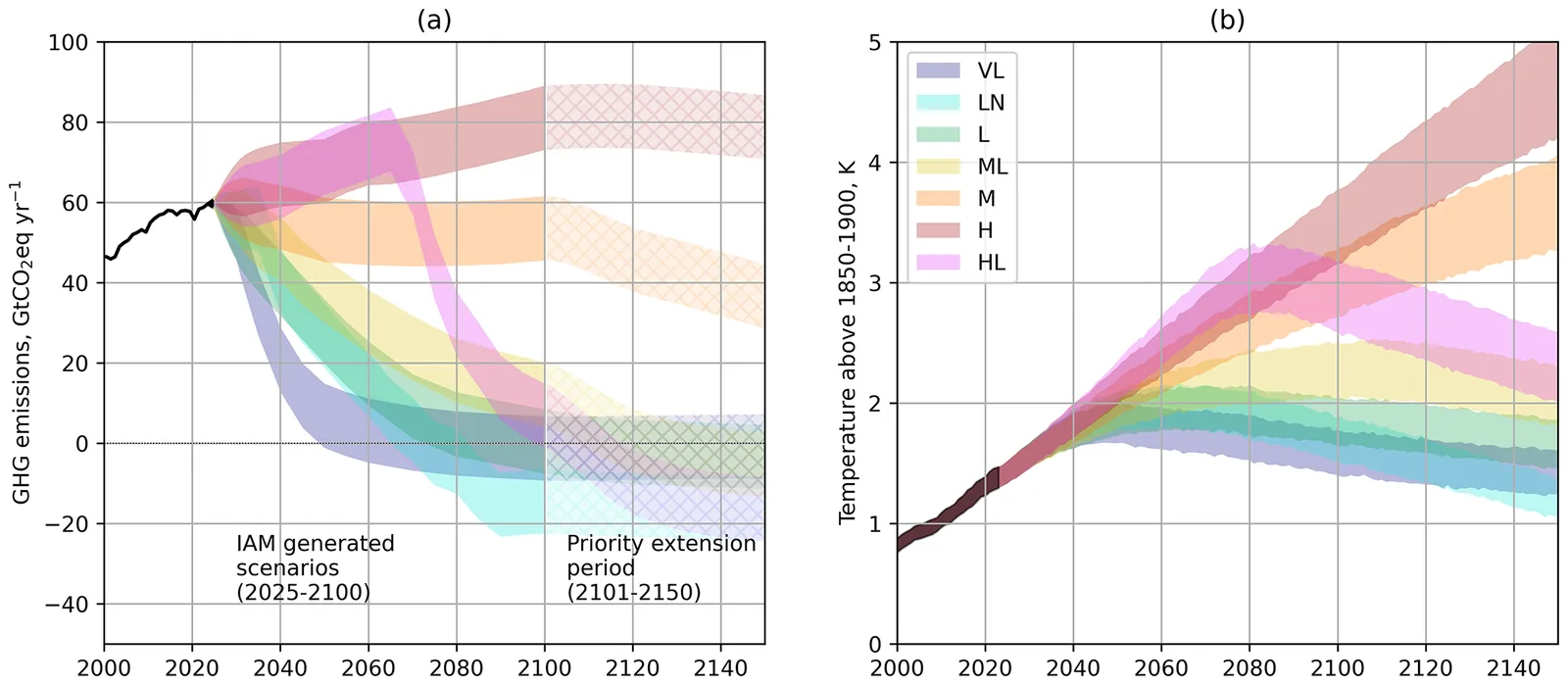
- The seven scenarios are High, High-to-Low, Medium, Medium-to-Low, Low, Low-to-Negative and Very Low. They cover a plausible range, and the High scenario is expected to give forcing below SSP5-8.5.
- Most scenarios are to run in emission-driven mode for CO2. The authors expect this to widen the range of outcomes. They also ask for at least one concentration-driven run for comparison.
- Illustrative simple-model runs suggest warming in 2100 from around 1.5 to almost 3.5 °C above 1850–1900. Final values will come from Earth system model runs.
- Models are asked to run all scenarios to 2150, and at least two extensions to 2500, preferably H-ext and VL-ext. In the illustrations, M-ext and H-ext settle at around 4 and 6 °C of warming.
- In the extensions, the Medium-to-Low and High-to-Low scenarios risk exceeding the prudent limit for storing removed carbon. Cumulative emissions in M-ext, HL-ext and H-ext exceed proven fossil fuel reserves.
Limitations
- No probabilities are given for the scenarios. Plausibility is a subjective judgment, and futures outside this range are possible.
- The scenarios assume no climate change impacts, and they do not explicitly address equity and justice. The extensions beyond 2100 are stylized and not checked as thoroughly for plausibility as the earlier period.
- Figures use preliminary stylized data and a simple climate model. Final emissions will come from the integrated assessment model runs, and temperatures from Earth system model runs.
Glossary
- Emission-driven mode: A model run where CO2 emissions are prescribed and the model’s own carbon cycle decides the resulting atmospheric CO2.
- Integrated assessment model (IAM): A model that links economy, energy, land use and emissions to produce scenario pathways.
- Overshoot: A temperature path that exceeds a warming level for a time and then falls back below it.
- Carbon dioxide removal (CDR): Methods that take CO2 out of the air and store it, such as BECCS, direct air capture and afforestation.
Original paper
The Scenario Model Intercomparison Project for CMIP7 (ScenarioMIP-CMIP7)
Geoscientific Model Development · 7 April 2026
AI-generated summary of the original article; changes were made. Check the original before relying on it.