Depleted groundwater made the 2022 Po River drought far worse than rainfall alone explains
In the 2022 Po drought, an aquifer already drained before the dry year appears to have amplified the river's collapse and kept hydrological drought going long after rainfall indices recovered.
Why it matters
Drought indices based on rain can declare a drought over while groundwater and river baseflow are still impaired. The authors suggest adding satellite groundwater storage and river recession measures to drought monitoring in irrigated basins with few well records. These are preprint findings and have not been peer reviewed.
What they did
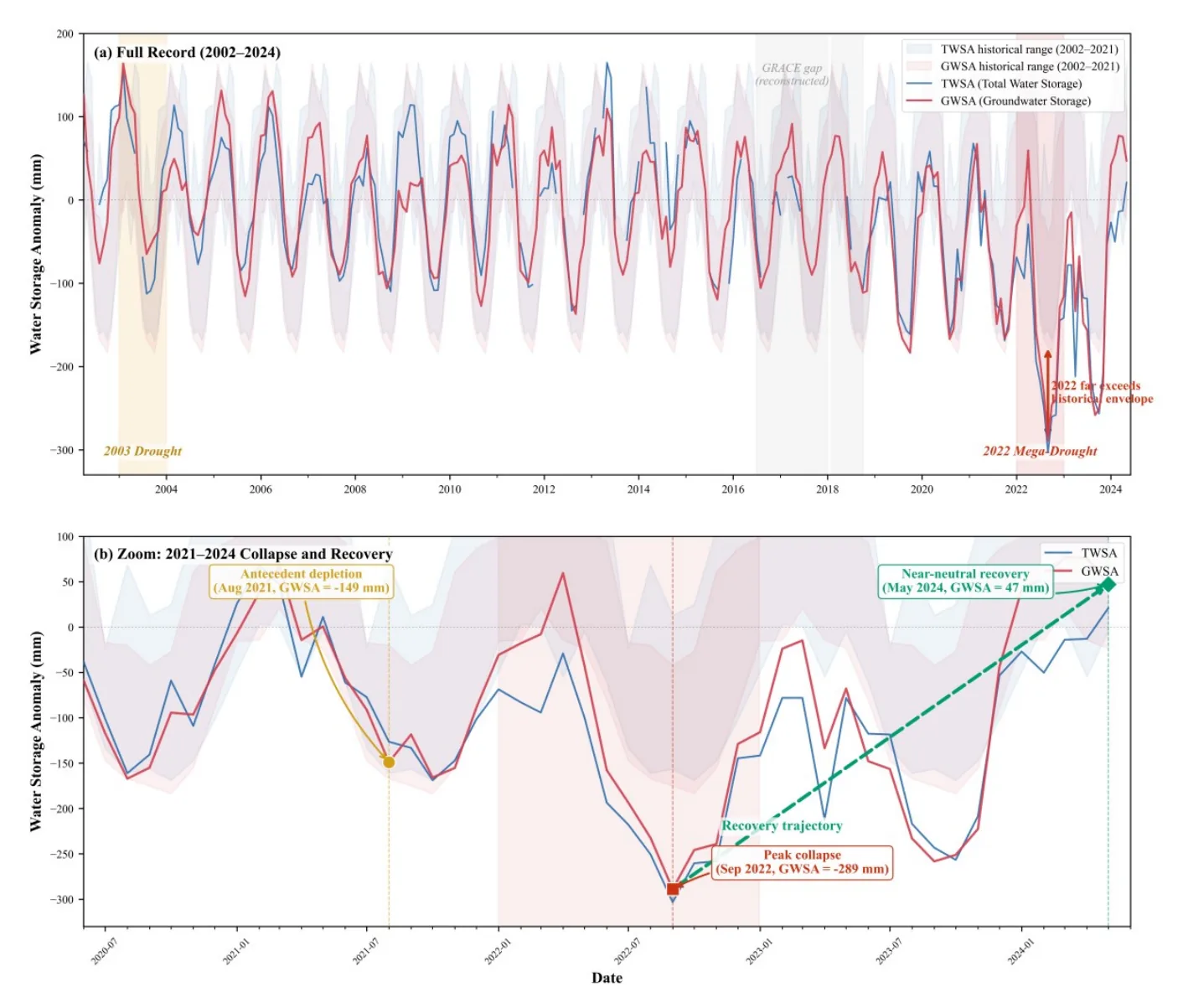
The authors combined GRACE-FO satellite gravity data, ERA5-Land soil moisture and snow, and a 25-year daily discharge record at Pontelagoscuro. They isolated groundwater storage anomalies by subtracting soil moisture and snow from total water storage. They separated baseflow from direct runoff with a digital filter and fitted recession rates to low-flow periods. They also timed the recovery of five variables after the September 2022 drought peak.
Key findings
- Annual discharge fell 52% in 2022 and summer discharge about 78%, much more than a 20–25% precipitation deficit would be expected to cause.
- Groundwater storage was already at -149 mm in August 2021 and reached -289 mm in September 2022.
- The May–September 2022 groundwater loss was -246 mm, the largest in the satellite record (Z = -2.32), as surface water for irrigation ran short.
- The baseflow recession coefficient rose 90.7% from 2021 to 2022, and it stayed high in 2023 and 2024, which the authors read as multi-year hysteresis.
- Rain-based indices recovered in 8 months, discharge in 12 and soil moisture in 14. Groundwater had not returned to normal within the record.
Limitations
- The Po is heavily regulated, which can bias recession fits. The recession-to-storage trend has an R² of only 0.15 across 13 years.
- GRACE-FO resolves only about 300 km scales, so it misses local variation. The study cannot separate climate-driven from human-driven depletion, and no irrigation abstraction data were available.
- Recovery timing depends on the thresholds chosen, and the three-tier pattern breaks down under large threshold changes. The -150 mm threshold may not transfer to other basins.
Glossary
- GWSA: Groundwater storage anomaly: groundwater storage compared with a baseline, here estimated from satellite gravity minus soil moisture and snow.
- Recession coefficient (k): A measure of how fast baseflow declines during dry spells; higher means faster drainage.
- Baseflow: The part of river flow that comes from groundwater rather than recent runoff.
- SPEI: Standardised Precipitation Evapotranspiration Index, a drought index based on the balance between rain and evaporative demand.
Original paper
Antecedent groundwater depletion amplifies hydrological drought severity: aquifer-river connectivity and cascading recovery in the 2022 Po Plain extreme event
EGUsphere · 14 August 2026
This paper is a preprint. It has not been peer reviewed, and its results may change.
AI-generated summary of the original article; changes were made. Check the original before relying on it.