Dry land before a flash drought is linked to stronger heat feedback during it
Satellite data show that flash droughts starting from water-stressed land have stronger surface heating, and in parts of Africa low vegetation water content 1–2 months earlier goes with hotter peaks.
Why it matters
Forecast models for 2 weeks to 2 months ahead often miss flash droughts. The results suggest that getting the land’s prior moisture state right could improve them. Vegetation water content from satellites may be a convenient early signal in some regions.
What they did
The authors found flash droughts in 2000–2020 using daily satellite surface soil moisture at 0.25° resolution. They combined these events with satellite and reanalysis data on radiation, evaporation, land surface temperature, vegetation and air temperature. They used the gap between land surface and air temperature as a proxy for sensible heat flux, and split events into quartiles by its peak. They then tested three semi-arid African regions with a bootstrapped Mann-Whitney U test.
Key findings
- Net radiation rises as drought develops. After onset, sensible heat flux keeps rising while net radiation falls and latent heat flux declines, which indicates water limitation.
- Events with stronger evaporative stress show shifted surface energy budgets for 4 months both before and after onset, and also larger losses in vegetation water content and fluorescence.
- Vegetation and air temperature respond most to soil drying in semi-arid regions.
- In West Africa in summer, 9 % of events in the lowest heat-flux quartile exceed a 1.5σ air temperature anomaly, against 27 % in the highest quartile.
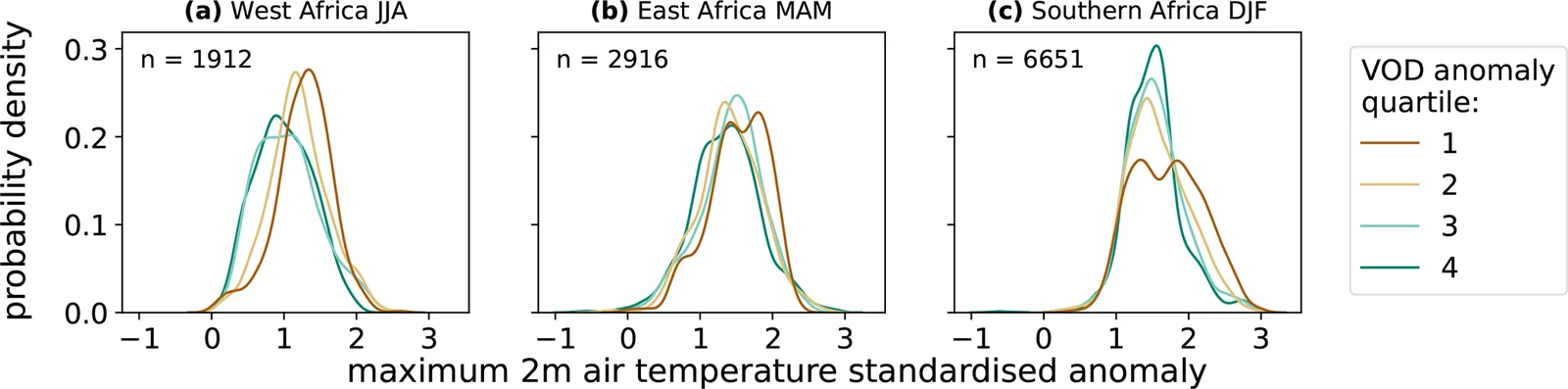
- In West Africa, 12 % of events with high precursor vegetation optical depth reach a peak anomaly above 1.5σ, against 27 % with low precursor values. East Africa shows the same direction, but southern Africa shows no robust link.
Limitations
- Events in densely forested areas are missing because satellites cannot observe surface soil moisture there.
- Some inputs are not purely observed: air temperature comes from reanalysis and latent heat flux comes from a model driven by satellite data. Land surface temperature is also missing under clouds.
- The precursor signal is not robust in southern Africa, and land information alone cannot predict onset, since rainfall deficits must also be forecast.
Glossary
- Flash drought: A drought that develops rapidly, over about 2 weeks to 2 months.
- Vegetation Optical Depth (VOD): A microwave-based measure of the water content of vegetation.
- Sensible heat flux: Heat passed from the land surface to the air, as opposed to heat used to evaporate water.
- Standardised anomaly: How far a value is from normal, in units of its usual variability (σ).
Original paper
Global observations of land-atmosphere interactions during flash drought
Hydrology and Earth System Sciences · 2 December 2025
AI-generated summary of the original article; changes were made. Check the original before relying on it.