El Niño peaks have stayed below a seasonal limit set by the Pacific temperature gradient
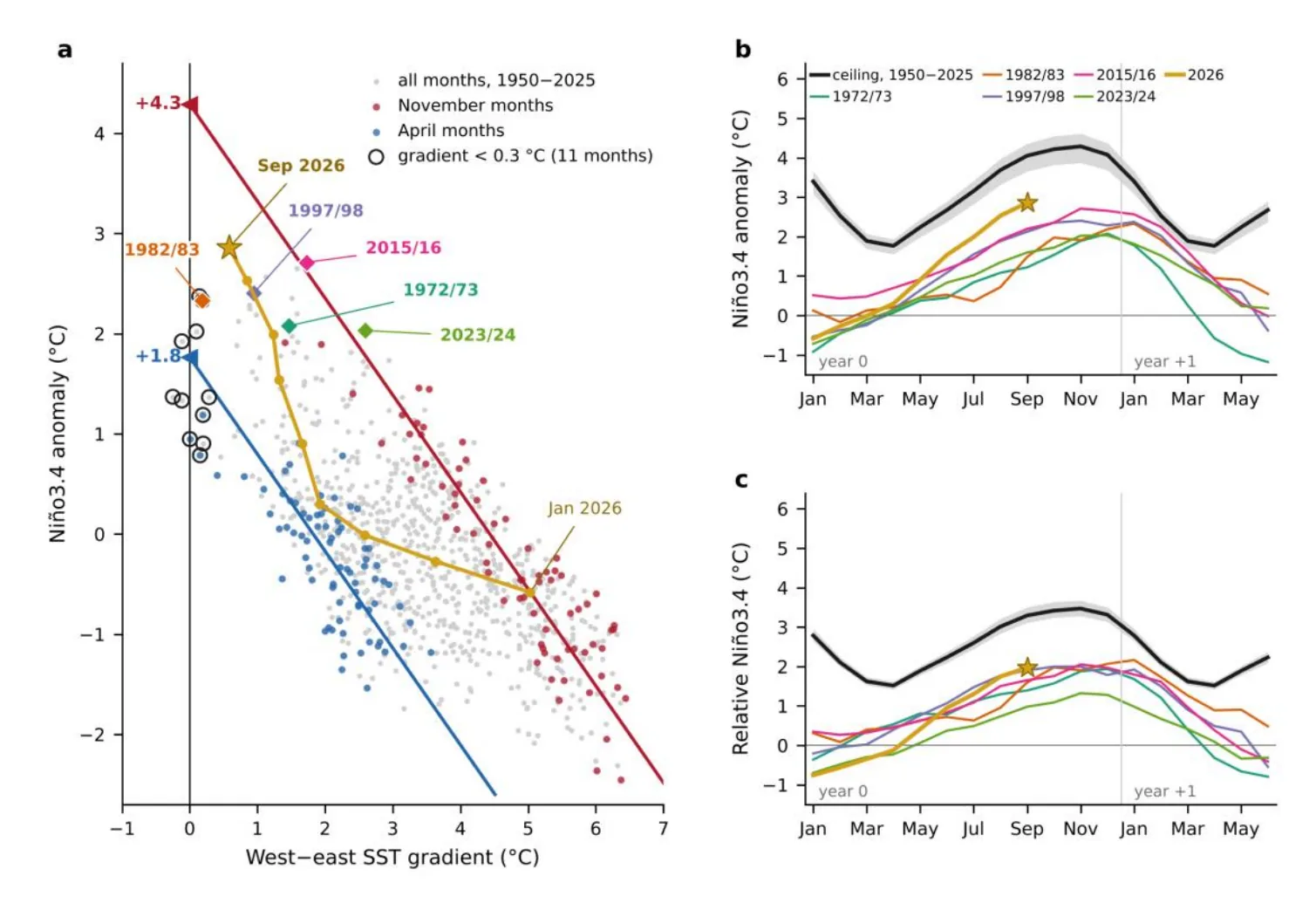
Extrapolating the shrinking west–east Pacific temperature contrast gives a seasonal El Niño ceiling, which no month since 1950 has passed, but the 2026 event will test whether it is a real limit.
Why it matters
If the limit is physical, it would tie the upper range of El Niño strength to the mean state of the tropical Pacific. That could say something about rare extremes that the short record cannot sample. The authors stress this is a candidate constraint, not a proven ceiling.
What they did
The authors regressed the west–east Pacific sea-surface temperature gradient on the Niño3.4 anomaly for each calendar month, using three SST datasets for 1950–2025. They took the Niño3.4 value where the fitted gradient reaches zero as a seasonal threshold. They examined ocean heat budgets in months with near-zero gradient and repeated the regression in 57 CMIP6 climate models. They also set prospective tests, fixed before the outcome, for the ongoing 2026 event.
Key findings
- The gradient falls by about 1°C per degree of Niño3.4 warming. The fitted threshold runs from +1.8°C in April to +4.3°C in November, and no month since 1950 has exceeded its threshold.
- Relative to tropical mean SST, the November threshold changed little, from +3.59°C in 1950–1974 to +3.57°C in 2000–2025.
- In the 11 historical months with gradient below 0.3°C, the ocean advective terms reversed and Niño3.4 fell the next month. All of these months fell between January and May, when strong events normally decay.
- In CMIP6 models during September–December, Niño3.4 grew in the next month in 29% of near-zero-gradient cases, against 62% when 1–2°C of gradient remained.
- In 2026 the September gradient was 0.58°C, a record low for that month, while the event was still growing.
Limitations
- Historical near-zero gradients occurred only in the decay season, so the data cannot separate a gradient limit from normal seasonal decay. The autumn threshold is an extrapolation beyond observed values.
- The threshold depends on the chosen regional boxes and on the direction of regression. It is not a common temperature limit across models, and one reversed regression gave +3.3°C, which three months exceeded.
- The near-unit slope arises partly because Niño3 and Niño3.4 overlap. The 2026 data are preliminary, and this is a preprint that has not been peer reviewed.
Glossary
- Niño3.4: Average sea-surface temperature anomaly in a central equatorial Pacific box, used to measure El Niño strength.
- Zonal SST gradient: Warm-pool sea-surface temperature minus eastern Pacific (Niño3) temperature along the equator.
- Bjerknes feedback: A loop in which warmer eastern Pacific water weakens the trade winds, which in turn favours more warming.
- Warm water volume: Amount of warm water above the 20°C isotherm in the equatorial Pacific, used as a measure of ocean heat recharge.
Original paper
A seasonal threshold on El Niño amplitude set by the Pacific zonal temperature gradient
EGUsphere · 27 October 2026
This paper is a preprint. It has not been peer reviewed, and its results may change.
AI-generated summary of the original article; changes were made. Check the original before relying on it.