Fossil corals and model runs both show weaker El Niño in the cold deglaciation
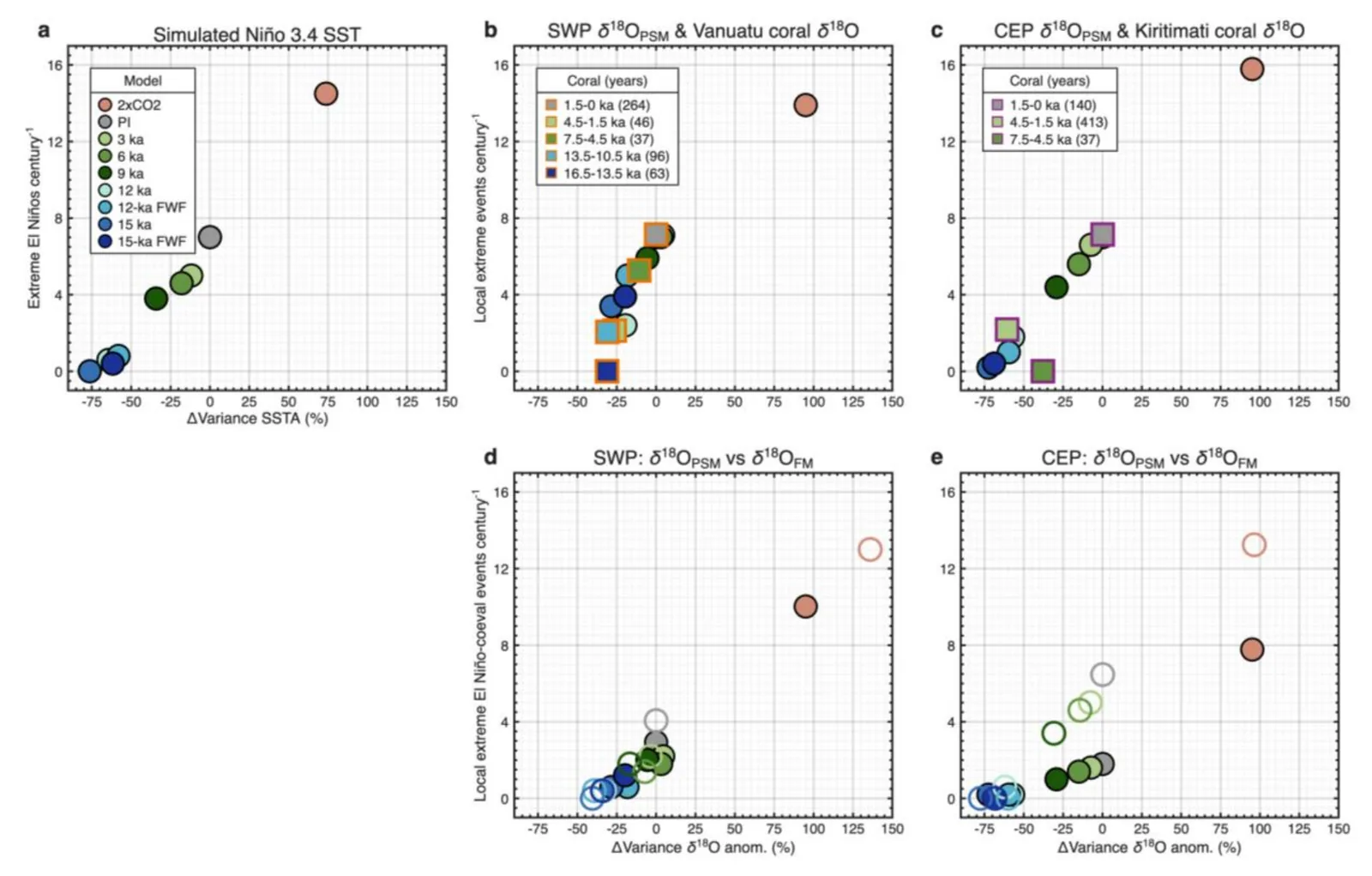
Coral records from Vanuatu dated to about 12 and 15 thousand years ago show weaker year-to-year variability, and climate model runs suggest El Niño and its extreme events grow as the climate warms.
Why it matters
Climate models disagree on how El Niño will change with warming, and the modern record is too short to settle it. Past climates that were much colder offer a test of how El Niño responds to background climate. The authors say the match between corals and model strengthens confidence in projections of more frequent extreme El Niño. This is a preprint, so the results are not yet peer reviewed.
What they did
The team drilled uplifted fossil Porites corals in Vanuatu and measured oxygen isotopes monthly. Ages came from uranium-thorium dating. They compared 30-year windows of year-to-year variance with a climate model (CESM1.2) run for past time slices, a CO2 doubling, and new freshwater runs at 12 and 15 thousand years ago that weaken the Atlantic circulation. Model output was converted to simulated coral values so it could be compared directly with the corals. They also counted extreme El Niño events using a percentile threshold.
Key findings
- Deglacial corals from Vanuatu show lower year-to-year variance than late Holocene corals, matching the simulated Vanuatu corals.
- In the model, El Niño strengthens steadily from 15 thousand years ago to pre-industrial. Weakened Atlantic circulation adds only 10–15% to ENSO, against 60–80% increases from glacial forcing.
- Extreme El Niño frequency rises linearly with variance: 0–1 events per century in the deglacial runs, 4–5 in early-to-mid Holocene runs, and 14–15 under CO2 doubling.
- At Vanuatu, 34–50% of the deglacial variance drop is attributed to ENSO. The early-to-mid Holocene ENSO share is only 0–11%, so Holocene signals are hard to detect.
Limitations
- The model overestimates ENSO amplitude and places its patterns too far west, so a percentile threshold and a nearby model region stand in for Vanuatu.
- Only a few short coral records exist, and the Bølling Allerød interval (14.6–12.9 ka) is poorly constrained.
- The projection of future ENSO relies on one model and assumes ENSO responds linearly to forcing.
Glossary
- ENSO: El Niño–Southern Oscillation, a natural swing in tropical Pacific ocean and air conditions that affects weather worldwide.
- Coral oxygen isotopes (δ18O): A chemical signal in coral skeleton that tracks sea temperature and salinity, used to read past climate month by month.
- AMOC: Atlantic Meridional Overturning Circulation, the large Atlantic current system that carries heat northward.
- Proxy system model: A tool that turns simulated climate into simulated coral records, including dating and measurement error.
Original paper
Rare deglacial-aged corals point to weaker El Niño in a colder world
EarthArXiv · 24 September 2026
This paper is a preprint. It has not been peer reviewed, and its results may change.
AI-generated summary of the original article; changes were made. Check the original before relying on it.