French river projections: emissions drive low-flow loss, while internal variability stays large
In a large ensemble of French river projections, low flows fall in the south under high emissions, but changes in mean and high flows are very uncertain, and natural year-to-year variability is often as large as the model spread.
Why it matters
Planners who adapt water management to river projections need to know which choices drive the spread. Here, the choice of regional climate model matters a lot for low flows, and natural variability should not be ignored. Looking at single models can also show which ones push the spread.
What they did
The authors analysed Explore2, an ensemble of 36 bias-adjusted regional climate projections from EUROCORDEX. Four hydrological models used these projections to simulate flows at 1735 points in France. They applied QUALYPSO, a method that handles incomplete ensembles and separates scenario, global model, regional model, hydrological model and internal variability. They focused on changes for 2071–2099 relative to 1976–2005.
Key findings
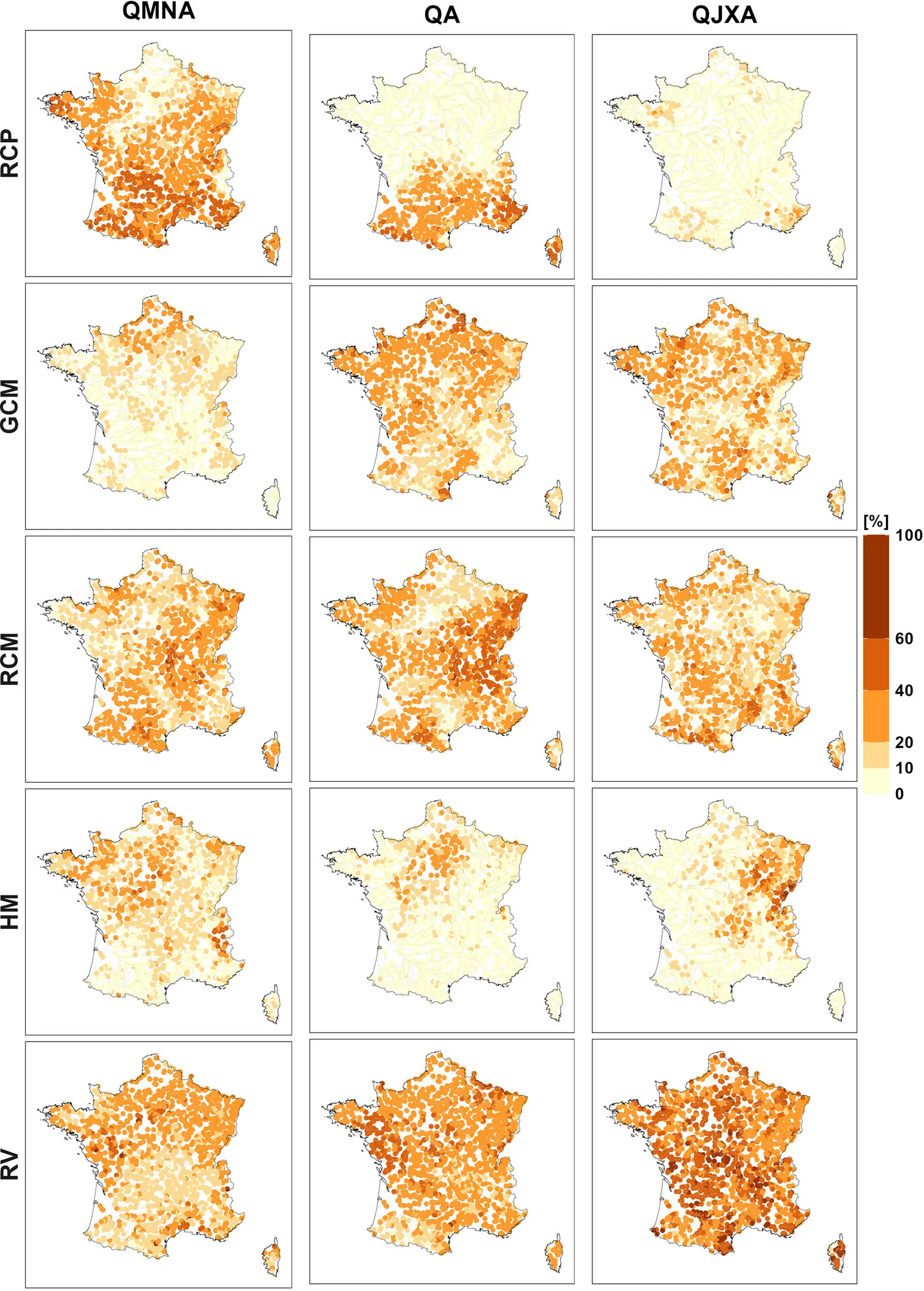
- Under the high-emission scenario RCP8.5, models agree on lower low flows across much of southern France, but disagree on the sign of change for mean annual and high flows.
- Emission scenario is the main source of uncertainty for low flows across France, and for mean annual flows in the southeast.
- Global and regional climate models matter most for mean and high flows. For low flows, regional models add much more uncertainty than global ones.
- Hydrological model uncertainty is large for low flows, moderate for mean annual flows and small for high flows.
- Internal variability is often as large as the spread in climate change response, and sometimes larger. It is much larger for precipitation and flows than for summer temperature.
- A few individual models often cause much of the model uncertainty. Examples are HadREM3-GA7-05 and WRF381P for summer warming and ORCHIDEE for mean annual flow.
Limitations
- Bias adjustment and hydrological model uncertainty are probably underestimated, because only two similar adjustment methods and four hydrological models were used.
- The flows are natural flows without human water use, and the models do not suit glacier-covered or karstic catchments. Most of them also ignore the effect of CO2 on vegetation.
- The climate response estimate depends on subjective smoothing choices, and a large residual variance suggests interactions between model types that the method does not capture.
Glossary
- Internal variability: Natural, chaotic year-to-year fluctuations of the climate that cannot be reduced by better models.
- QUALYPSO: A statistical method that splits the spread of an incomplete ensemble of projections into scenario, model and internal-variability parts.
- Climate change response: The long-term change in an indicator between a future period and the reference period.
- Main effect: How far one model or scenario pushes the result away from the ensemble average.
Original paper
Uncertainty sources in a large ensemble of hydrological projections: Regional Climate Models and Internal Variability matter
Hydrology and Earth System Sciences · 20 February 2026
AI-generated summary of the original article; changes were made. Check the original before relying on it.