Human-induced warming reached 1.37 °C in 2025, rising 0.27 °C per decade
The fourth annual indicator update finds human-induced warming at 1.37 °C in 2025, rising at 0.27 °C per decade, with emissions at a record high but no longer growing rapidly.
Why it matters
The update gives an up-to-date reference point for the next IPCC assessment report and tracks the effect of choices made in the 2020s. It also shows the remaining carbon budget for 1.5 °C is small: 130 GtCO2 at 50 % likelihood. The authors warn that funding cuts threaten the satellite and ocean observations needed to track these indicators.
What they did
The authors repeat the IPCC AR6 methods with data through 2025, using over 40 global datasets. They go from greenhouse gas emissions and concentrations to radiative forcing, Earth energy imbalance, observed temperature and attributed human-induced warming. They then update the remaining carbon budget, extremes, land rainfall and sea level. A new indicator this year counts marine heatwave days.
Key findings
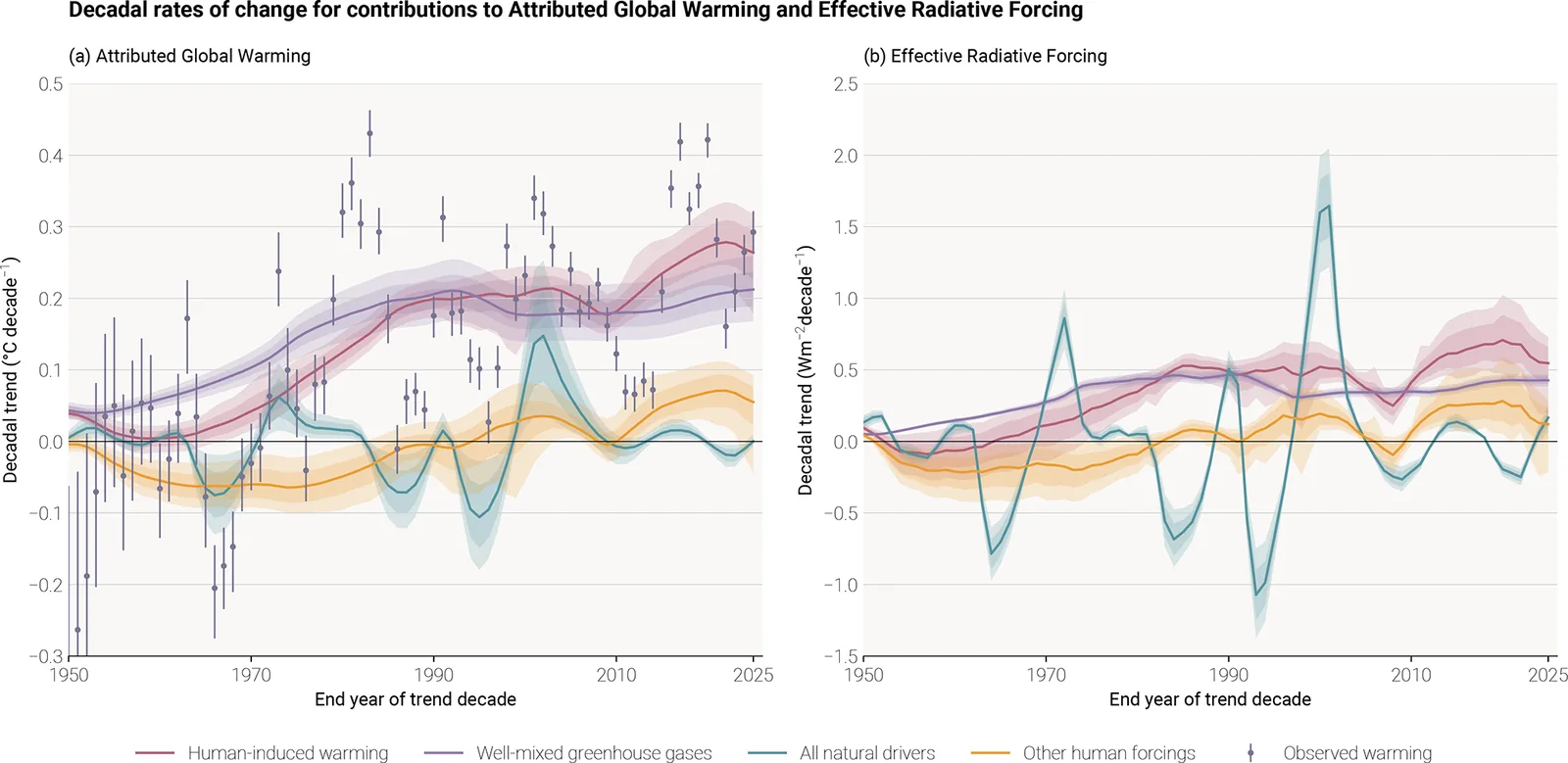
- Human-induced warming was 1.37 [1.1 to 1.7] °C in 2025, and 1.24 [1.0 to 1.5] °C for 2016–2025. The rate is 0.27 [0.2–0.4] °C per decade, unchanged from last year and slightly lower than in the last couple of years.
- Greenhouse gas emissions were 56.8 ± 5.5 GtCO2e in 2024, an all-time high. The decade 2015–2024 averaged 54.6 ± 5.5 GtCO2e per year, and the authors see evidence that CO2 emission growth is slowing.
- Total anthropogenic radiative forcing reached 3.10 [2.35 to 3.83] W m−2 in 2025, up from 2.72 W m−2 for 2019 in AR6. Reduced biomass burning aerosol drove most of the 2024-to-2025 jump.
- Earth’s energy imbalance rose from 0.40 W m−2 in 1976–1995 to 1.04 W m−2 in 2006–2025. Marine heatwave days more than tripled between 1991 and 2025.
- Observed 2025 warming was 1.39 ± 0.13 °C, close to human-induced warming, so 2025 counts as a normal year at current warming. The 1.5 °C budget is 130 GtCO2, about 3 years of emissions at the 2025 level.
Limitations
- Berkeley Earth extreme-temperature data end in 2023 and HadEX3 is static, so only ERA5 covers 2025. An updated Berkeley Earth release is expected to change the results.
- Biomass burning aerosol and wetland methane may include climate feedbacks. Single-year forcing changes are hard to interpret, and the rise in energy imbalance is still being investigated.
- Heat uptake by land, ice and atmosphere is only available to 2020, so 2021–2025 is scaled up from ocean heat content. Uncertainty in some emission estimates remains large, especially for land-use CO2.
Glossary
- Earth energy imbalance (EEI): The gap between the energy Earth absorbs and the energy it sends back to space, which heats the climate system.
- Effective radiative forcing (ERF): The change in Earth’s energy balance caused by a driver such as greenhouse gases or aerosols, after fast adjustments.
- Remaining carbon budget: The amount of CO2 that can still be emitted while keeping warming below a given level.
- Marine heatwave day: A day when local sea surface temperature exceeds the 99th percentile of its usual range.
Original paper
Indicators of Global Climate Change 2025: annual update of key indicators of the state of the climate system and human influence
Earth System Science Data · 5 June 2026
AI-generated summary of the original article; changes were made. Check the original before relying on it.