ISIMIP3b supplies CMIP6-based climate inputs and experiments for impact models
ISIMIP3b gives impact modellers a common set of bias-adjusted climate, cyclone, ocean and CO2 inputs from five CMIP6 models, with historical and future experiments that hold human forcing fixed.
Why it matters
Impact models from many sectors can now run on the same climate inputs. Their results can then be compared and combined across sectors. The fixed-2015 human forcing and the very high emission scenario let users test whether impacts scale with global warming.
What they did
The authors describe the experiment design of ISIMIP3b groups I and II and the reasoning behind each experiment. They document the climate inputs: daily atmospheric data from five CMIP6 models, bias-adjusted and downscaled to a 0.5° grid with ISIMIP3BASD v2.5. They also cover tropical cyclone tracks from two methods, ocean data, lightning data, and plans for coastal water levels. The paper is a catalogue and does not analyse the datasets in depth.
Key findings
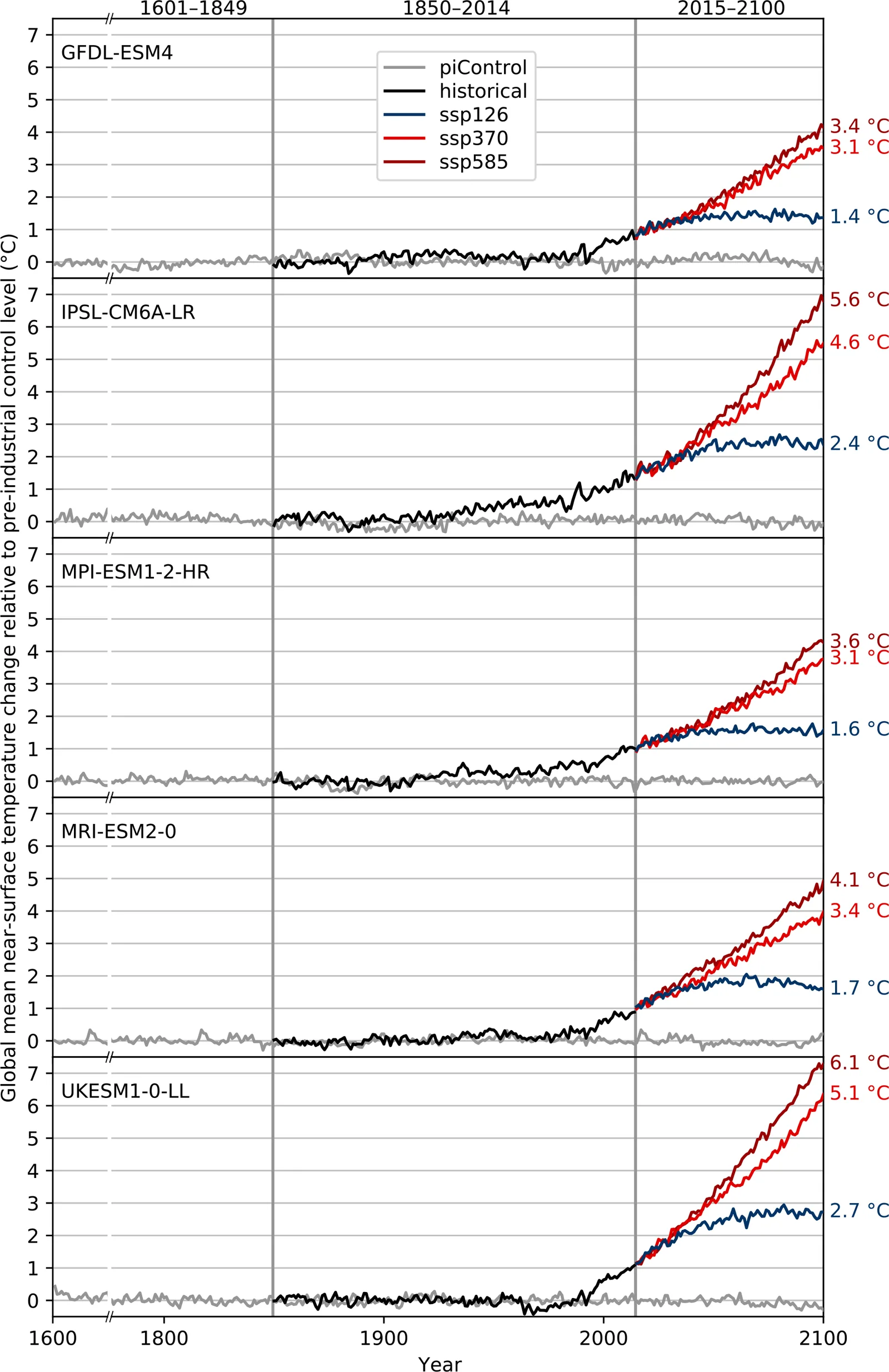
- Group I covers the pre-industrial period (1601–1849) and the historical period (1850–2014). Group II covers 2015–2100 under SSP1-2.6, SSP3-7.0 and SSP5-8.5, with human forcing fixed.
- The five models are GFDL-ESM4, IPSL-CM6A-LR, MPI-ESM1-2-HR, MRI-ESM2-0 and UKESM1-0-LL. Their mean ECS of 3.7 °C and TCR of 2.0 °C match the CMIP6 multi-model mean.
- GFDL-ESM4 projects the weakest warming and UKESM1-0-LL the strongest. Under SSP5-8.5, 2100 temperature is about 3 °C higher in UKESM1-0-LL.
- Running the bias adjustment in a 31 d running window removes the jumps at month boundaries that month-by-month adjustment creates.
- For relative humidity, the new version fixes the supersaturation frequency at the observed level. This keeps the simulated climate change signal better preserved.
Limitations
- Coastal water levels are not yet provided, so impact simulations that need them cannot be run yet.
- The default ocean data are not bias-adjusted. The de-biased ocean version uses monthly fluxes, so it does not keep the daily variability of the original models.
- Two of the five models have ECS above the AR6 likely range, so users should keep their strong warming in mind. Lightning that varies with climate is available for only one model.
Glossary
- Climate-related forcings (CRF): Climate inputs for impact models: atmosphere and ocean data, coastal water levels, and CO2 and methane levels.
- Direct human forcings (DHF): Human-driven inputs such as land use, population, and farming and water management.
- Bias adjustment: A statistical correction that makes climate model output match the observed distribution over a reference period.
- Equilibrium climate sensitivity (ECS): The long-term global warming a climate model produces for a doubling of CO2.
Original paper
Scenario set-up and the new CMIP6-based climate-related forcings provided within the third round of the Inter-Sectoral Model Intercomparison Project (ISIMIP3b, group I and II)
Geoscientific Model Development · 19 May 2026
AI-generated summary of the original article; changes were made. Check the original before relying on it.