Italian snow droughts cut summer runoff by about half, raise high-elevation plant growth and strain water supply
In 38 Italian mountain catchments, snow droughts, mostly warm and dry, shortened the snow season, roughly halved summer runoff, boosted high-elevation plant productivity, and hit water supply from huts to foothills.
Why it matters
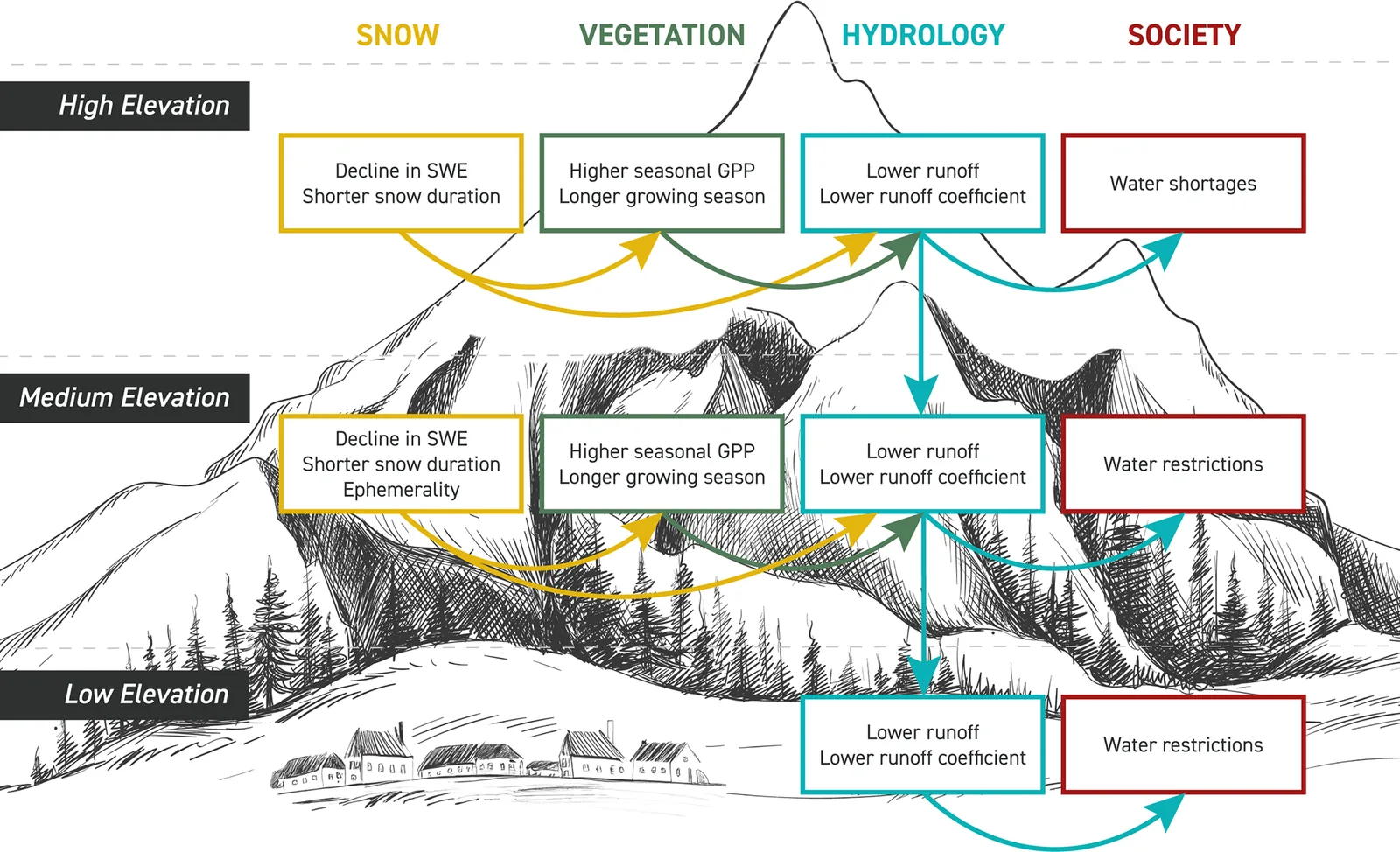
Snow droughts affect water, plants and people at once, so managing them sector by sector misses the links. Runoff losses grow downstream, while water-supply problems showed up at all elevations and were reported most by high huts. Planners need an approach that spans elevations and sectors.
What they did
The authors defined snow-drought years as those with average snow water equivalent below the 30th percentile in 38 Italian headwater catchments, over water years 2011–2023. They compared snow-drought and other years using snow reanalysis, streamflow, satellite and flux-tower measures of plant productivity, and greening date. For societal impacts, they built an inventory of emergency water restrictions from web-scraped news and local records for 2022–2023. They also surveyed mountain huts and received 113 answers.
Key findings
- Of 152 catchment snow droughts, 53 % were warm-dry and 22 % were warm-wet.
- Snow seasons shortened by as much as one month at median, with more melt-out episodes above 1000 m.
- Summer runoff fell by a median of about 50 % even though summer precipitation did not differ significantly, and the runoff ratio declined.
- Growing-season productivity was up to 10 % higher after snow droughts, mainly above 1500 m, with earlier greening; in 2022 a forest site gained but a grassland site lost productivity.
- Water restrictions hit 1291 municipalities, densest in the foothills; about 70 % of hut managers reported water-supply impacts and 28 % reported effects on opening dates.
Limitations
- Snow droughts were defined per water year, so multi-year events were not analysed, and the snow-drought sample is based on a short 13-year record.
- Societal data cover only 2022–2023, and the hut survey had a response rate of about 20 %.
- Satellite results may carry retrieval uncertainty and mix different ecosystems, and the flux-tower evidence comes from only two sites.
Glossary
- Snow drought: A period with snow water equivalent below normal.
- Snow water equivalent (SWE): The depth of water the snowpack would yield if melted.
- Gross Primary Production (GPP): The total carbon that plants take up through photosynthesis.
- Warm-dry snow drought: A snow drought with above-median temperature and below-median precipitation.
Original paper
Impacts of Mediterranean snow droughts on mountain socio-ecohydrology
Hydrology and Earth System Sciences · 14 September 2026
AI-generated summary of the original article; changes were made. Check the original before relying on it.