Long-window 4D-Var with NeuralGCM beats 20CRv3 using only surface pressure
A differentiable weather model lets a simple long-window 4D-Var, with no background-error term, fit surface-pressure observations and give analyses closer to ERA5 than 20CRv3 over three months.
Why it matters
Reanalysis systems need complex error estimates and heavy code. The authors report that a differentiable model can replace much of that with a short GPU program. If it holds up, sparse-observation reanalyses could become simpler and more accurate. This is a preprint and has not been peer reviewed.
What they did
The authors used the NeuralGCM weather model (2.8° deterministic version) and automatic differentiation to find the initial state that best fits real surface-pressure observations from land stations, ships and buoys. They dropped the usual background-error term and assumed a perfect model. Windows ran from 2 to 7 days, and the system cycled every 6 hours for 360 cycles from 1 January 2015. They compared the results with ERA5 and with 20CRv3, which assimilated the same observations.
Key findings
- Every window length gave smaller 500-hPa geopotential height error than 20CRv3, relative to ERA5.
- With a 4-day window, the minimum error was 10.65 meters versus 23.92 meters for 20CRv3, a 55% reduction.
- At the end of the 4-day window, which uses no future observations, error was 14.7 meters, 38% below 20CRv3.
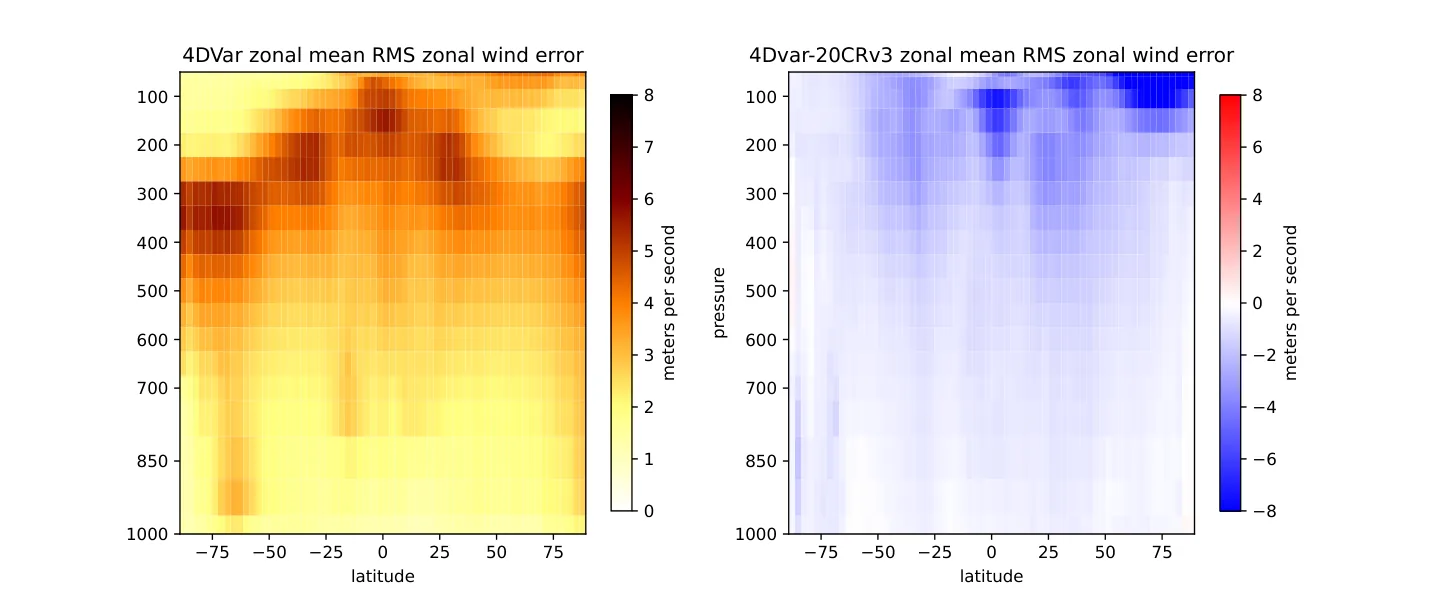
- Cycling stayed stable over three months. Zonal winds and precipitable water, which were not directly fitted, also looked closer to ERA5 than 20CRv3 did.
- Errors grew for windows longer than four days.
Limitations
- The method assumes a perfect model. The authors suspect model error, or overfitting at the window end, causes the loss of accuracy beyond four days, but they did not test this.
- Rapidly decaying noise at the start of the window is only partly controlled by the tendency penalty.
- Moisture variables were not optimized, and the test covers only three months of 2015 and is judged against ERA5 rather than independent truth.
Glossary
- 4D-Var: A method that finds the starting state whose model run best fits observations spread over a time window.
- Background-error term: The usual penalty that keeps the analysis close to a prior forecast, weighted by estimated forecast errors.
- Strong constraint: The assumption that the model is perfect, so the trajectory must follow the model exactly.
- Automatic differentiation: A software technique that computes exact gradients through a model, so no hand-written adjoint code is needed.
Original paper
Long-window 4DVar for reanalysis using a differentiable weather model
arXiv · 12 August 2026
This paper is a preprint. It has not been peer reviewed, and its results may change.
AI-generated summary of the original article; changes were made. Check the original before relying on it.