Marine heatwaves boost net CO2 uptake in global shelf seas, driven by polar regions
Across shelf seas worldwide, marine heatwaves raise net CO2 uptake by 11.0 ± 1.6%, because sea-ice loss and lower dissolved carbon in polar and subpolar waters outweigh weaker uptake in warmer regions.
Why it matters
Earlier work found marine heatwaves reduce CO2 uptake in the open ocean. This study shows coastal seas can respond in the opposite way overall. Projections of the coastal carbon sink under more extreme events need to treat high-latitude shelves separately from tropical and warm-current regions.
What they did
The authors used four observation-based CO2 flux datasets, with most weight on a product built for coastal seas. They defined marine heatwave months (at least 15 marine heatwave days in a month, after removing the SST warming trend) for 1985 to 2020. They split flux anomalies into drivers: sea ice, wind, and thermal and non-thermal changes in seawater CO2 pressure. They also used a global ocean biogeochemical model, ICON-Coast, to look at carbon budgets in the top 50 m.
Key findings
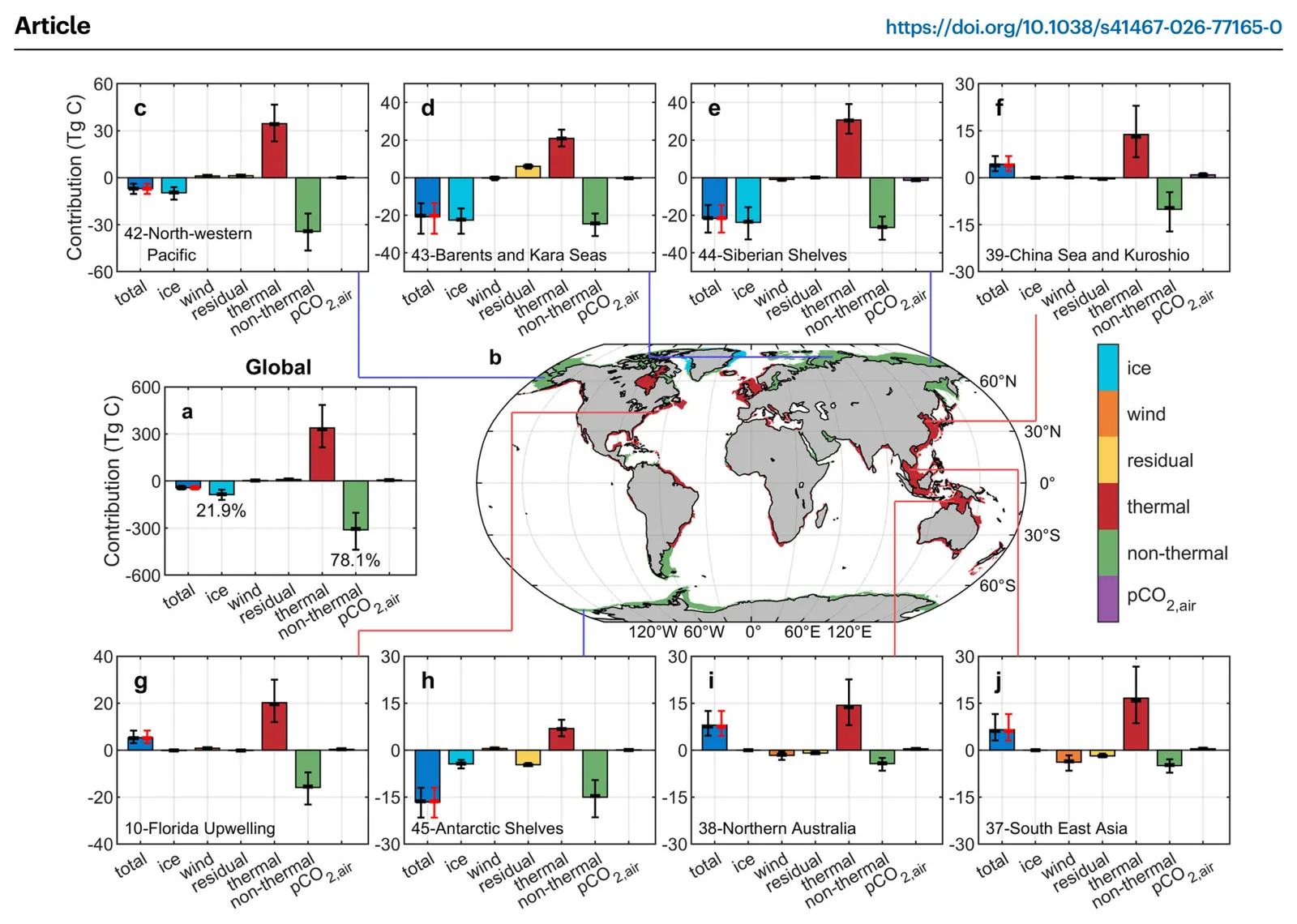
- Over 1985 to 2020, marine heatwave months added −40.02 Tg C to the flux, which is an 11.0 ± 1.6% increase in global coastal CO2 uptake. The three other datasets also show more uptake.
- Tropical shelf seas and western boundary current regions mostly show reduced uptake or more outgassing, driven by warming. Most polar and subpolar shelves show more uptake.
- Globally, the warming effect is offset by sea-ice loss (21.9%) and non-thermal changes in seawater CO2 pressure (78.1%).
- Lower dissolved inorganic carbon is the main cause of the non-thermal effect. In the model, net primary production rises in polar and subpolar shelves during heatwave months, which points to biological carbon fixation.
- Results held in all eleven tests with different heatwave-month thresholds. The signal-to-noise ratio is 2.38.
Limitations
- The model does not fully reproduce the observed uptake enhancement, and its flux anomalies are weaker. It also underestimates heatwave frequency at high latitudes.
- Reconstructed CO2 data are uncertain in areas with few observations or seasonal sea ice. Monthly data also exclude heatwaves that span two months but last under 15 days in each.
- The estimated enhancement depends on how heatwaves are detected. Detrending SST raised it from 4.3% to 11.0%.
Glossary
- Marine heatwave: A stretch of unusually high sea surface temperature, here at least five days above the local seasonal 90th percentile.
- Dissolved inorganic carbon (DIC): The total amount of dissolved CO2 and related carbon forms in seawater.
- Net primary production (NPP): The net amount of carbon that plankton fix by photosynthesis.
- Reynolds decomposition: A way to split an anomaly into parts caused by separate drivers and their interactions.
Original paper
Polar and subpolar shelf seas dominate enhanced coastal CO2 uptake during marine heatwaves
Nature Communications · 1 September 2026
AI-generated summary of the original article; changes were made. Check the original before relying on it.