Nine climate models disagree widely on dust forcing, but agree dust cuts precipitation
When nine CMIP6 models double dust emissions, they differ a lot in how much energy dust adds or removes, yet eight of nine show less precipitation.
Why it matters
Dust has probably increased since the industrial era, but models represent it in very different ways. The authors argue that this makes dust forcing uncertainty likely underestimated in AerChemMIP. They also suggest dust alone could reduce precipitation by an amount comparable to anthropogenic black carbon.
What they did
The authors analysed the piClim-2xdust experiment from AerChemMIP. Nine Earth System Models doubled dust emissions with fixed sea surface temperatures, and each ran at least thirty years against a control run. They split the effective radiative forcing into direct (dust-radiation) and cloud (dust-cloud) parts for the seven models that gave the needed output. They also used an atmospheric energy budget to explain precipitation changes.
Key findings
- Net direct forcing ranged from -0.56 to 0.05 W m−2. Models with less absorbing dust and less coarse dust were the most negative.
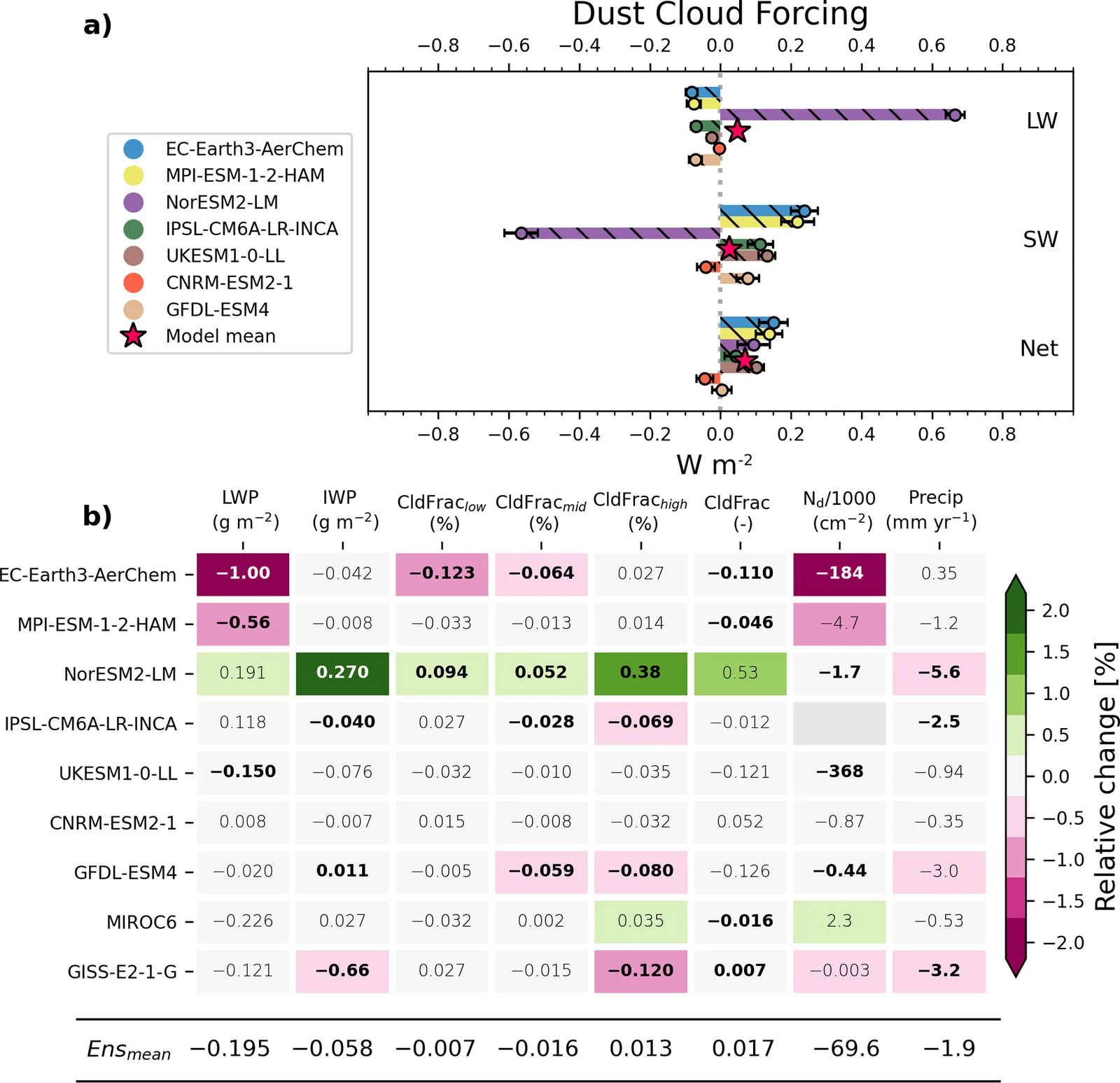
- Cloud forcing ranged from -0.02 to 0.2 W m−2 in the abstract. Most models were positive, but their longwave and shortwave parts differed.
- NorESM2-LM was the outlier. Dust increased its cirrus clouds, giving a longwave cloud forcing of 0.66 W m−2 and a shortwave cloud forcing of -0.56 W m−2.
- Eight of the nine models showed less precipitation. Strongly absorbing dust reduced it through less clear-sky atmospheric radiative cooling, and NorESM2-LM did so through cirrus clouds.
- Forcing efficiency differed by a factor of ten among models. Combined dust absorption and cirrus effects could cut precipitation by up to about 10 mm yr−1, versus 15 mm yr−1 for black carbon.
Limitations
- The setup is idealised. Sea surface temperatures are fixed, anthropogenic aerosols are at pre-industrial levels, and emissions are doubled uniformly, so results cannot be compared directly with historical forcing. Only the fast precipitation response is captured.
- Most models lack aerosol-aware ice nucleation, and only one of the nine includes longwave scattering. Cloud forcing consistency therefore reflects missing processes, not low uncertainty, and the standard output could not diagnose some effects.
- Direct and cloud forcing could only be separated for seven of the nine models. Some key diagnostics, such as CCN, were often missing.
Glossary
- DuERF: Dust effective radiative forcing: the change in top-of-atmosphere energy balance caused by the dust perturbation after fast adjustments.
- Atmospheric radiative cooling (ARC): The difference between net radiative flux changes at the top of the atmosphere and at the surface, which sets how much the atmosphere cools by radiation.
- Ice nucleating particles (INP): Particles, such as dust, that help ice crystals form in clouds.
- Perturbation parameter ensemble (PPE): A set of runs of one model in which many parameters are varied together to map out uncertainty.
Original paper
Dust radiative forcing in CMIP6 Earth System models: insights from the AerChemMIP piClim-2xdust experiment
Atmospheric Chemistry and Physics · 21 October 2025
AI-generated summary of the original article; changes were made. Check the original before relying on it.