Ocean reanalyses show Atlantic heat transport falling since 1993, but with wide uncertainty
Seventeen ocean reanalyses roughly match observed Atlantic heat transport, mostly run low in the mean, and point to a decline since the early 1990s whose size is uncertain.
Why it matters
Reanalyses are used to study how the ocean moves heat, but they were never checked against all the Atlantic and Arctic monitoring sections in one consistent way. The results show where they can be trusted, such as RAPID and the Greenland-Scotland Ridge, and where they cannot, such as OSNAP. They also warn users of one-degree products to include the parameterized eddy terms. Otherwise they get artificial biases.
What they did
The authors computed heat transport from 17 global ocean reanalyses at sections across the Atlantic and Arctic gateways. They compared the results with mooring and inverse-model observations and with estimates from the ocean heat budget, which combines surface heat fluxes, ocean heat content change and sea-ice terms. They checked the mean, the seasonal cycle, monthly and 12-month variability, and linear trends. Uncertainty was taken as twice the spread across products.
Key findings
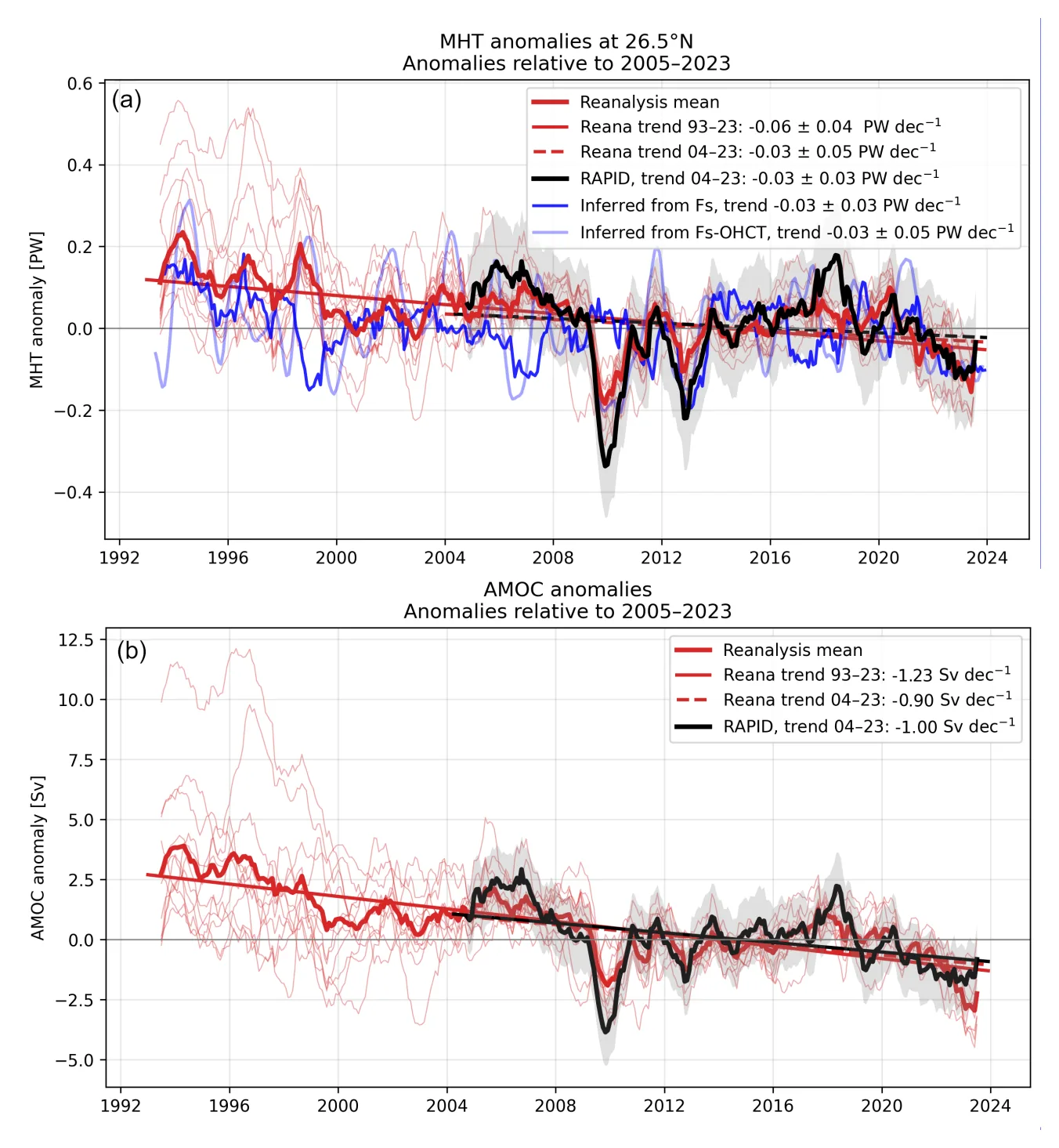
- Reanalyses and observations generally agree within two sigmas, but the reanalysis mean runs low. At RAPID (26.5°N) it is 0.91 ± 0.16 PW against 1.21 ± 0.12 PW observed and 1.18 ± 0.09 PW from the heat budget.
- Most reanalyses underestimate heat transport through Fram Strait and overestimate it through the Barents Sea Opening. The two errors partly cancel in the total, so the split between the Arctic inflow pathways is uncertain.
- Agreement is best at RAPID and the Greenland-Scotland Ridge, with correlations around 0.75–0.8 and 0.65–0.75. OSNAP is the hardest section.
- For one-degree reanalyses, using only temperature and velocity output gives artificial biases. Adding the parameterized eddy and diffusive terms removes them. The highest-resolution products do not consistently beat the quarter-degree ones.
- At 26.5°N the ensemble shows a 1993–2023 decline of −0.058 ± 0.039 PW decade−1, and all 14 reanalyses in the trend analysis show a negative trend. Over 2004–2023 the decline is about 0.03 PW decade−1, close to the RAPID observed trend.
Limitations
- Observational estimates have their own biases and method assumptions, so part of the low bias in reanalyses may not be real. The authors note that RAPID-style geostrophic methods can give higher transport than direct model calculation.
- Monthly output was used, which leaves out sub-monthly covariance terms. The heat-budget estimates are not fully independent of the reanalyses and do poorly at SAMBA.
- Trends before the Argo era are very uncertain and are affected by spin-up and assimilation shifts. Most heat-budget trends are not statistically significant, and the record may be too short to separate long-term change from natural variability.
Glossary
- Meridional heat transport (MHT): The amount of heat the ocean carries north or south across a line of latitude.
- AMOC: The Atlantic Meridional Overturning Circulation, the large north-south loop of Atlantic currents that carries warm water north.
- Ocean reanalysis: A model-based reconstruction of the past ocean state that is adjusted to fit observations.
- Bolus transport: Heat carried by small-scale eddies that coarse models cannot resolve and instead estimate with a parameterization.
Original paper
Atlantic Meridional Heat Transports from Ocean Reanalyses, Monitored Sections and Heat Budget Constraints
EGUsphere · 14 September 2026
This paper is a preprint. It has not been peer reviewed, and its results may change.
AI-generated summary of the original article; changes were made. Check the original before relying on it.