Plants tapping groundwater help explain lower summer flow in Colorado River headwaters
In Colorado River headwaters, warm summers cut late-summer streamflow about as much as low snowpack does, apparently because plants draw on shallow groundwater that would otherwise feed streams.
Why it matters
Water supply forecasts lean on winter snowpack. This work suggests summer temperature also controls how much water reaches streams, even in snowy years. Models and managers that ignore plant use of groundwater may overestimate supply as warming continues.
What they did
The authors instrumented an 81-ha headwater catchment in the East River watershed. They measured evapotranspiration, sap flow, soil moisture, shallow groundwater and streamflow over two growing seasons, 2023 and 2024. They used daily fluctuation patterns, tied to sunlight, to tell which water source plants used. They then analysed 625 gage-years of late-summer flow from 18 minimally impacted headwater catchments, paired with nearby SNOTEL snowpack, temperature and rain data from 1986 to 2024.
Key findings
- Evapotranspiration stayed high while shallow soil moisture fell to record lows. It never dropped below 25% of potential, which contradicts the usual model assumption that it falls with soil moisture.
- Daily fluctuations in groundwater and streamflow became more negative in long dry spells, while soil moisture fluctuations decoupled from them. This points to plants using groundwater.
- After rain recharged the soil, soil moisture fluctuations turned negative again and groundwater signals weakened. Plants appear to switch between sources.
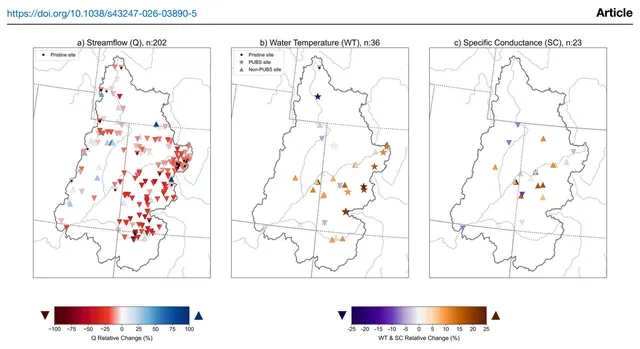
- Across 18 catchments, the warmest summers gave only 80% of median flow and the coolest gave over 118%. Warm summers gave 83% of the long-term average, compared with 79% for low-snowpack years.
- Warm summers cut flow from high-snowpack years to average levels, and cool summers raised flow from average-snowpack years.
Limitations
- Some uncertainty remains in attributing the summer temperature signal only to plant water use. Soil evaporation could vary more than assumed.
- The detailed mechanism was tested in one small catchment over two growing seasons. The basin-wide analysis is statistical and does not measure plant water sources directly.
- Spring and summer temperatures were moderately correlated, and the soil moisture signals may partly reflect sensor bias or hydraulic redistribution.
Glossary
- Evapotranspiration: Water returned to the air by plant transpiration and soil evaporation.
- Baseflow: The part of streamflow fed by groundwater rather than recent rain or melt.
- Diel cycle index: A daily correlation between sunlight and the hourly change in a water measure, positive for melt and negative for plant water loss.
- SNOTEL: A network of automated mountain stations measuring snowpack and weather.
Original paper
Vegetation groundwater use drives streamflow declines in Colorado River headwaters
Communications Earth & Environment · 14 September 2026
AI-generated summary of the original article; changes were made. Check the original before relying on it.