PM2.5 in south China fell 2007–2020 while nitrate's share doubled and aerosol acidity dropped
Winter PM2.5 at a Pearl River Delta background site fell from 87.1 to 34.0 µg m−3 over 14 years, but nitrate dropped more slowly than sulfate, so secondary species and nitrate now matter more.
Why it matters
Cutting sulfur first changed what the particles are made of, so nitrate and organic matter are now the main targets. Lower acidity and less aerosol water may also slow the formation of secondary particles, including secondary organic aerosol. Standard visibility equations overestimated light extinction in polluted conditions, so local settings are needed.
What they did
The authors collected 532 daily PM2.5 filter samples at Wanqingsha, a regional background site in the Pearl River Delta, mostly from October to December in 2007–2020. They measured carbon and water-soluble ions, split organic carbon into primary and secondary parts with a Bayesian method, and used the ISORROPIA-II model to estimate aerosol pH and liquid water. They also reconstructed light extinction with locally tuned parameters. Trends came from Theil–Sen slopes and Mann–Kendall tests.
Key findings
- PM2.5 fell from 87.1 ± 15.5 to 34.0 ± 11.3 µg m−3, at -4.0 µg m−3 yr−1.
- Secondary species made up 54 %–79 % of PM2.5, and their share rose from 57 % to 73 % as air got cleaner.
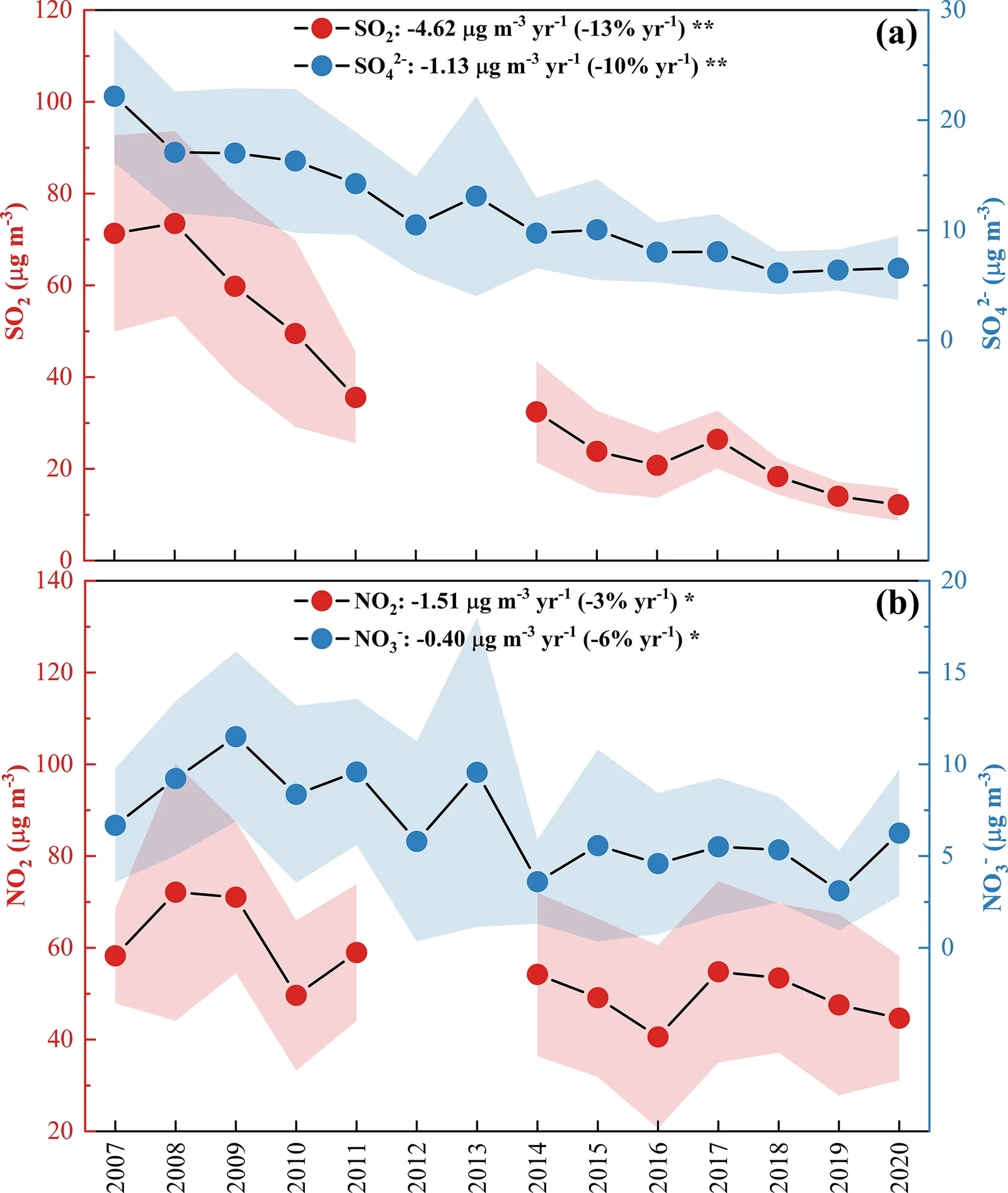
- Sulfate fell by -10 % yr−1 versus -13 % yr−1 for SO2, while nitrate fell by -6 % yr−1 versus -3 % yr−1 for NO2. Sulfur oxidation rate rose and nitrogen oxidation rate fell. By 2020 nitrate’s share had doubled from 2007.
- Aerosol pH rose from 1.51 ± 1.07 to 2.86 ± 0.49, and aerosol liquid water fell from 20.6 ± 10.0 to 9.5 ± 3.9 µg m−3.
- Light extinction fell by -21.44 Mm−1 yr−1. The revised IMPROVE equation gave higher values than the local scheme, mainly under heavy pollution.
Limitations
- Only wintertime samples from one site were used, and gas-phase data for ISORROPIA-II were missing, so pH came from an iterative workaround.
- Nitrate and ammonium may be underestimated because ammonium nitrate evaporates during sampling. The authors expect this to be steady over time.
- Links between acidity, liquid water and SOA decline rest on correlations. The year 2020 had COVID-19 lockdowns, though a sensitivity test showed little bias.
Glossary
- SOR / NOR: Sulfur and nitrogen oxidation ratios, the share of SO2 or NO2 that has turned into sulfate or nitrate.
- ALWC: Aerosol liquid water content, the water held in particles, which affects how fast secondary species form.
- Secondary species: Particle components formed in the air from gases, such as sulfate, nitrate, ammonium and secondary organic aerosol.
- ISORROPIA-II: A thermodynamic model that estimates aerosol pH and liquid water from composition, temperature and humidity.
Original paper
Long-term Trends in PM 2.5 Chemical Composition and Its Impact on Aerosol Properties: Field Observations from 2007 to 2020 in Pearl River Delta, South China
Atmospheric Chemistry and Physics · 26 October 2025
AI-generated summary of the original article; changes were made. Check the original before relying on it.