Radar-imaged ice layers could be built into a continent-wide age–depth model of Antarctica
Six decades of radar surveys have recorded dated layers inside Antarctic ice, but only a small part has been traced, and a community effort is needed to turn it into a continent-wide age model.
Why it matters
Dated internal layers cover much more area than ice cores or seabed sediment records. They can help pick new ice-core sites and estimate snowfall and basal melting. They can also give ice-sheet models a better target to be tuned against, which may reduce uncertainty in projections of future ice-sheet change.
What they did
The authors are the AntArchitecture community, and this is a review article. They describe how radio-echo sounding data are processed, how internal layers are traced and dated at ice cores or by modelling, and which surveys exist. They then summarise how layers have been used so far and set out a pathway for expanding the work.
Key findings
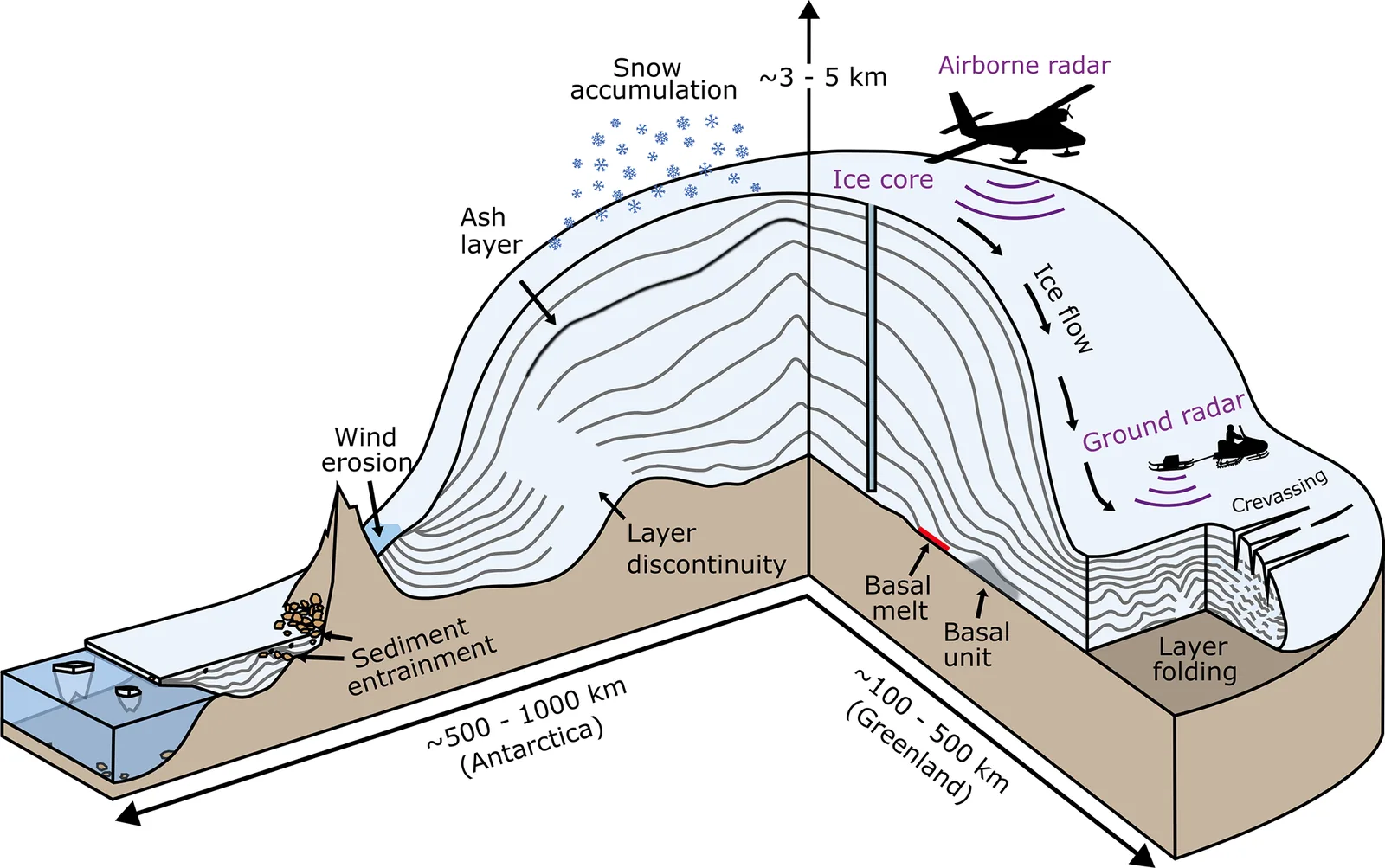
- Many layers seen by radar are isochrones, meaning each marks ice of one age, and they can be dated where they meet ice cores.
- In East Antarctica, isochrones have been traced back as far as 705 kyr. In West Antarctica, the dated record reaches up to 25 ka.
- Some layers are found widely, for example one dated to about 4.7 ka across West Antarctica, and one at about 73 ka linked to the Toba eruption.
- Traced radiostratigraphy covers only a small part of the available radar data, because most data were processed to find the bed rather than the layers.
- Layers have been used to link ice cores, reconstruct snow accumulation, infer basal melting and geothermal heat, read past ice flow, and test ice-sheet models.
Limitations
- Radar data from many operators are not standardised, and it is unknown how much layering can be traced through all the existing profiles.
- Tracing deep layers still mostly needs manual work, because machine-learning methods are in their infancy and work best on near-surface layers.
- Layer-derived ages will never match ice-core precision, and layers are hard to trace where ice flow disrupts them or where basal melting is high.
Glossary
- Radio-echo sounding (RES): A method that sends radio waves into ice and records the echoes to image the ice’s interior and bed.
- Internal-reflection horizon (IRH): A layer inside the ice that reflects radio waves, often because of changes in acidity or density.
- Isochrone: A radar layer treated as ice of a single age, which can be dated where it meets an ice core.
- Radiostratigraphy: The stack of layers seen in radar profiles of an ice sheet.
Original paper
Review article: AntArchitecture – building an age–depth model from Antarctica's radiostratigraphy to explore ice-sheet evolution
The Cryosphere · 20 October 2025
AI-generated summary of the original article; changes were made. Check the original before relying on it.