Realistic particle size and mixing shift black carbon radiative forcing in a coal region
In an industrial coal region of Shanxi, using the observed three-peak particle size and internal mixing, instead of simple standard assumptions, changes estimated absorption and radiative forcing by amounts comparable to local greenhouse gas forcing.
Why it matters
Models and satellite retrievals often assume one lognormal size peak and fixed mixing. This study finds those choices bias per-particle absorption and the column particle number needed to match observed aerosol optical depth. The authors also offer a fast regression fit that models could use to adjust forcing in other coal-heavy regions.
What they did
The team measured black carbon mass at several wavelengths, particle size (0.25 to 2.0 µm) and column aerosol optical depth in Shanxi, China, in August 2022. They used Mie theory with a core-shell particle (absorbing core, non-absorbing shell) to compute per-particle optical properties. They tested two ways of assigning black carbon mass (uniform and non-uniform) and three size treatments (observed, one lognormal, three lognormals). They then fed the results into the SBDART radiative transfer model to estimate forcing.
Key findings
- More than 95 % of size observations showed three peaks, near 0.25–0.28, 0.58–0.65 and 0.7–0.8 µm, unlike the single-peak assumption in many models.
- Single-lognormal and three-lognormal size fits both gave per-particle single scattering albedo that differed from the observed-size results. The three-peak fit was closer to the observations.
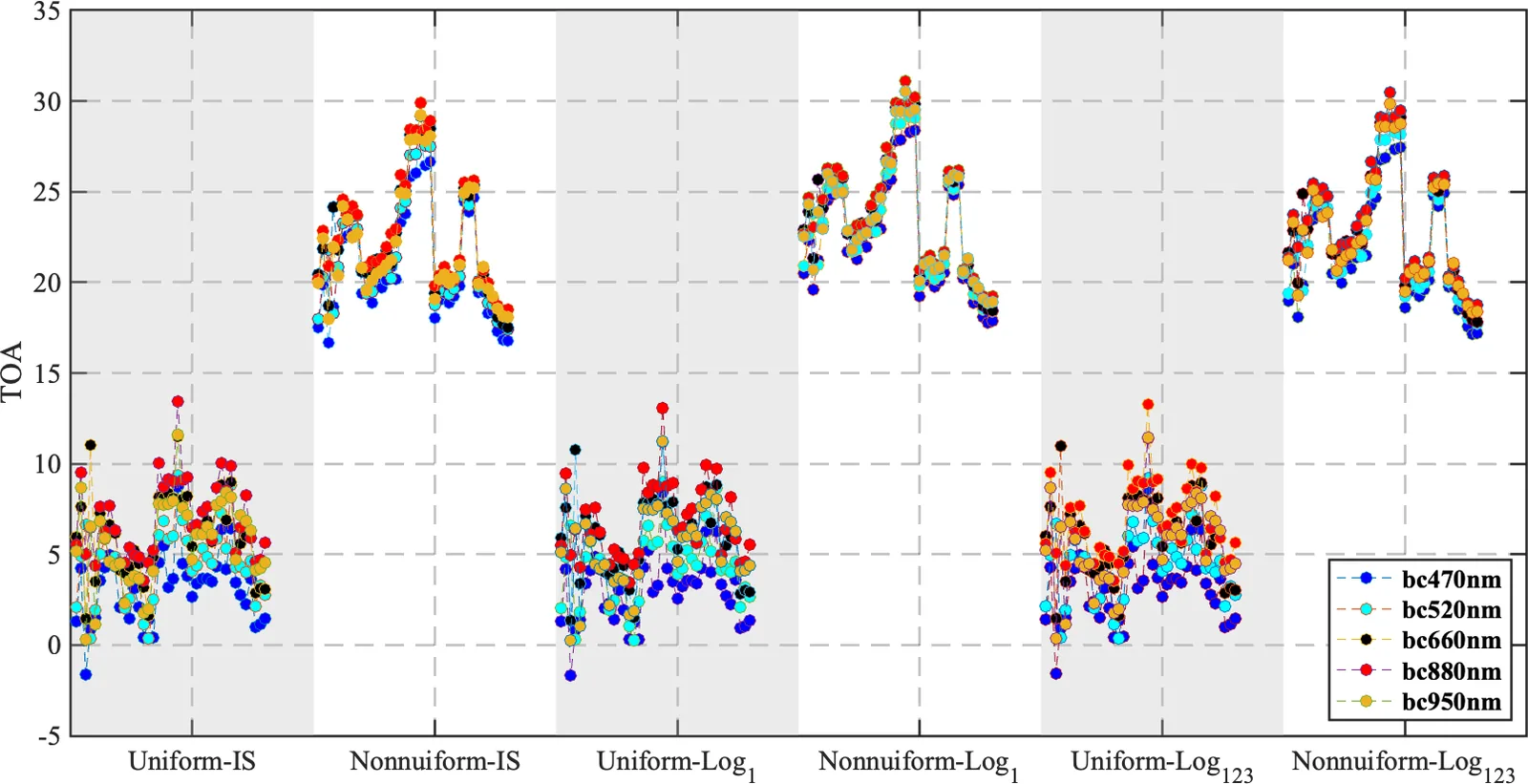
- Forcing at 880 nm under internal mixing ran 18.3–29.9 W m−2 with observed sizes, against 3.6–13.4 W m−2 for external mixing.
- Near-infrared (880 nm) inputs generally overestimated top-of-atmosphere forcing, and near-ultraviolet inputs usually gave the lowest values.
- A regression that combines single scattering albedo, optical depth and size fit forcing better than one using albedo alone. At 470 nm, RMSE fell from 2.27 to 1.77 W m−2 and R2 rose from 0.38 to 0.83.
Limitations
- Observations cover only one month and one site in the basin, so seasons and other locations are not represented.
- The two mixing assumptions are bounding cases, not the true mixing state, and the shell composition was not measured in detail.
- Some bias remains in every size treatment, and the three-peak fit does not fully reproduce the observed variability.
Glossary
- Single scattering albedo (SSA): The share of light removed by a particle that is scattered rather than absorbed; lower values mean more absorption.
- Aerosol optical depth (AOD): A measure of how much sunlight airborne particles block over the whole air column.
- Core-shell mixing: A particle model with an absorbing black carbon core wrapped in a non-absorbing coating such as sulphate.
- Radiative forcing: The change in the energy balance, in W m−2, caused by a factor such as aerosols.
Original paper
In-tandem multi-waveband particulate absorption and size observations yield substantial changes in radiative forcing over industrial Central China
Atmospheric Chemistry and Physics · 2 March 2026
AI-generated summary of the original article; changes were made. Check the original before relying on it.