Review compares four ways to model microplastics in estuaries and sets out good practice
Most estuary microplastic models use particle tracking, but all approaches are limited by scarce field data for inputs and validation, so models should be kept as simple as the question allows and tested with sensitivity runs.
Why it matters
Estuaries can both trap and export plastic, and field sampling alone cannot show where particles go. Process-based models can fill that gap. This review helps modellers pick an approach, set parameters, and avoid common weaknesses in validation.
What they did
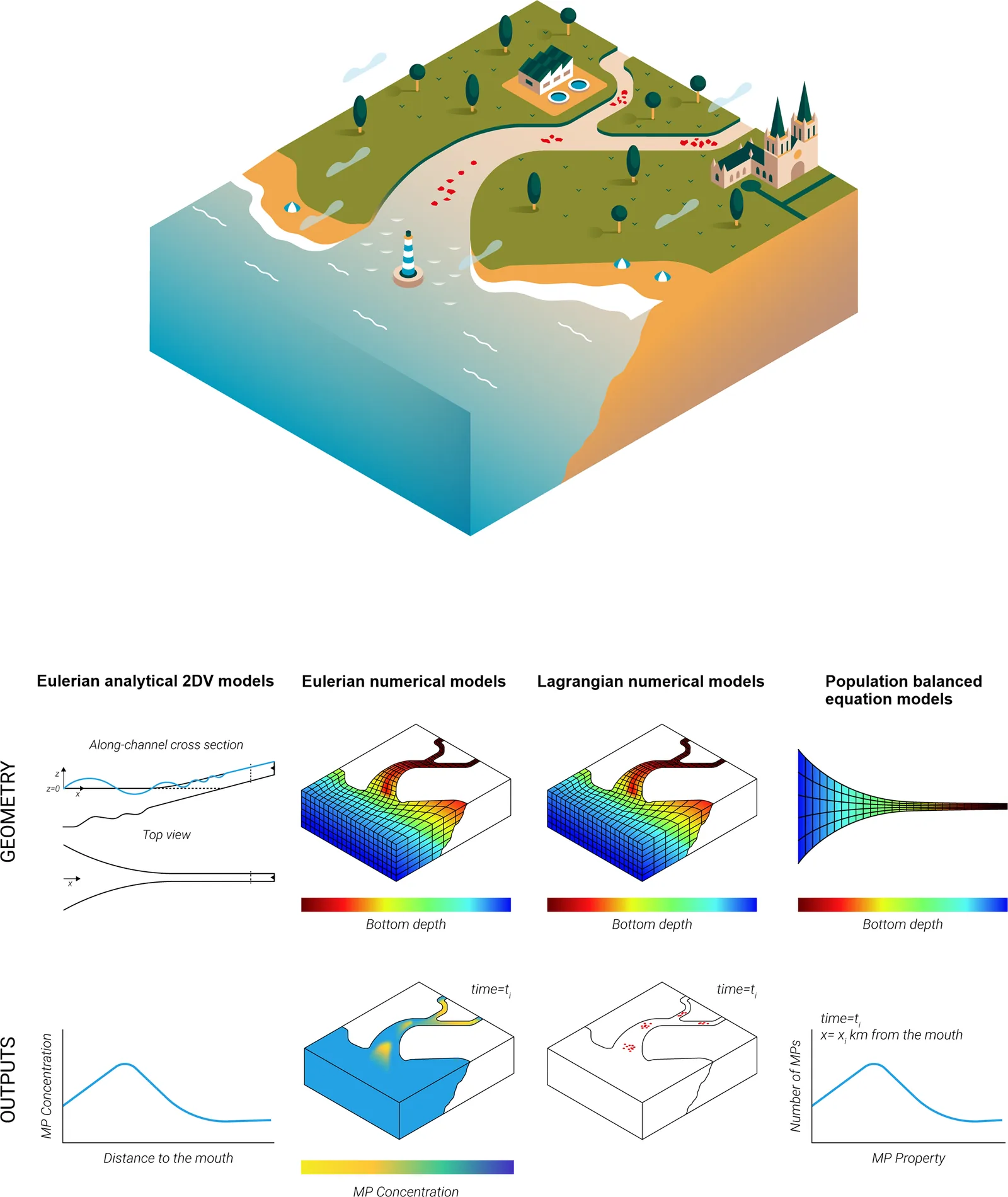
The authors reviewed published process-based studies of microplastic transport in estuaries, found through literature databases. They grouped them into four approaches: idealized Eulerian 2DV models, Eulerian numerical models, Lagrangian numerical models and a new population balance method. They compared the processes, parameter choices, set-ups and validation in each study, and then drew up recommendations.
Key findings
- Lagrangian particle tracking is the most used approach: seven estuary studies, four with offline and three with online coupling.
- Only two studies used Eulerian numerical models, and three used idealized Eulerian 2DV models. These idealized models are cheap to run but ignore lateral transport and long-term change.
- Lagrangian models suit floating particles, source-to-sink questions and backward tracking. Eulerian models handle resuspension and varying water density more easily.
- Settling speeds, mixing coefficients and release inputs vary widely between studies. In the Garonne tidal river, trapping was very sensitive to settling velocity.
- The population balance approach covers a continuous range of particle sizes and needed less computing time than a discrete-class Eulerian model in one comparison, but it is still at an early stage.
Limitations
- Few observations of microplastic concentrations exist, so transport modules are rarely well validated and many parameters are exploratory.
- Release locations, amounts and timing are poorly known, and none of the earlier studies fully represented realistic releases.
- Parameterizations for flocculation, biofouling and refloating lack experimental support, and few studies ran sensitivity tests.
Glossary
- Eulerian model: A model that tracks how particle concentration changes over time at fixed points in space.
- Lagrangian model: A model that follows individual particles as they move through the water.
- Population balance equation (PBE): A method that describes how the number of particles of each size changes over time, using a continuous size range.
- Terminal velocity: The steady speed at which a particle sinks or rises in water.
Original paper
Modelling microplastic dynamics in estuaries: a comprehensive review, challenges, and recommendations
Geoscientific Model Development · 15 October 2025
AI-generated summary of the original article; changes were made. Check the original before relying on it.