Saharan dust cut Argentière Glacier's 2022 mass balance by 0.63 m w.e., double earlier years
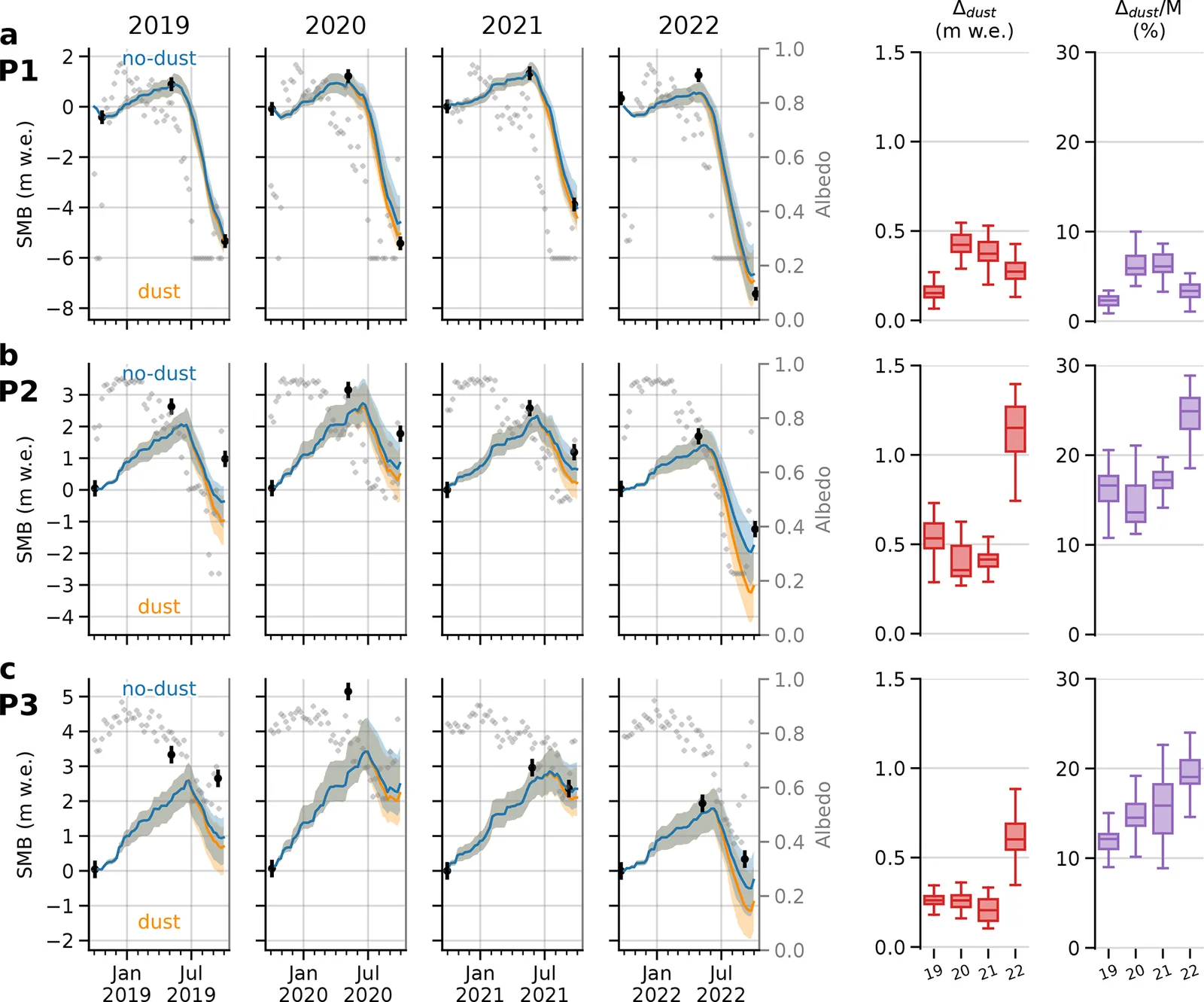
In a snow model of Argentière Glacier, mineral dust lowered annual surface mass balance by 0.31 to 0.45 m w.e. in 2019–2021 and by 0.63 m w.e. in 2022, most strongly just above the previous summer's snowline.
Why it matters
Dust in snow accounts for between 8 % and 16 % of summer melt on this glacier, so models that leave it out will likely overstate mass balance. Old firn layers that hold dust from earlier years can resurface and speed up melt later. Simulations therefore need a memory of past dust deposition and past weather.
What they did
The authors ran the SURFEX/ISBA-Crocus snow model at 250 m resolution over the glacier for 2019–2022, with a radiative transfer scheme that tracks dust and black carbon in each snow layer. They drove it with an ensemble of 40 perturbed weather forcings built from the SAFRAN reanalysis, adjusted with local observations. Dust deposition came from a regional climate model. They compared paired runs with and without the dust effect on albedo. They checked results against stake measurements, Sentinel-2 images and satellite-derived mass balance from Pléiades.
Key findings
- Glacier-wide, dust lowered annual mass balance by 0.31, 0.42 and 0.45 m w.e. in 2019, 2020 and 2021, and by 0.63 m w.e. [0.54, 0.69] in 2022.
- At single locations the 2022 impact reached up to 1.2 m w.e. The largest values were just above the 2021 end-of-summer snowline, where dusty firn from earlier years came back to the surface.
- Dust accounted for 8 % to 16 % of summer melt depending on the year. In 2022 the glacier-wide share was 13.2 % of total melt.
- Raising the black carbon scavenging efficiency from 0.2 to 1.0 doubled the dust impact, from 0.63 to 1.3 m w.e.
- The dust impact was not tied only to the current year’s deposition. In 2021 more dust fell (15.1 g m-2) than in 2022 (13.1 g m-2), yet the 2022 impact was larger.
Limitations
- Avalanche snow redistribution was not modelled. The model underestimates accumulation at the base of the headwalls, so results there need caution.
- Black carbon scavenging and dust absorption efficiency are very uncertain and can strongly change the dust impact. Dust deposition was also assumed uniform over the glacier.
- Dust was simulated only in snow and firn, not in ice, so the impact in the ablation area is probably underestimated.
Glossary
- Surface mass balance (SMB): The net gain or loss of snow and ice at a glacier’s surface over a period, given in metres of water equivalent (m w.e.).
- Light-absorbing particles (LAPs): Particles such as mineral dust and black carbon that darken snow and make it absorb more sunlight.
- Scavenging efficiency: How readily particles are carried down through the snowpack by meltwater instead of staying at the surface.
- Firn: Old snow that has survived at least one summer and has not yet turned to ice.
Original paper
Saharan dust impacts on the surface mass balance of Argentière Glacier (French Alps)
The Cryosphere · 29 October 2025
AI-generated summary of the original article; changes were made. Check the original before relying on it.