Saharan dust reached Monte Cimone on 15.8 % of days over 21 years, with no trend
Over 2003–2023, Saharan dust reached an Italian mountain station on about 58 days a year, with no trend, and longer summer events brought the largest coarse-particle rises.
Why it matters
The long record gives a baseline for judging future changes in dust transport towards the Mediterranean. It can also be used to test dust forecast models, such as Copernicus products. Dust events matter for air quality and for solar energy production.
What they did
The authors used 21 years of optical particle counter data from Monte Cimone (2165 m a.s.l., northern Italy). They flagged days when coarse particle counts rose well above a smoothed baseline and confirmed them with 7-day backward air trajectories passing over the Sahara. They turned counts into coarse particle mass (PMcoarse), grouped consecutive days into events, and compared the mass with CAMS reanalysis. They also ran a trend test and estimated uncertainties.
Key findings
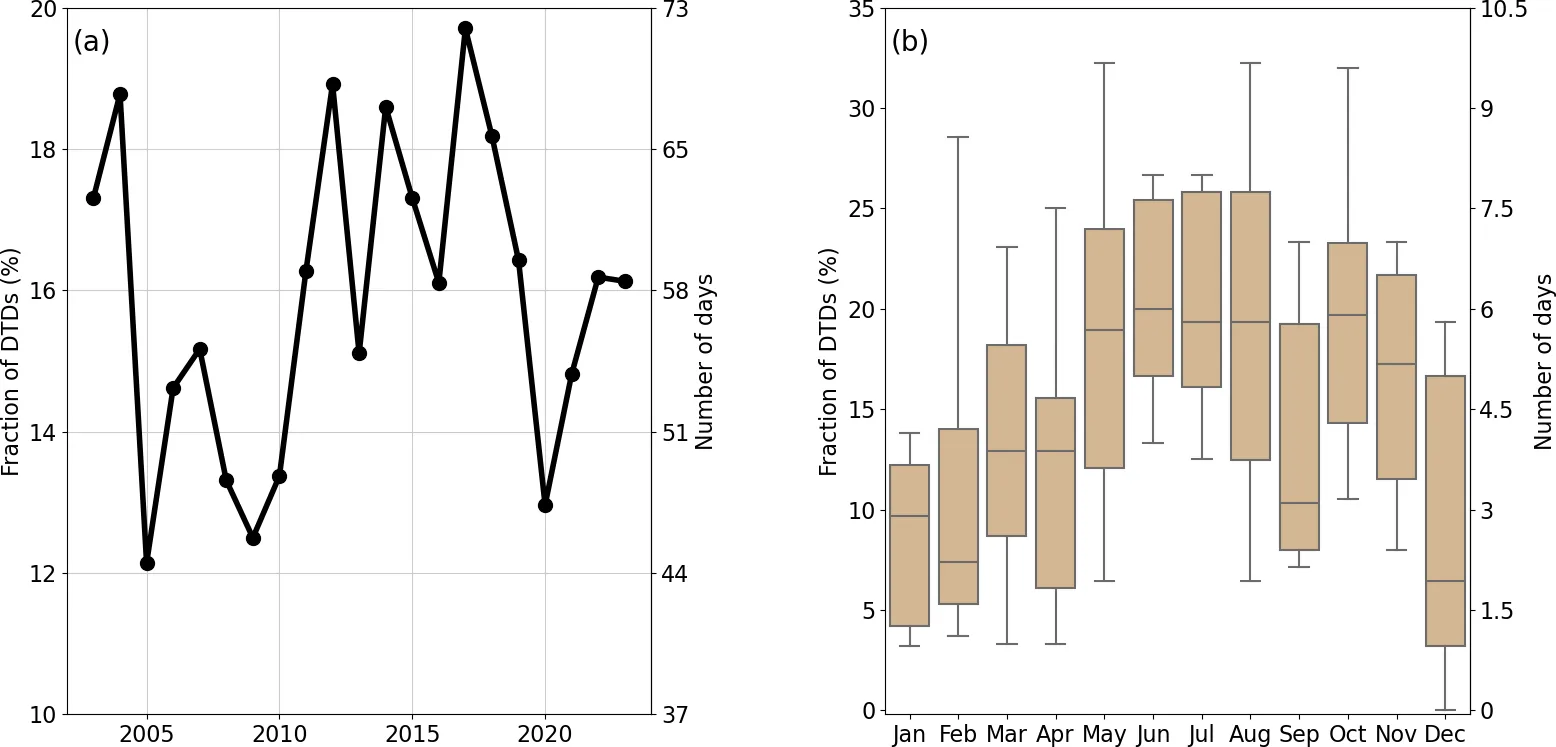
- 15.8 % of valid days (1004 d) were dust transport days, about 58 d per year. The annual fraction ranged from 12 % to 19.5 % with no significant trend.
- Dust days peaked from May to August and again in October and November, at up to 20 %. Winter values were lowest, at 6 % to 10 %.
- Most trajectory points crossed the Central Sahara (72 %), then the Western Sahara (19.2 %).
- Median PMcoarse on dust days was about one order of magnitude above the background. The enhancement factor was higher in winter than in summer.
- Winter events were mostly 1 d long, while events of 4 d or more were most common from May to November. The median peak enhancement rose from 2.28 µg m−3 for 1 d events to 19.47 µg m−3 for events of at least 4 d. The share of events above the WHO threshold of 45 µg m−3 rose from 5.8 % to 24.1 %.
Limitations
- Missing data left 81 % of days valid, and PMcoarse has large uncertainty (±61 % on dust days). The inlet was also modified during the record.
- Only PMcoarse was used, not PM10, so the WHO threshold exceedance figures are lower limits. Some seasonal duration groups have very few events.
- CAMS reanalysis underestimates winter values and extreme events, and the causes of the autumn peak and of the roughly 12-year cycle remain unclear.
Glossary
- Dust transport day (DTD): A day when coarse particle counts spike above the baseline and air trajectories passed over the Sahara.
- PMcoarse: Mass concentration of particles larger than 1 µm in diameter.
- Enhancement factor (EF): The dust-day rise in PMcoarse divided by the background median.
- Backward trajectory: A modelled path showing where an air parcel came from before reaching a site.
Original paper
Saharan dust transport event characterization in the Mediterranean atmosphere using 21 years of in-situ observations
Atmospheric Chemistry and Physics · 12 November 2025
AI-generated summary of the original article; changes were made. Check the original before relying on it.