Siberian Arctic upper-ocean currents now follow sea ice and stratification more tightly
Over 2013–2023 the upper Siberian Arctic Ocean showed no trend in current speed or shear, but its seasonal cycle strengthened and now tracks sea ice closely, with near-inertial currents dominating in summer.
Why it matters
Shear drives vertical mixing, which affects halocline weakening and the spread of Atlantic water (atlantification). The results show that near-inertial currents matter in summer and that deep winter ventilation spreads wind energy far down. The authors say climate models need mixing schemes that capture this.
What they did
The authors analysed current records from nine moorings in the Siberian Arctic, mostly from September 2021 to September 2023. They added a long record from the MB1 mooring, which began in 2002 and was compared across 2004–2010 and 2013–2023. They paired the currents with satellite sea ice concentration, ERA-5 winds and temperature and salinity profiles. They also ran a 1-D ocean model (GOTM) with summer and winter wind forcing.
Key findings
- Near-inertial currents explained on average 54 % of total current speed and 40 % of shear, and 64 % of speed and 50 % of shear in summer.
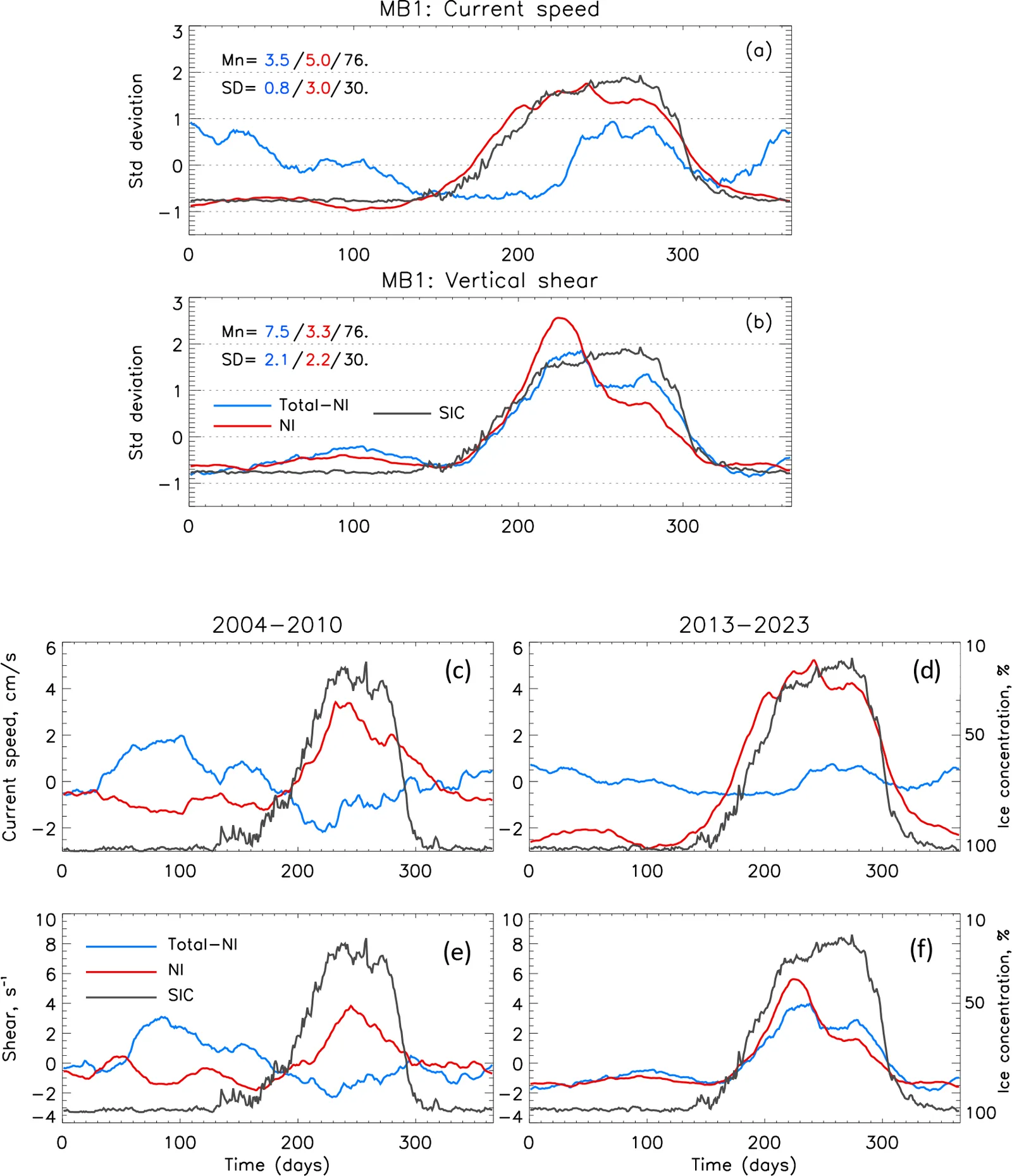
- At MB1 there was no trend in current speed or shear from 2013 to 2023, though both were stronger than in 2004–2009. Wind speeds showed no significant change since the 1990s.
- Summers lengthened. The 80 % sea ice concentration transition now comes 20 d later in fall and six days earlier in spring.
- The seasonal range of near-inertial currents rose from 4.8 cm s−1 (2004–2010) to 8.0 cm s−1 (2013–2023). The correlation between seasonal ice concentration and shear went from -0.73 to -0.94.
- In summer a thin, strongly stratified surface layer concentrates wind energy near the surface. In winter, deep ventilation spreads it below 100 m.
Limitations
- Moorings had no temperature or salinity data in the top 20 m, so the authors used current and shear profiles to infer mixed-layer stratification.
- The subsurface (10–110 m) analysis covers only 2018–2021 because high-resolution data are lacking, and the authors say the physical mechanism linking currents and stratification at depth remains unclear.
- Compass errors in the Arctic can reach 30°, and the 1-D model cannot fully settle whether wind is the cause of the winter deep currents.
Glossary
- Near-inertial currents: Wind-driven oscillating currents with periods near the local inertial period, filtered here at 10–14 h.
- Atlantification: Growing influence of Atlantic-origin water in the Arctic Ocean, which weakens stratification and adds heat.
- Vertical shear: How fast horizontal current changes with depth, a key driver of mixing.
- Buoyancy frequency (N): A measure of how stable, or stratified, the water column is.
Original paper
Role of sea ice, stratification, and near-inertial oscillations in shaping the upper Siberian Arctic Ocean currents
Ocean Science · 25 November 2025
AI-generated summary of the original article; changes were made. Check the original before relying on it.