Slow-moving Mediterranean cyclones lift the deep chlorophyll maximum by tens of metres
Intense Mediterranean cyclones that move slowly and lose a lot of heat pull the deep chlorophyll layer upward, while nearshore chlorophyll rises mainly from runoff and currents.
Why it matters
Cyclones can inject nutrients into the sunlit layer of a nutrient-poor sea, especially in late summer and autumn. The results help explain how storms shape marine productivity in the Mediterranean. The authors say this matters for predicting productivity under changing cyclone patterns.
What they did
The authors studied twenty Mediterranean cyclones, both tropical-like and extratropical. They tracked pressure minima in ERA5 reanalysis to find slow-moving phases. They used Copernicus reanalysis, ARGO float profiles and Sentinel-2 images to follow chlorophyll a, nitrate, currents, mixed layer depth and heat fluxes. They compared offshore and nearshore responses.
Key findings
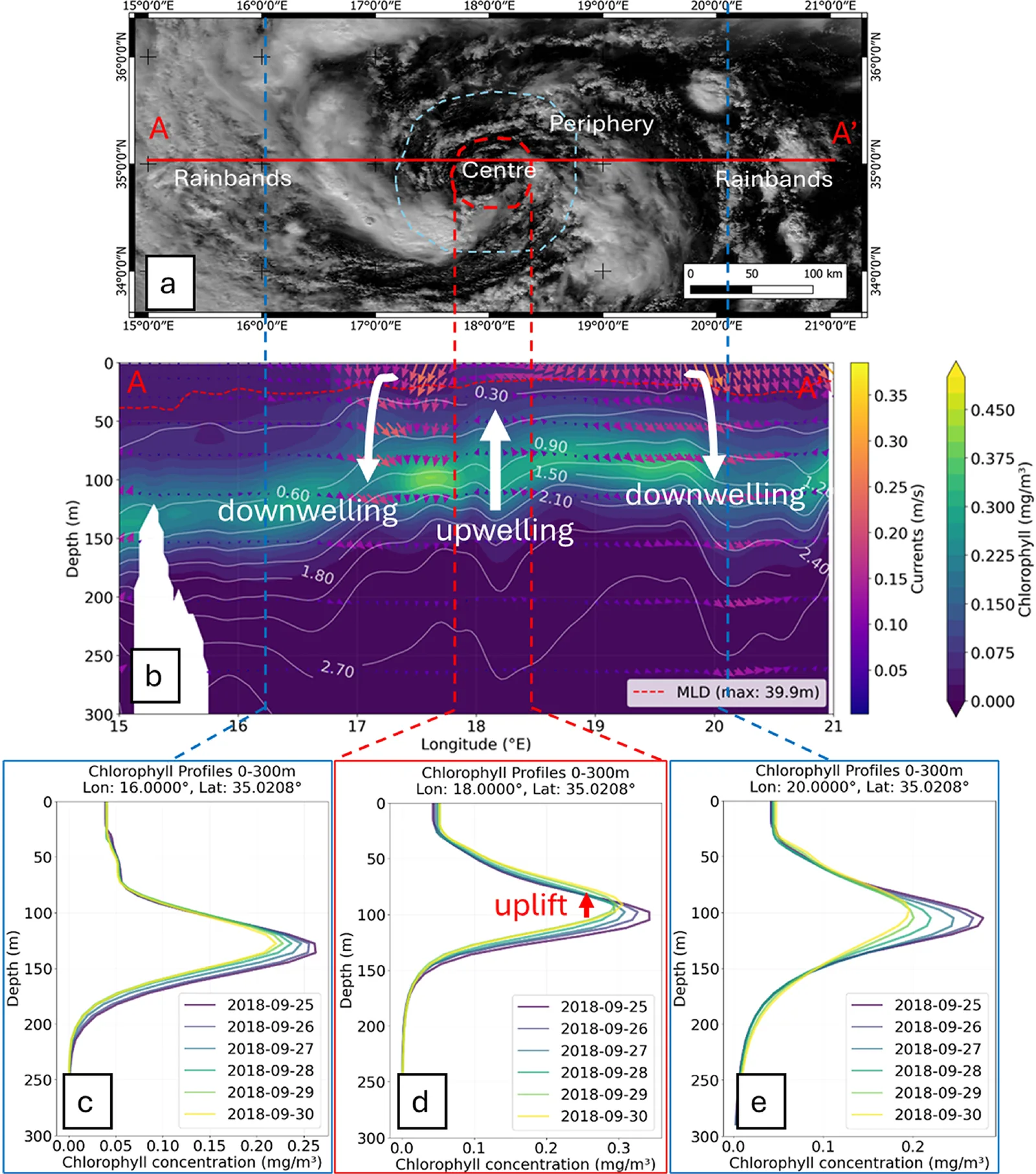
- Cyclones with slow-moving phases lifted the deep chlorophyll maximum by about 40–60 m, while short events of under 20 h gave 0–10 m.
- The hours of slow movement correlated with DCM uplift (Pearson r 0.80). Greater heat loss from the sea correlated with greater uplift (r -0.64).
- Uplift was strongest at the cyclone centre, with upwelling, nitrate enrichment and a shallower mixed layer. The periphery showed alternating up- and downwelling and weak change.
- Nearshore chlorophyll rose through runoff plumes, as with medicane Daniel off Libya, or through currents carrying organic matter offshore, as with Zorbas off Sicily.
- Weaker cyclones sometimes showed a downward shift of the DCM near the centre.
Limitations
- Offshore results rely on reanalysis products with coarse vertical resolution (3 m). For medicanes Ianos and Blas the error against float data was larger than 1 m.
- Results for Zorbas differ from an earlier study that found mixed layer deepening. The authors link this to different spatial focus and methods.
- The effect on yearly productivity is likely modest, and the authors say future work must measure how these events add up.
Glossary
- Deep chlorophyll maximum (DCM): A subsurface layer where chlorophyll, a proxy for phytoplankton, peaks, usually near the base of the sunlit zone.
- Medicane: A tropical-like cyclone in the Mediterranean with a warm core.
- Mixed layer depth (MLD): The depth of the well-mixed upper ocean layer.
- Nutricline: The depth range where nutrient levels rise sharply with depth.
Original paper
When storms stir the Mediterranean depths: chlorophyll a response to Mediterranean cyclones
Ocean Science · 11 November 2025
AI-generated summary of the original article; changes were made. Check the original before relying on it.