SMOS satellite product detects first autumn soil freezing, but later than ground sensors
The updated SMOS freeze–thaw product tracks when northern soils first freeze in autumn fairly well, with a lag of several days, and works poorly in spring and in areas with radio interference.
Why it matters
Soil freezing timing affects greenhouse gas release, especially methane, in high-latitude regions. A global, operational L-band record of freeze–thaw gives carbon cycle studies a tool for the cold season. The product has already been used in a methane flux modelling system to help describe cold-season emissions.
What they did
The authors describe version 3 of the SMOS Level-3 freeze–thaw product. It uses L-band brightness temperatures, turned into a polarization ratio, smoothed with a Kalman filter, and compared with frozen and thawed reference values for each 25 km cell. Air temperature and snow cover data are used to remove obvious errors. They checked the autumn first-freezing day against in situ soil moisture and temperature from six networks, and against ERA5-Land soil temperature for 2010 to 2024.
Key findings
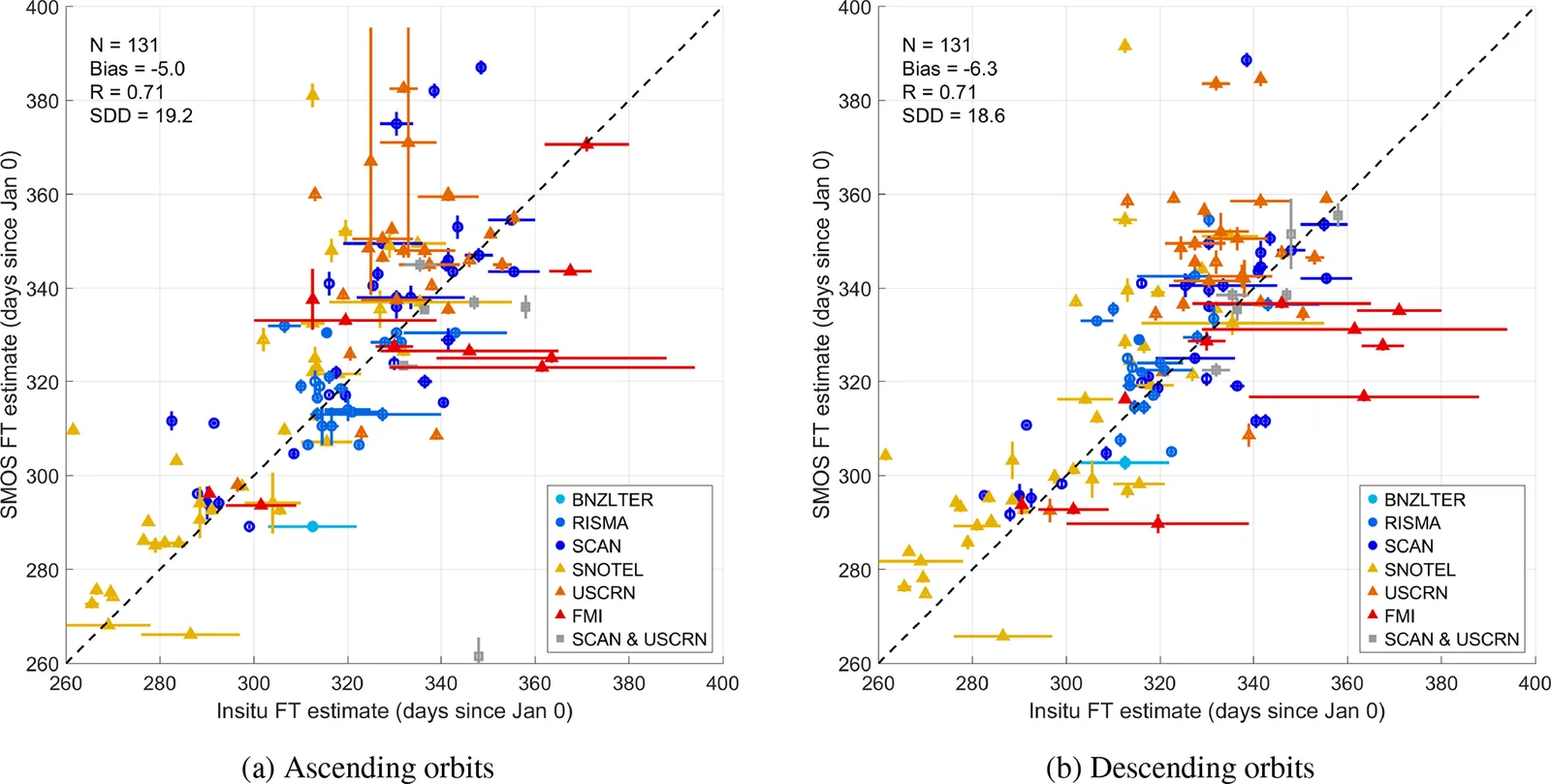
- Against in situ data, the first-freezing day from descending orbits had a bias of -6.3 d, correlation of 0.71 and standard deviation of difference of 18.6 d.
- For ascending orbits, the bias was -5.0 d, correlation 0.71 and standard deviation of difference 19.2 d. Ascending passes detect freezing 1.3 d earlier than descending ones.
- After representativeness checks, the comparison data points fell from 550 to 131.
- Compared with ERA5-Land soil temperature, SMOS puts first freezing later, with median differences of +10.7 d (ascending) and +12.3 d (descending).
- Patterns of first freezing broadly agree with ERA5-Land at high latitudes. Differences are larger in dense forest, strong radio interference areas and mountains.
Limitations
- Radio frequency interference limits coverage, especially over Eurasia, and it grew over Eastern Europe after 2022.
- In spring, wet snow can look like thawed soil, so the thaw signal cannot be trusted as soil thaw.
- Dry soils, thin soils, dense forest and water bodies reduce sensitivity. Point sensors also differ from 25 km cells, and SMOS does not observe every day.
Glossary
- Normalized polarization ratio (NPR): The difference between vertical and horizontal brightness temperature divided by their sum, used to separate frozen from thawed soil.
- L-band: A microwave frequency range of 1–2 GHz that senses the top few centimetres of soil.
- Radio frequency interference (RFI): Man-made radio signals that contaminate satellite measurements.
- Day of first freezing (DoFF): The first autumn day followed by at least 5 consecutive days of frozen soil.
Original paper
An operational SMOS soil freeze–thaw product
Earth System Science Data · 15 October 2025
AI-generated summary of the original article; changes were made. Check the original before relying on it.