Soil moisture falls as precipitation rises in some dry and cold Northern Hemisphere regions
In parts of the Northern Hemisphere, mostly deserts, montane shrublands and tundra, soil moisture can be negatively tied to precipitation, and temperature and vegetation productivity help explain it.
Why it matters
Many studies assume wetter soils follow more rain. This work shows the link can reverse in some ecoregions and soil layers. That matters for drought and hydrometeorology research and for models of land–atmosphere coupling.
What they did
The authors paired ERA5-Land soil moisture at three depths with GPCP precipitation for 2000 to 2019. They used copula functions to measure nonlinear dependence, including at the extremes, at monthly and annual scales. Ridge regression ranked precipitation volume, precipitation frequency and evapotranspiration as controls on soil moisture. Bayesian multilevel models then tested land surface temperature, air temperature and gross primary production as drivers within 16 ecoregions.
Key findings
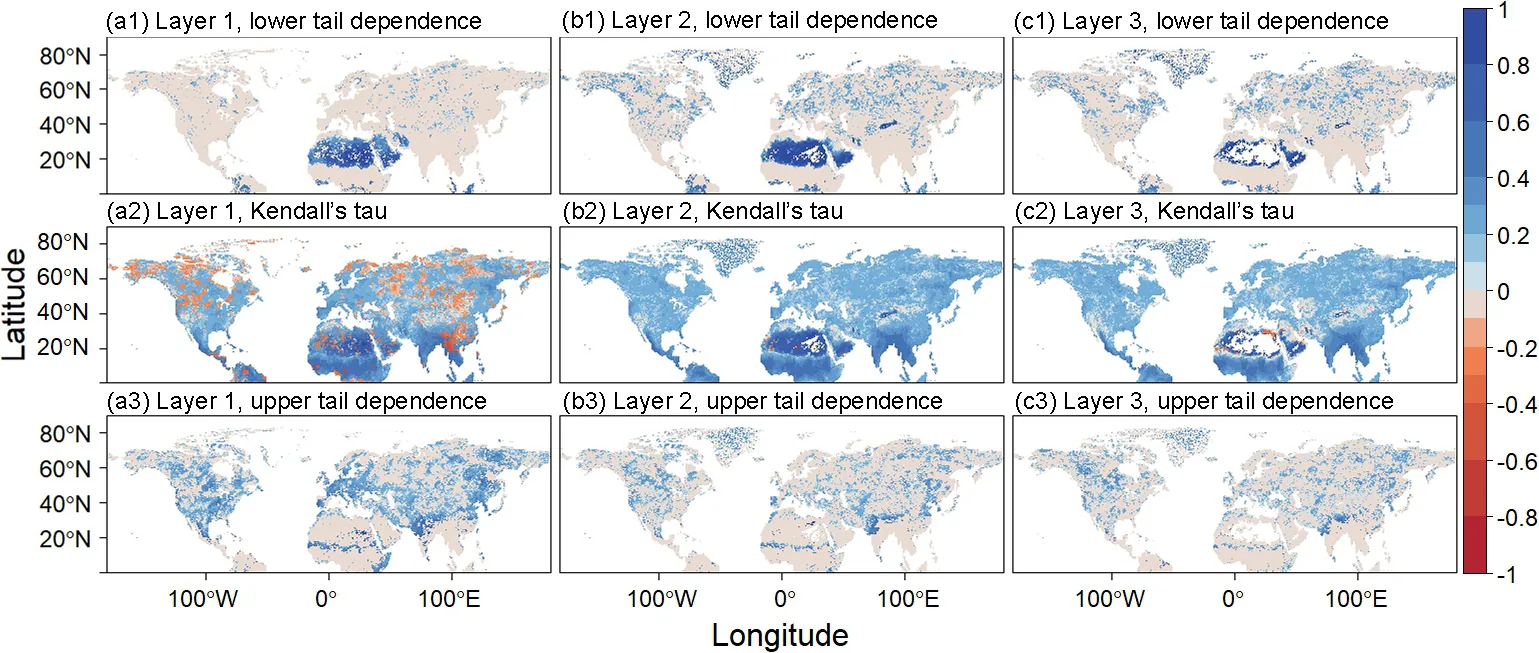
- At the monthly scale, 19.2 %, 0.7 % and 2.3 % of grid cells showed negative dependence for the 0 to 7, 7 to 28 and 28 to 100 cm layers.
- At the annual scale, the shares were 3.0 %, 4.0 % and 8.6 % for the same three layers.
- Negative dependence was most prominent in deserts, xeric shrublands, montane grasslands and shrublands, temperate grasslands and savannas, and tundra.
- Monthly negative dependence was linked mainly to land surface temperature and to the air temperature–GPP interaction. At the annual scale it was mainly in montane grasslands and shrublands and tied to the GPP–land surface temperature interaction.
- Precipitation volume mainly controlled soil moisture in boreal forest and temperate grasslands. Precipitation frequency mattered most at high latitudes. Evapotranspiration dominated in spring and summer.
Limitations
- Monthly series were not de-seasonalized, so leftover seasonal signals may affect the dependence results.
- Evapotranspiration was left out of the Bayesian models, and wind, topography and soil properties were not examined.
- Ecoregion boundaries may add regional bias, and the soil moisture data come from a reanalysis model rather than direct observation.
Glossary
- Copula: A statistical tool that links two variables through their joint behavior, including nonlinear and extreme-value links.
- Tail dependence: The chance that one variable is extreme when the other is also extreme, high or low.
- Ridge regression: A regression method that stays stable when predictors are strongly correlated, at the cost of some bias.
- Gross primary production (GPP): The total carbon taken up by plants through photosynthesis, a measure of vegetation activity.
Original paper
A study of the dependence between soil moisture and precipitation in different ecoregions of the Northern Hemisphere
Hydrology and Earth System Sciences · 22 October 2025
AI-generated summary of the original article; changes were made. Check the original before relying on it.