Swiss glaciers cushioned the 2022 drought, but total meltwater was lower than in 2003
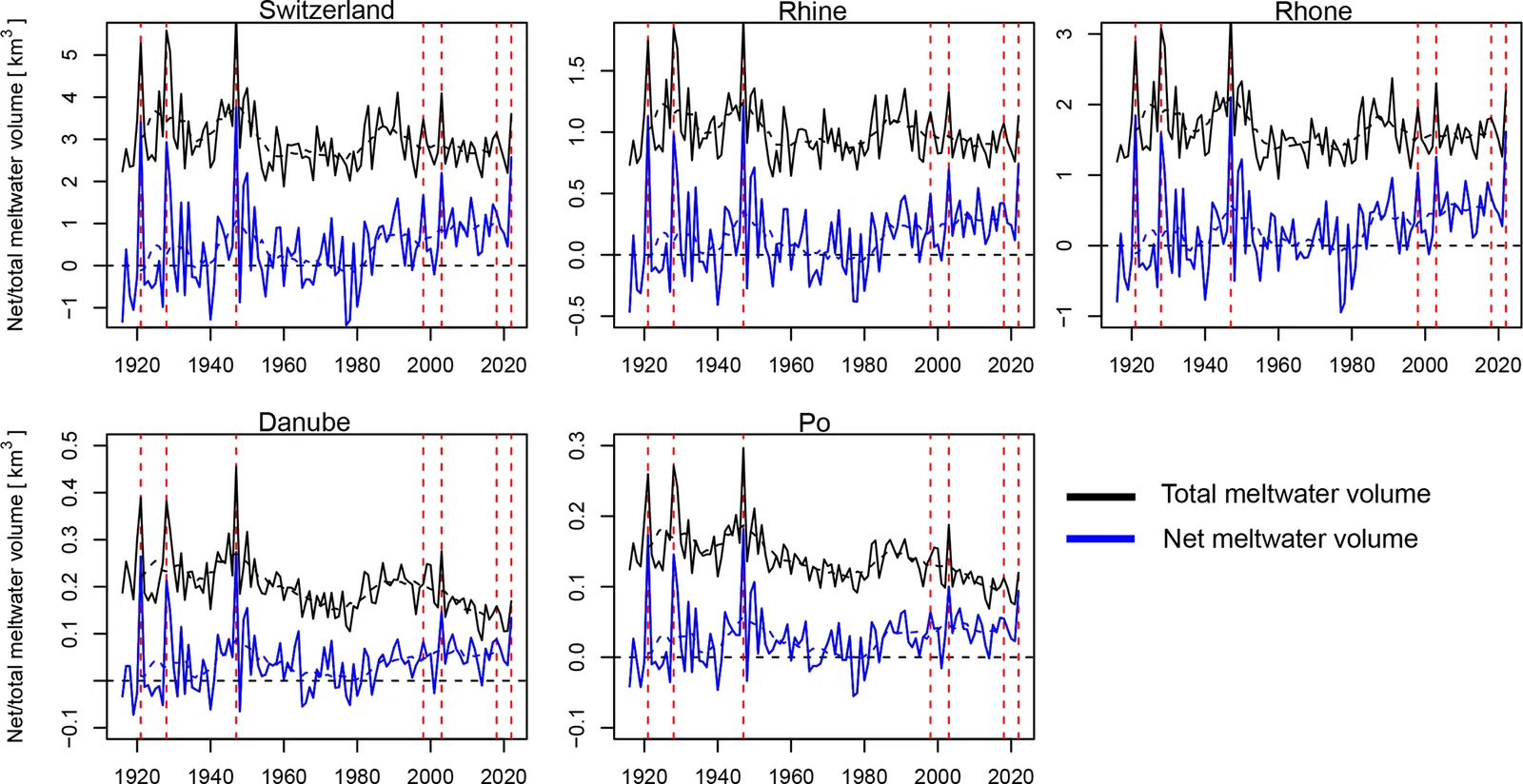
In the 2022 drought, extra glacier melt offset water deficits in catchments with around 15 % glacier cover, yet shrinking glacier area meant total meltwater was already below the 2003 level in most catchments.
Why it matters
Glaciers supplied water to rivers when rain and snowmelt failed, even far downstream. But the total meltwater they can supply in extreme years is starting to fall as glaciers shrink. Water managers should plan for less glacier buffering in future droughts.
What they did
The authors built daily mass change estimates for all 1400 Swiss glaciers from 1916 to 2022. They did this by extending measurements from 28 surveyed glaciers, using satellite-era height surveys and a melt model. They combined these with streamflow, precipitation, snow and evapotranspiration data for 88 glacierized catchments. They then compared 2022 with six earlier hot, dry years, mainly 2003.
Key findings
- Between 60 %–80 % of the total glacier melt in 2022 was imbalanced melt, meaning a net loss of glacier mass.
- In summer, extra glacier melt fully offset the precipitation and snowmelt deficits in catchments with around 15 % glacierization.
- Extra summer melt eased water input deficits by up to 5 % at Basel (Rhine) and 70 % at Porte du Scex (Rhone).
- Versus 2003, total summer meltwater fell in two thirds of the catchments, despite higher melt rates and a 21 % loss of glacier area.
- Glacier shares of streamflow stayed roughly constant or rose in some months, because other water sources were scarce.
Limitations
- The water balance terms come from different sources and do not always add up. Reservoirs, water transfers and groundwater were not accounted for.
- Glacier mass change for all 1400 glaciers is extrapolated from a few measured ones, and estimates before 1950 are especially uncertain.
- Past extremes are hard to compare. Only about one third of catchments have streamflow data covering all extreme years.
Glossary
- Imbalanced melt: Glacier melt beyond the winter snow accumulation, which causes a net loss of glacier volume.
- Glacier compensation level: The share of water deficits in other sources that surplus glacier melt can make up.
- Peak water: The point when glacier meltwater volume stops rising and starts to decline as glaciers shrink.
- Specific mass balance: Glacier mass change per unit of glacier area, in meters of water equivalent.
Original paper
Swiss glacier mass loss during the 2022 drought: persistent streamflow contributions amid declining melt water volumes
Hydrology and Earth System Sciences · 6 January 2026
AI-generated summary of the original article; changes were made. Check the original before relying on it.