TFA in Swiss rain and rivers rose four to six times since the 1990s; known sources explain part
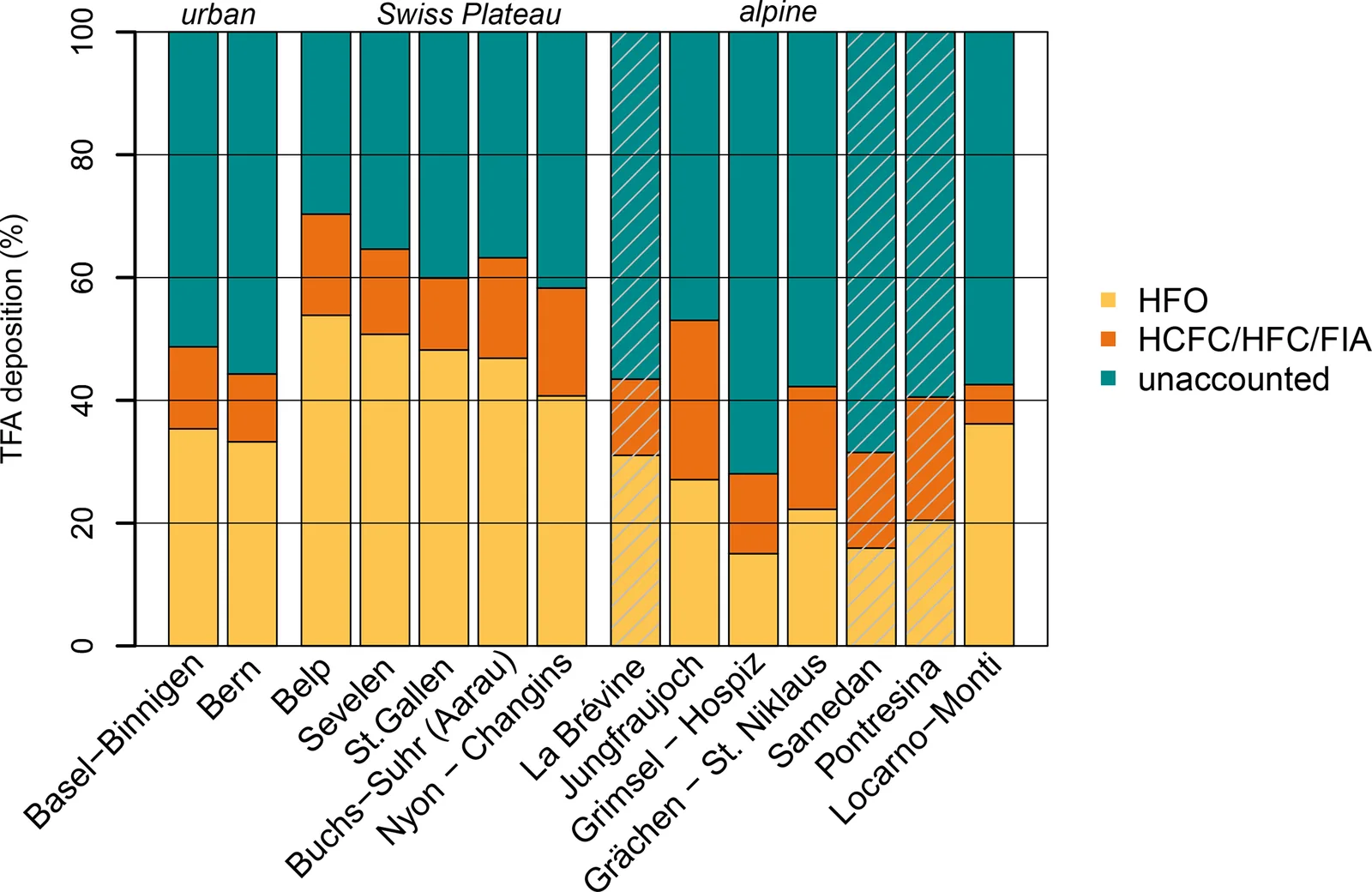
Swiss rain and river TFA levels have climbed several-fold since 1996/1997, and simulated breakdown of known fluorinated gases explains only about 63 % of the TFA deposited on the Swiss Plateau.
Why it matters
TFA is a very persistent compound, and health agencies are now reviewing its risk. This study gives a country-wide budget of where Swiss TFA comes from and where it goes. It shows that important sources are still missing from current models, which limits forecasts of future levels. The authors expect TFA deposition to keep rising if fluorinated compounds stay in use.
What they did
The team measured TFA in monthly rain samples at 14 sites, in river samples at 9 sites and in lake water, from 2021 to 2023. They also analysed archived rain and river samples going back to 1984. They simulated TFA from the breakdown of long-lived fluorinated gases with box models, and from the short-lived gas HFO-1234yf with the FLEXPART transport model. They compared the simulations with the observed deposition and built a Swiss TFA budget.
Key findings
- Mean TFA was 0.30 to 0.96 µg/L in rain and 0.33 to 0.88 µg/L in rivers in 2021–2023, a four-to-six-fold rise since 1996/1997.
- Rain TFA was much higher in summer than in winter, which points to atmospheric breakdown of precursor gases as the main driver.
- On the Swiss Plateau, simulations explained 63 % of observed deposition: 48 % from hydrofluoroolefins and 15 % from long-lived fluorinated gases. Summertime deposition was underestimated about five-fold.
- Atmospheric deposition in Switzerland was 24.5 ± 9.6 Mg/yr. Plant protection products added an estimated 2.9 to 11.8 Mg/yr. River exports were 31 ± 4 Mg/yr.
- Over Swiss cropland, plant protection products were estimated to deliver 2–3 times more TFA than atmospheric deposition.
Limitations
- Simulations leave a gap that could come from unknown precursors, underestimated TFA yields, model shortcomings or a mix. Even with upper-limit emissions and yields, only about 80 % was explained on the Plateau.
- The plant protection product input comes from literature estimates, and the budget has gaps: wastewater plants were not sampled and groundwater was not measured. Some river exports rest on few samples.
- The HFO model uses emissions inferred from a few measurement sites, no non-European HFO emissions, and a washout scheme that may be too fast in the Alps.
Glossary
- TFA (trifluoroacetate): A very stable, water-soluble fluorinated acid that builds up in the environment.
- HFO (hydrofluoroolefin): A short-lived fluorinated refrigerant gas, some of which break down fully to TFA.
- TFA yield: The share of a precursor gas molecules that end up as TFA after atmospheric breakdown.
- Plant protection products (PPP): Pesticides, some of which contain a CF3 group and can form TFA in soil.
Original paper
Trifluoroacetate (TFA) in precipitation and surface waters in Switzerland: trends, source attribution, and budget
Atmospheric Chemistry and Physics · 6 January 2026
AI-generated summary of the original article; changes were made. Check the original before relying on it.