Station-derived drought near Apalachicola National Forest has increased since 1945
A drought index computed from the Tallahassee airport record shows rising annual dryness since 1945, clearest in May, but this does not prove forest-wide soil drying or a usable fire forecast.
Why it matters
Long local records can show how drought exposure changes where soil-water networks are short. The paper shows what such a record can and cannot support. It supports a station-based drying trend. It does not support a forest-wide trend, a cause, or an operational fire forecast.
What they did
The author recomputed the Keetch-Byram Drought Index (KBDI) daily from Tallahassee airport temperature and rain, with strict quality control and rules for missing data. He fitted linear trends to annual and monthly summaries, with uncertainty that allows for correlation between years. He tested the results against 27 index settings, different start years and ENSO adjustment. He compared the series with PRISM gridded data for 2009-2018 and with one soil-moisture sensor site. As an application, he tested whether April 30 deficit improves hindcasts of May-July natural fire counts.
Key findings
- Across 69 complete years spanning 1945-2024, mean moisture deficit rose by 2.63 mm per decade (95% interval: 0.58-4.67).
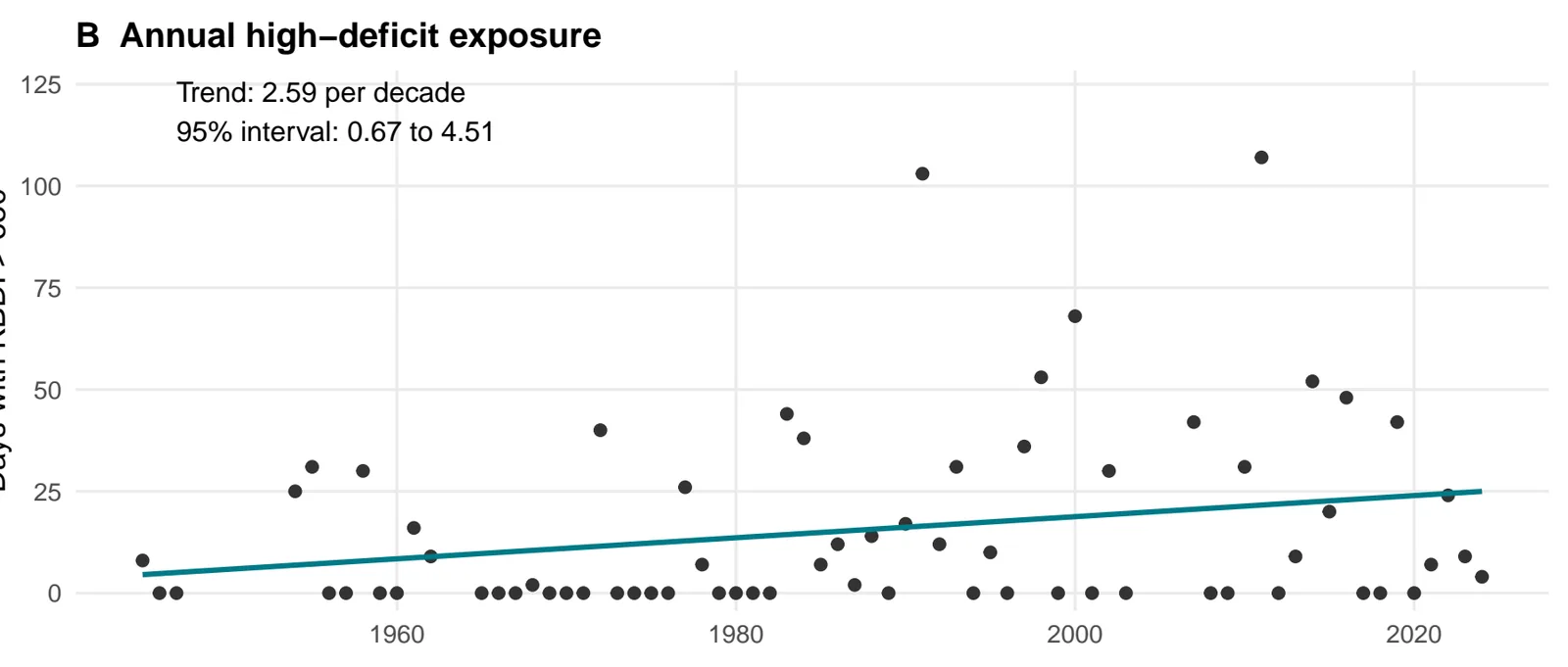
- Days with KBDI above 650 rose by 2.59 days per decade (0.67-4.51), but this depended on the record’s start year and the threshold chosen.
- May was the only month with a clear signal after adjusting for 12 monthly tests: 4.64 mm per decade (1.68-7.61). April’s trend stayed uncertain.
- Airport and PRISM daily anomalies matched with an area-weighted squared correlation of 0.72 over 2009-2018. Correlations with measured soil moisture were modest.
- April 30 deficit lowered hindcast error for natural fires (MAE 8.06 versus 9.93), but the paired improvement interval (-0.26 to 4.02) included no improvement.
Limitations
- The station data were not checked for changes in siting, instruments or observation practice, and the complete-year rule may select an unrepresentative set of years.
- The PRISM check is short and not independent of the stations. The single soil sensor has gaps and level shifts, so neither can validate the long-term trend or show forest-wide change.
- The fire hindcast uses only 15 seasons and was not reconstructed as real-time forecasts. The paper does not attribute the trend to human-caused climate change.
Glossary
- Keetch-Byram Drought Index (KBDI): A daily index of built-up moisture deficit, computed from maximum temperature and rainfall.
- Newey-West covariance: A way to widen trend uncertainty to allow for correlation between neighbouring years.
- Benjamini-Hochberg adjustment: A correction to p-values that accounts for running many tests at once.
- Negative binomial model: A count model that allows more spread than a Poisson model, used here for fire counts.
Original paper
Long-term increases in station-derived drought near Apalachicola National Forest, Florida
EarthArXiv · 17 October 2026
This paper is a preprint. It has not been peer reviewed, and its results may change.
AI-generated summary of the original article; changes were made. Check the original before relying on it.