Uncertainty in global upper-ocean heat content has fallen about six-fold since 1955
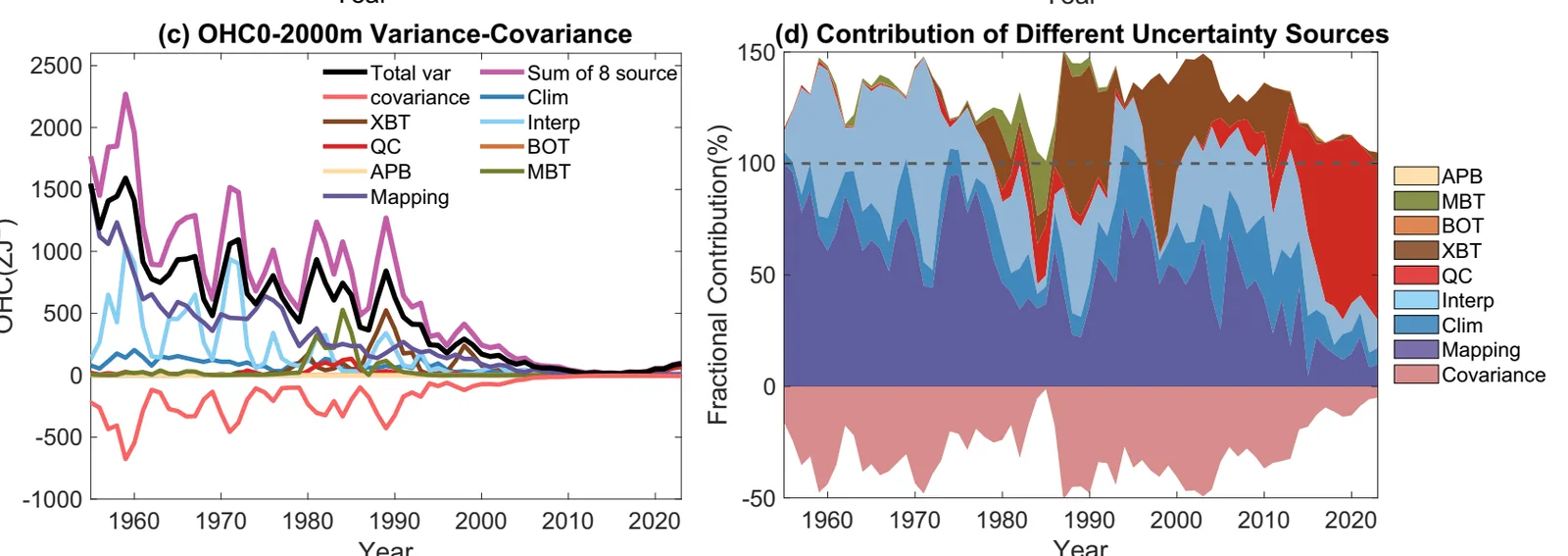
A large ensemble of ocean heat estimates shows the 0–2000 m uncertainty fell from ~111 ZJ to ~19 ZJ, mostly from better sampling, while quality control is now a leading error source.
Why it matters
Ocean heat content tracks most of Earth’s energy imbalance, so knowing how uncertain it is matters for judging warming. The results show that the long-term rise and speed-up in ocean warming stand out from the estimated errors. They also point to where the ocean observing system needs work, such as eddy-rich regions and data-poor areas.
What they did
The authors built an ensemble of about 900 ocean heat content estimates from ocean temperature profiles. They varied eight groups of error sources: quality control, four instrument biases, climatology, vertical interpolation, and mapping with instrument error. For each source they used the most up-to-date techniques from the literature and combined them. The 5–95% range across members gives the uncertainty, and the ensemble also captures how errors in different sources interact. They compared heating rates with satellite and surface flux estimates.
Key findings
- The 0–2000 m annual uncertainty fell from ~111 ZJ in 1955–1965 to ~19 ZJ in 2014–2023, mainly because mapping and sampling improved.
- Upper 2000 m heat content rose by 449 [385, 519] ZJ since 1955.
- Quality control became a main error source after 2010, about 1.7 times larger than mapping, because outliers are hard to detect in eddy-rich regions.
- The 0–2000 m trend rose from 2.8 [2.0, 4.3] ZJ per year in 1960–1990 to 9.9 [8.5, 10.6] ZJ per year in 1991–2023, and these ranges do not overlap.
- The ocean heating rate increase for 2005–2023 is 0.34 [0.19, 0.46] W m-2 per decade, a little below the satellite estimate of 0.48 ± 0.13 W m-2 per decade, with overlapping ranges.
Limitations
- An ensemble cannot capture unknown error sources, so it may give only a lower bound on the true uncertainty.
- Mapping uncertainty comes from one method (IAP) in a different framework from the other sources, and only two quality-control systems and three techniques per step were used.
- The study covers only in-situ estimates; satellite-based or hybrid estimates have different error budgets. Quality control uncertainty may be overestimated in recent decades.
Glossary
- Ocean heat content (OHC): The total heat stored in the ocean water, here counted down to 2000 m or full depth.
- ZJ: Zettajoule, a unit of energy used for ocean heat totals.
- Mapping: Filling gaps between sparse ocean measurements to get a complete field.
- Quality control (QC): Checks that flag and remove suspect ocean temperature readings.
Original paper
Six-fold reduction in ocean heat content estimate uncertainty since 1960
Nature Communications · 29 August 2026
AI-generated summary of the original article; changes were made. Check the original before relying on it.