Warm lake water above 4 °C helped an Arctic Swedish glacier retreat quickly
At Kaskasapakte Glacier in Arctic Sweden, lake water warmer than 4 °C carved notches into the ice front and drove calving, and ice lost at the front made up about 30% of volume loss from 2015 to 2019.
Why it matters
Some earlier studies reported small proglacial lakes at a uniform 1 °C. This glacier’s lake was warmer at the ice front, so lake temperature may matter more for retreat than assumed. The authors say lake effects are poorly constrained in glacier mass loss models, and they call for more lake temperature and terminus monitoring.
What they did
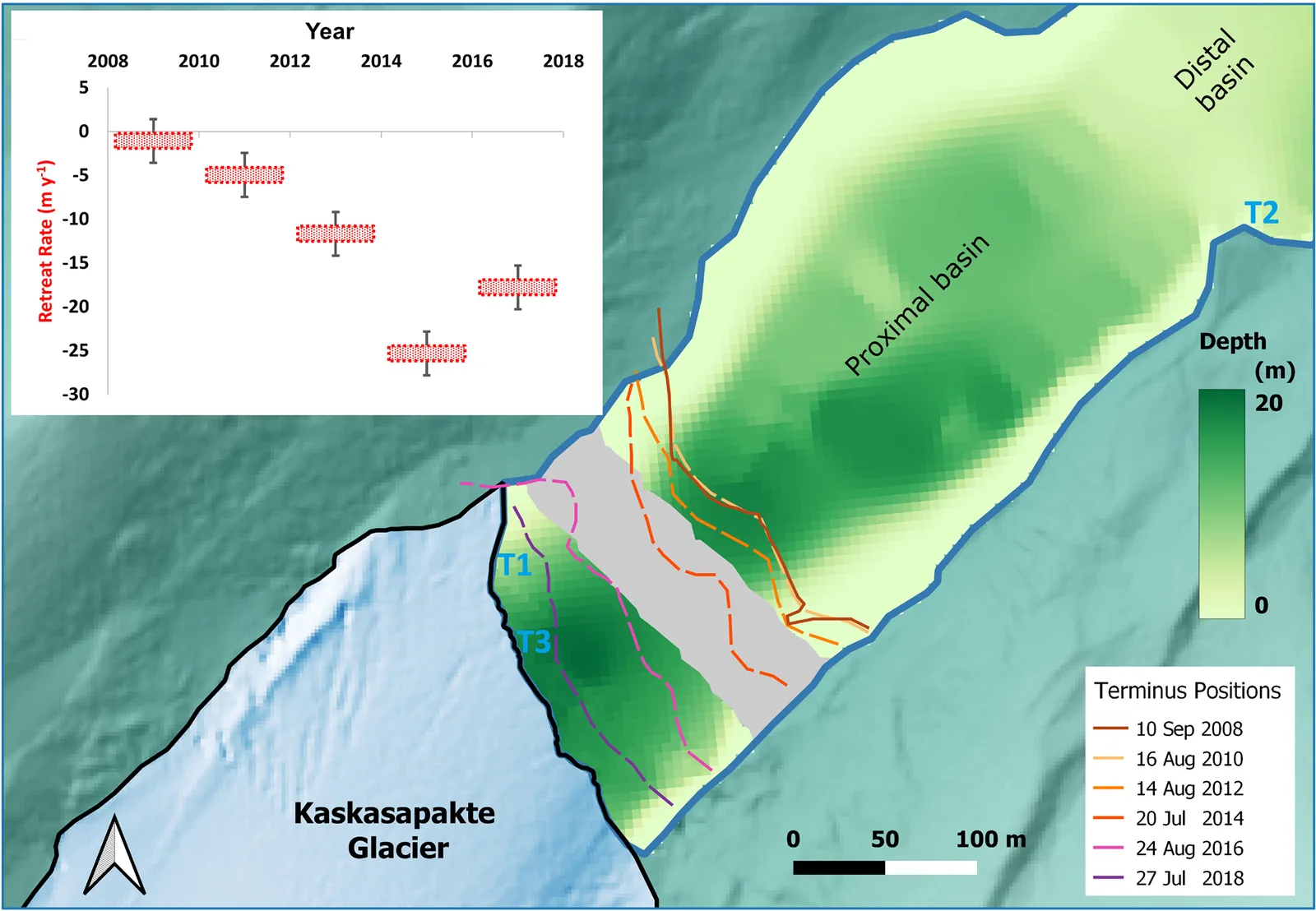
The team combined satellite images (2008 to 2018), a 2015 lidar elevation model and a 2019 photo-based elevation model of the terminus. They measured lake temperature at the ice front in summer 2019 and filmed the terminus with time-lapse cameras in 2017 and 2019. They sorted 41 calving events in 2019 by type. They used sonar to image the underwater ice front in 2019 and to map the lake bed in 2022.
Key findings
- Width-averaged retreat rose from 1.06 m per year (2008 to 2010) to a peak of 25.31 m per year (2014 to 2016), then 17.77 m per year (2016 to 2018).
- Water at the ice front was about 4 °C, with a mean of 3.2 °C at 1 m depth from 29 July to 28 August 2019. The lake appeared well mixed.
- Most of the 41 calving events in 2019 were linked to undercutting at the waterline: 15 sheet collapses, 12 roof or arch collapses and 9 waterline events.
- A sharp thermal notch re-formed in about 9 days in 2017, and sonar showed undercutting several metres deep in 2019.
- Retreat of the front (ice lost into the lake) was 30.2% of the volume change in the terminus area from 2015 to 2019.
Limitations
- The temperature record covers only part of one summer (2019) and the observations are a short snapshot. Volume change is ‘static’, because ice velocity data were too uncertain to include ice flow.
- A gap of about 50 m in the lake bathymetry, and a bed survey done in 2022, leave some doubt about how lake depth affected retreat, especially around 2012 to 2016.
- Sonar position accuracy was limited, so the exact shape of the underwater ice front is uncertain.
Glossary
- Thermal undercutting: Melting at the waterline that cuts a notch into an ice cliff and leaves the ice above unsupported.
- Frontal ablation: Ice lost at the glacier front, mainly through calving and melt at the ice–water contact.
- Proglacial lake: A lake that forms at the front of a glacier.
- Bathymetry: The shape and depth of a lake bed.
Original paper
Warm proglacial lake temperatures and thermal undercutting enhance rapid retreat of an Arctic glacier
The Cryosphere · 10 October 2025
AI-generated summary of the original article; changes were made. Check the original before relying on it.