Water stress in central Chile has risen for decades, driven mostly by rising water use
Water stress in central Chile has grown mainly because people use more water, and the 2010–2022 megadrought and future drying would push many basins to high or extreme stress.
Why it matters
The study shows that water use, not only climate, drives stress in central Chile. This means demand can be managed even when climate cannot. The authors argue that a simple, measurable index like the WSI could set water security targets and compare ways to reach them.
What they did
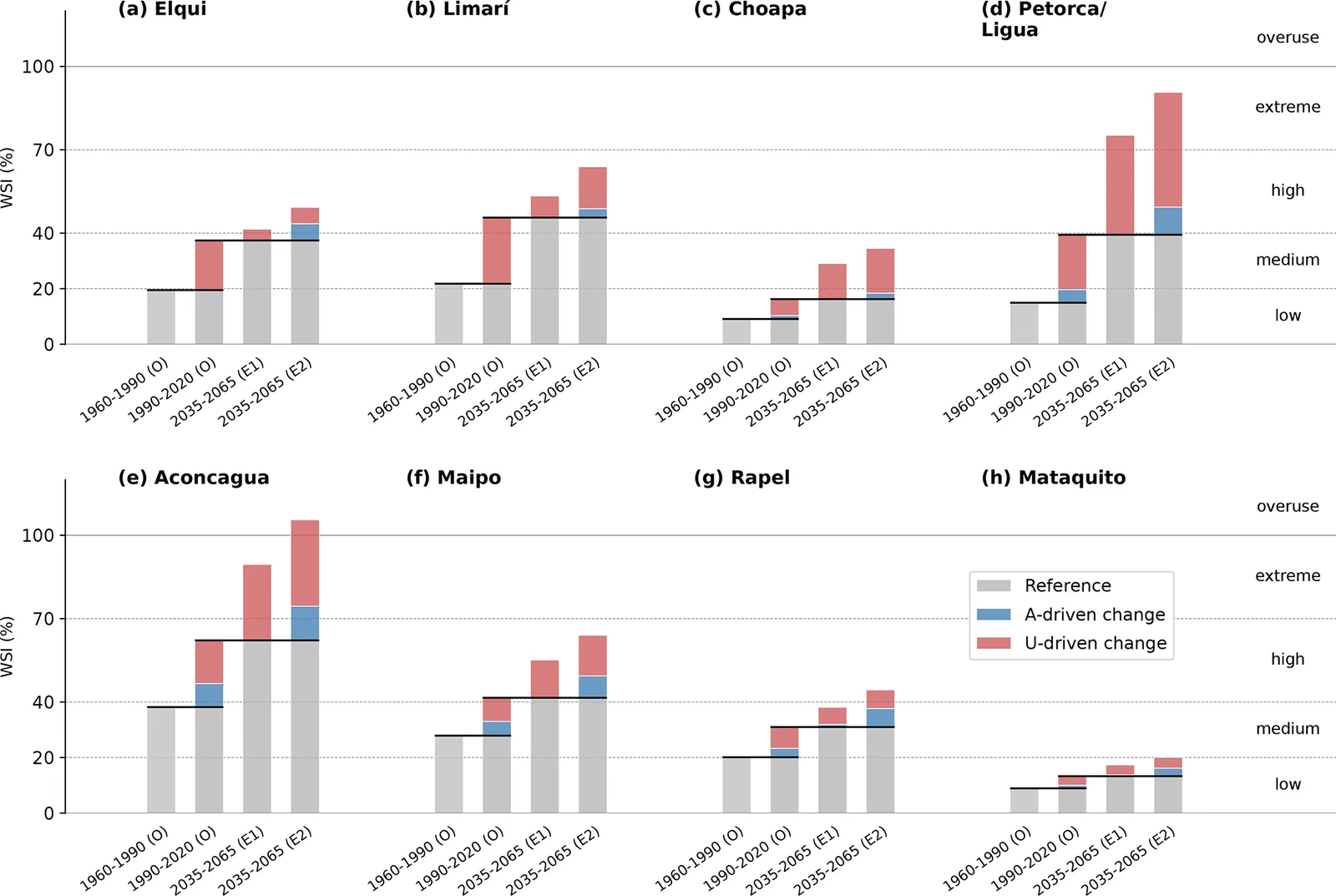
The authors built new national datasets for water availability, land use (CR2LUC) and water use (CR2WU), covering the mid-20th century to 2020. Availability is rainfall minus near-natural evapotranspiration. They computed a Water Stress Index (consumptive use divided by availability) for all major basins. They split changes in stress into a climate part and a water-use part. They also used downscaled CMIP6 climate models under two scenarios, SSP1-RCP2.6 and SSP3-RCP7.0, to project stress to mid-century.
Key findings
- Most basins in semi-arid central Chile had high to extreme stress during the megadrought, mainly from reduced availability and worsened by high demand.
- Over 1960–2020, stress in central Chile rose mainly because water consumption grew, and less because availability fell.
- Consumptive water use in the country doubled over six decades, largely due to irrigated agriculture and forestry.
- Several basins from Santiago northward now have a 30-year mean WSI above 40 %. Maipo reached extreme stress, and La Ligua and Aconcagua exceeded 100 % in 2010–2020.
- Under the adverse SSP3-7.0 scenario, a drop of nearly 30 % in precipitation could make megadrought conditions permanent by the end of the century. Most central basins would then face high to extreme stress.
Limitations
- Water use estimates are uncertain, especially for forestry and other land-use sectors, and they are higher than other independent estimates.
- The index ignores water quality, access, governance and groundwater depletion. Precipitation data likely underestimate rainfall in Chile’s wettest southern basins.
- Future water use is a simple extrapolation of 2000–2020 trends, and climate projections vary widely with natural variability and model sensitivity.
Glossary
- Water Stress Index (WSI): The ratio of consumptive water use to available renewable water in a basin. Above 40 % is high stress and above 70 % is extreme.
- Consumptive water use: Water taken from a basin and not returned, for example water lost to evapotranspiration by crops.
- Megadrought: The long dry spell that hit central Chile from 2010 to 2022.
- Water Use Rights (WURs): Legal entitlements in the Chilean Water Code that set how much water users may take and when.
Original paper
Increasing water stress in Chile revealed by novel datasets of water availability, land use and water use
Hydrology and Earth System Sciences · 15 October 2025
AI-generated summary of the original article; changes were made. Check the original before relying on it.